We hope that Society members will send in articles for publication to this page. These articles can be about any wildlife-related topic that they would like to share with other members.
There were lots of bats flying around our buddleia when it was in bloom, feasting on the nocturnal pollinators. The bats were not registering on Rob’s bat detector which made us think they might be Brown Long-eared bats (Plecotus auritus), as they use very quiet echolocation calls, earning them the name “whispering bats.” These faint sounds fade fast and do not trigger standard bat detectors unless the bat flies within a few meters.
One evening, Rob was determined to capture some real evidence and snapped away every time the mystery bat came close until he eventually caught this image, which I love, as Long-eared bats are my absolute favourite British bat.
On another occasion, Rob phoned me from a morning dog walk to tell me know there were two young Tawny Owls (Strix aluco) in Rushmere by the Black Pond. I raced to where Rob was and luckily got there in time to see them peering down comically. Here is one of the duo.
Our pond is a trial to keep topped up in this drought but is full of wildlife including bathing birds, baby newts, dragonfly larvae and a mole (Talpa europaea). We very much enjoy seeing mole-hills on our lawn and around the borders and are happy to collect the kicked-up soil and re-use it. Moles are essential for the environment for many reasons, including adding drainage, mixing and blending organic matter, aerating the substrates to help plants receive oxygen and eating the grubs that munch on roots. We hadn’t seen any mole activity for a while until several hills appeared at once around our pond. My research as to why this happened suggested that in normal weather conditions moles receive all the moisture they need from grubs and worms but, in severe heat waves, earth worms dig deep, making them too difficult for the moles to reach. So maybe our mole popped up for a drink and to hunt in the dampness around the pond’s edge.
Members may be interested in the linked Anglia News news item which was shown on Thursday 3rd Sept, about the felling of ash trees in Milton Keynes’ ancient woodlands. It includes interviews with representatives of The Parks Trust (including one of the tree fellers), and a very brief interview with Charles Kessler.
This month has been a very exciting month because it has included the possible beginnings of one of our dreams coming true.
Last year we put up a swift box in which House Sparrow (Passer domesticus) successfully reared many broods. We still felt this was a good result as Sparrows are a seriously declining species too. This year they were on their second brood when a pair of Common Swift (Apus apus) suddenly arrived and started to show interest. Luckily the Sparrows were ready to fledge and, as soon as they left, the Swifts moved in. Mrs Sparrow, with Mr Sparrow close behind, did try her best to reason with them to leave, but the Swifts held fort and won the battle outright.
Since then, the Swifts have regularly been circling our house and sleeping each night in our box. Swifts are some of nature’s most agile and efficient flyers and it is an absolute joy to watch their amazing acrobatic display, like a team of Red Arrows zooming around at incredible speed between the houses. Rob put up two more boxes which they instantly entered and explored. (Swift boxes need to be installed as near possible to a north-facing wall to avoid chicks overheating and dying.) They then brought over more Swifts to see the new nest boxes. It is too late for them to breed this year but it is very likely that they will return from Africa next year to rear their young in our boxes, fingers crossed.
I am now in contact with a local Milton Keynes Swift initiative, which aims to increase awareness of Swifts and House Martins in the MK area and help rebuild local populations. (You can follow their excellent Facebook page called “Milton Keynes Swifts & Martins”.) Paul Dubery, who delivered a brilliant and inspiring talk at the Milton Keynes Natural History Society back in 2024 with Emma Rix about the Wolverton Swift project, informed me that our birds are the first recorded Swifts in our area. In the last 20 years, Swifts have declined by 50%, through a combination of loss of nest sites and declining insect populations. It would be great if we can erect many more boxes on houses around the area to help out these awesome birds.
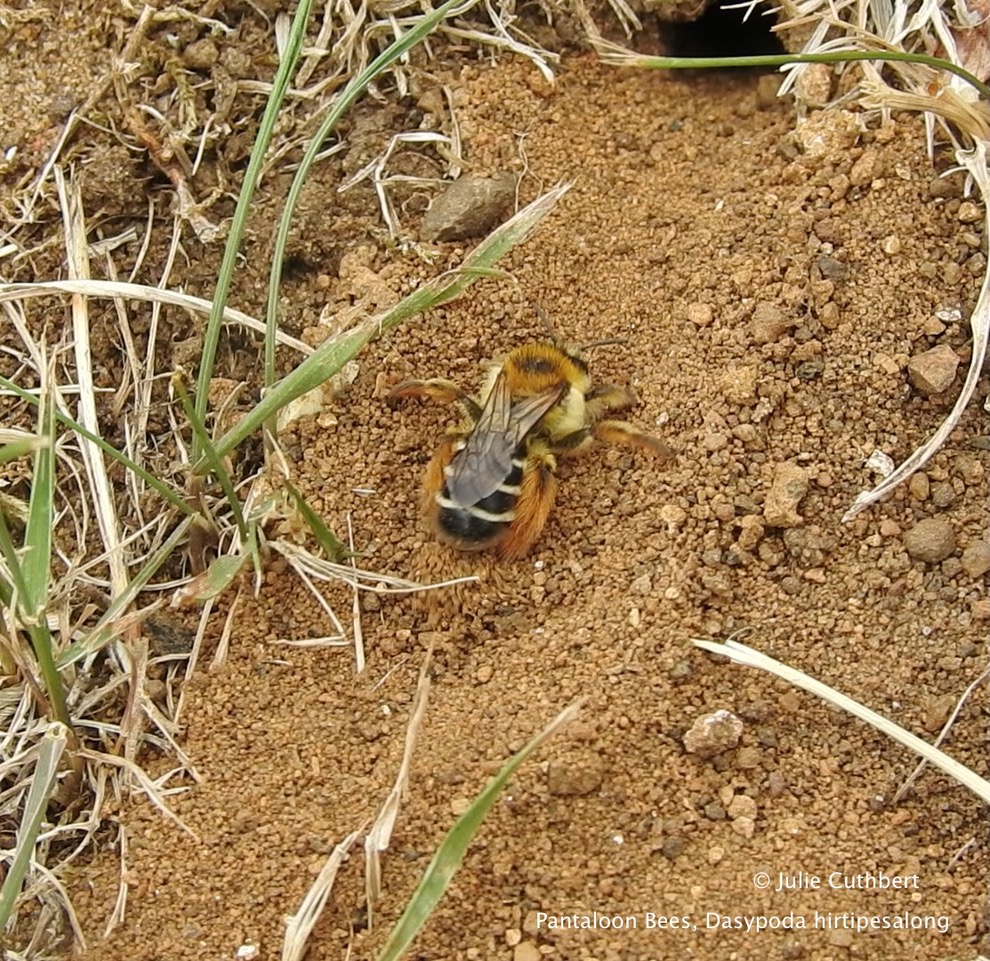
Another of our incredible wildlife residents made an appearance this month too – the beautiful and fascinating Pantaloon bees (Dasypoda hirtipes) who are busy digging their burrows on the south-facing sandy bank in our village. These extraordinary bees dig a burrow 60 to 90 cm deep. From these they excavate many more chambers in which they place an egg perched on a dough ball made from pollen and nectar. The eggs then hatch and develop from a larva to a bee before emerging in the following spring.
Pantaloon bees require nectar from the yellow daisy-like flowers (Asteraceae family) ie. Ragwort, Common Fleabane, Dandelions, Hawksbeard and Cat’s Ear, so please let these flowers be a welcome part of your garden to help support our declining pollinators.
We are so lucky to be on the Greensand Ridge as, due to the sands that was washed here millions of years ago by a sudden rising sea, we are now host to many species of digger bees and wasps which are usually more often associated with coastal areas, making them very rare in Bucks.
These meadows are a magical place. I’ve found secrets hidden amongst the wildflower and grass threads, prehistoric time capsules emerging from the sandy soil and the scarcest creatures jumping across my path like ghosts. I hunt to record the wonders of the local wildlife I have found. Despite all the hostile arrows modern life endlessly throws including loss of habitat, fragmentation, industrial farming, pesticides and human interference which includes our dogs and cats, some of the rarest relic species, with their pure and precious ancient DNA have managed to survive, on the edge of Milton Keynes City, within our parish.
There are so many tales to tell. Maybe one day you will read about them in the book I am writing, but this is the story of one of my most significant local discoveries. The reason I am choosing to share this with you now is because these near threatened creatures need our protection as they are living in the Ivy Lane Meadows which are in danger of being developed into a substantial housing estate.
It all started in 2024, when I noticed on top of the cut meadow stubble an odd ball shaped hay nest, rolling about like tumbleweed, which I photographed. A few days later, I began to google my suspicions and typed “Harvest Mice Nest” into the search engine. The images matched! It was absolutely pouring with rain at that time but I was on a mission to re-find my hay ball and, despite getting soaked, I found it. I carefully loaded the ball of soggy woven grasses into a bag and returned home to dry it out with a hairdryer on the lowest setting. A few insects (which I relocated in our garden meadow area) and a couple of tiny mouse droppings fell out onto the foil tray I’d placed it in. How exciting! The research journey was now in full swing. I placed the droppings onto a glass slide and looked into their depths with my compound microscope which has a huge magnification.
I could see grass seed particles and splinters of insects including the lens of a fly eye but, best of all, it was entwined with tiny ginger hairs. Harvest mice are ginger. I posted my photographs of the nest and magnified dropping to experts for verification and received validation from many sources including, most importantly, Derek Crawley who runs the National Harvest Mice survey and is one of the leading experts in the country. Derek was hugely supportive and taught me how to recognise the defining characteristics that provide proof that it was a Harvest Mouse nest.
Since then I have found more than 20 nests along the Ivy Lane Meadows footpath all validated by Derek and recorded. Harvest mice were once plentiful but are now considered near threatened in Great Britain and are a priority species. Reintroduction programmes have had limited success as the captive bred mice don’t have natural instinct.
Why are they in the Ivy Lane Meadows when elsewhere they are rapidly declining or extinct? They are here because these pristine meadows are one of the rarest habitats left in our country. The UK has lost 97% of our flower meadows since the 1940s which equates to 7.5 million acres of species-rich habitat lost. Biodiversity net gain is a fallacy as these sensitively balanced, complex ecological systems cannot simply be relocated, replicated or recreated. For example, the importance of the microorganisms alone is something we are only just beginning to grasp. Areas like this must be protected for our future generations as we are not separate from nature, we are part of nature. Without the worms and the bees we would not survive.
Please take a look at my film on YouTube by searching for “ Ivy Lane Meadows in Great Brickhill ” or paste https://youtu.be/5OwQcFa-sDE
If you spend any time looking closely at the twigs of street trees or hedges, the surface of a weathered fence panel or even metal man-made objects, you will almost certainly encounter two of Milton Keynes’ most familiar lichens: Physcia adscendens and Physcia tenella. They are small, grey foliose lichens that thrive in the bright, nutrient enriched conditions typical of towns. Although easy to overlook at first, they quickly become recognisable companions once you learn their shapes and habits.
For full species description and glossary click on the PDF image or click here.
Distribution and Urban Habitats
Both species are widespread across Milton Keynes and can be found on a variety of substrates. They are particularly noticeable on hawthorn and weathered fence panels in Milton Keynes. But they happily also conquer the plastic, metal signs and concrete posts. No matter where you are in MK, you will spot them at every corner. Their success reflects their tolerance of mild nitrogen enrichment from traffic, fertilisers and bird activity.
Fig. 1. Physcia species growing on a twig, a rose hip and a sycamore seed. The rose hip and sycamore seed were photographed in Joe Clinch’s garden when he kindly opened it to the MKNHS members to see his flowering fritillaries. (Image credit: Jagoda Zajac, MKNHS)
Fig. 2. Physcia species growing on man‑made structures, including a plastic rope near the Cruck Barn, a metal gate – visible as the silver, speckled patches – and a wooden fence. (Image credit: Jagoda Zajac, MKNHS)
Key Identification Differences
The most important difference between the two species lies in the shape of their lobe tips (Fig. 3 and Fig. 4). Physcia adscendens is instantly recognisable once you learn to spot its distinctive hooded lobes. The tips of the lobes inflate into small-helmet-like hoods, where the soralia develop, which release the tiny reproductive propagules called soredia (Fig 5). These hoods give the species a slightly three-dimensional, pocketed appearance around the margins.
In contrast, Physcia tenella has lip-shaped lobe tips. Instead of forming hoods, the lobe ends turn back to create open, powdery soralia that look like tiny pale mouths. This difference—hoods versus lips—is the most reliable way to separate the two species in the field.
However, you may sometimes find specimens that clearly belong to the P. adscendens–P. tenella pair but still can’t be confidently placed in one species. This often happens when young thalli haven’t developed their distinctive soralia, or when the material is too poorly developed to interpret reliably.
Fig. 3. Comparison of Physcia adscendens and Physcia tenella, showing the contrasting lobe‑tip structures that distinguish the two species. (Image credit: Jagoda Zajac, MKNHS)
Fig. 4. Close‑up views of the lobe‑tip regions shown in Fig. 3, illustrating the hooded soralia of P. adscendens and the lip‑shaped soralia of P. tenella.(Image credit: Jagoda Zajac, MKNHS)
Fig. 5. Physcia adscendens showing the characteristic hooded lobe tips with soredia developing beneath the hoods. (Image credit: Jagoda Zajac, MKNHS)
Both Physcia adscendens and Physcia tenella are capable of producing apothecia (Fig.6) which are the disc‑like fruiting bodies that release sexual spores. In Physcia, they typically appear as black (P.adscendens) and dark brown (P.tenella) discs with a paler, slightly raised margin. P. tenella tends to produce apothecia more readily, sometimes quite abundantly in older thalli, whereas P. adscendens forms them less frequently. When present, apothecia add another layer of texture to the thallus and can be a useful feature for confirming identification.
Many publications state that both Physcia species have black apothecia, but my observations suggest that P. tenella may show dark brown apothecia when wet, which then appear almost black once dry. This needs far more field checking to confirm or disprove — and I now find myself peering at every Physcia I pass, just in case.
Fig. 6. Comparison of the apothecia of Physcia adscendens and Physcia tenella (wet state) , showing the differences in their colour, frequency and overall appearance. (Image credit: Jagoda Zajac, MKNHS)
Morphological Features
Morphologically, the two species share many features typical of the genus Physcia. They form small rosettes, usually between one and five centimetres across, with a grey upper surface. Both species have marginal cilia, the fine hair-like projections that fringe the lobe edges (Fig. 7). Their purpose is not entirely clear. Sometimes the cilia grow from one lobe and connect to another, helping to steady the lichen in the wind. This lets air move freely around the lobes which prevents them from becoming waterlogged.
Fig. 7. Physcia tenella showing the marginal cilia and the black pycnidia scattered on the lobes. (Image credit: Jagoda Zajac, MKNHS)
You may also notice tiny black dots on the lobe tips or margins: these are pycnidia, structures that produce asexual spores (Fig.7). The pale speckles scattered across the upper surface are maculae (Fig. 8). They occur where the algal layer is thinner or absent, allowing the pale fungal layer beneath to show through. Maculae often give Physcia species a speckled or frosted look and can be useful in identification. It is worth noting that some publications refer to these pale spots as pseudocyphellae but true pseudocyphellae are actual breaks in the cortex, forming pores or slits and are not present in Physcia.
Fig. 8. Physcia tenella showing the pale maculae clearly visible when the thallus is wet, with Xanthoria parietina on the right. Look closely for the marginal cilia. (Image credit: Jagoda Zajac, MKNHS)
Ecological Role and Air Quality
Beyond their identification, these lichens play a subtle but important role in the urban ecosystem. Their tolerance of nitrogen makes them useful indicators of air quality: their abundance suggests moderate enrichment, typical of towns but not extreme industrial pollution.
They also contribute directly to wildlife. Long-tailed tits, for example, collect fragments of Physcia and Xanthoria species to decorate the outside of their nests. The lichens adhere to the spider silk outer layer almost like Velcro, helping the nest blend perfectly with the surrounding twigs.
The Xanthorion Community
Both Physcia adscendens and P. tenella belong to the wider Xanthorion community, a group of lichens adapted to nutrient-rich, well-lit habitats. This assemblage includes genera such as Caloplaca (now often split into Flavoplaca and Athallia), Physcia, Physconia, Ramalina and Xanthoria. When you find one member of this group, you will often find several others nearby, forming a characteristic urban and suburban lichen flora shaped by light, nutrients and human influence.
Lichenicolous Fungi
Fig. 9. Physcia spp. with three lichenicolous fungi: A – Illosporiopsis christiansenii, forming pinkish patches; B – Laetisaria lichenicola, appearing as a reddish, web‑like film; C – Erythricium aurantiacum, showing its characteristic orange colouration.
Lichenicolous fungi add yet another layer of interest to these common Physcia species (Fig. 9). These are specialised fungi that live on or within lichens, often forming distinctive growths while relying on the lichen as their host. Three of the most frequently encountered lichenicolous fungi parasitising Physcia species are Illosporiopsis christiansenii, which forms soft pinkish patches on the thallus; Laetisaria lichenicola, a reddish, web‑like film that creeps across the surface; and the bright orange Erythricium aurantiacum, a striking but less common species. Lichens themselves support their own specialised communities, creating miniature ecosystems even on the smallest patch of bark or fence panel.
A Perfect Starting Point for Beginners
For beginners, these two Physcia species are ideal starting points. They are common, easy to observe without equipment, and their contrasting lobe shapes provide a clear and satisfying introduction to lichen identification. Learning to recognise them opens the door to understanding the broader ecology of lichens in Milton Keynes and helps build the confidence to explore the rest of the Xanthorion community.
I would like to thank Martin Ferns for proofreading the text and to Mark Powell for being such a great support throughout my lichen‑learning journey — helping me understand the terminology, introducing me to new species and reviewing my articles with his expert knowledge.
Jagoda Zajac, June 2026
References
British Lichen Society. British Lichen Society Bulletin. Effects of hydration on the reproductive structures of Illosporiopsis christiansenii – the feasibility of a simple water-drop test in a binary field key; 2023; 132; p.15-24 BLS_Bulletin_2023_Summer.pdf
British Lichen Society. British Lichen Society Bulletin. Cilia and rhizines in two common Physcia species; 2022; 130; p.20-26 BLS Bulletin 2022 Summer.pdf
British Lichen Society. Physcia tenella, [Internet]. Available from: Physcia tenella
British Lichen Society. Physcia adscendens, [Internet]. Available from: Physcia adscendens
FIELD GUIDE TO THE GRASSHOPPERS AND ALLIES OF GREAT BRITAIN AND IRELAND: Grasshoppers, Crickets, Earwigs, Cockroaches, Mantids & Stick-insects
Peter Sutton, Björn Beckmann – Illustrated by Richard Lewington Bloomsbury Wildlife Guides, 2026 – 304 pages
Paperback £40 / hardback £60: better prices from most Natural History booksellers
This new Field Guide to the Grasshoppers and Allies of Great Britain and Ireland (2026) by two knowledgeable and experienced Orthopterists, covers 65 species, of which 44 are in the Orthoptera Order of Crickets, Bush-crickets, Grasshoppers and Groundhoppers; 30 of these are native species, others are either recent migrants from Europe or migrants from distant areas. Other Orders included are Cockroaches and Termites Blattodea, Mantids Mantodea and Stick-insects Phasmida.
Grasshoppers and Crickets in Britain are a relatively straightforward group of insects to learn to identify. The core of this book is its identification keys.
The structure of this new Field Guide is that the first 86 pages cover background, including: anatomy, how these species are classified, their life history, feeding, song, courtship & mating, egg-laying, migration & dispersal, their distribution, threats to them & their enemies, and their conservation. Then there are a few pages on survey methods and equipment, followed by 33 pages of Regional Guides. The core of the field guide starts at page 87. For each Order there is an identification key followed by individual species accounts with colour photos and colour illustrations. (Who else but Richard Lewington could illustrate these species so accurately, attractively and clearly?)
For each species there is a description of the adults, their measurements, variations, life cycle, song, habitat, status & distribution, their conservation and how to find them, as well as large-scale colour illustrations and photos, or illustrations of specific features. For singing species there is a visual sonogram and a QR link to hear a recorded example. Each has a small map of their distribution and there is a colour-coded phenology chart showing which months eggs, nymphs and adults can be seen. There are colour illustrations of males and females and more detailed ones of specific identification features, some in colour, others monochrome, also with some colour photos. Towards the end is a Glossary, finally followed by larger-scale distribution maps which are presented mostly side-on to the format of the book.
So how well does this Field Guide to the Grasshoppers and Allies of Great Britain and Ireland succeed?
It is a remarkably comprehensive book and should enable careful identification of all species; and answer many other questions you might have. But seen another way, there is a considerable quantity of other information to find your way through, that may seem to imply that identifying these species is difficult. Technical terms include some that are not widely-used, although the Glossary, at the end of the book, explains these well. Do not be put off by the ‘allies’ that have been added to the Orthoptera, the Grasshoppers and Crickets: it is useful to have a guide that covers more neglected groups of insects, particularly the Earwigs, and species mainly found indoors such as Cockroaches; but also: Termites, Mantids and Stick-insects.
I am less sure that I would want to carry this into the field. Its coverage of individual species can spread over two or three pages. It does not readily lead to the one or two essential distinctives you need to look for in the field. A few of the photos or illustrations are too small to show key features clearly. But as a mine of information to be consulted on your return from fieldwork, this is a suitably encyclopaedic handbook.
What I would prefer to carry into the field is a field guide comparable to Bloomsbury’s Pocket Guide to Butterflies and Pocket Guide to Bumblebees. These have wonderful at-a-glance guides to all the species on a few double-page spreads. They have individual species illustrated and described on one double-page spread and it is easy to find your way through while in the field. Those are my ideal formats for a practical identification guide – I hope that Bloomsbury will publish a Pocket Guide to Grasshoppers and Crickets that would complement Sutton and Beckman’s Field Guide.
So how well does Sutton and Beckman’s new guide compare with other guides to the Orthoptera?
Reading this Field Guide reminded me of when I was learning to identify some of these species on Tooting Bec Common in a small area of acid grassland, using a 24-page booklet in the Shire Natural History series, Grasshoppers and Bush-Crickets of the British Isles by Andrew Mahon (1988), usually available secondhand. This had a graphic representation of the ‘song’ of each species. Later, I learned to recognise these, and heard them using a bat detector. For identification, that booklet had a flow-chart on a single page that took you through a series of choices in much the same way, but more simply and briefly than the identification keys in the Peter Sutton and Björn Beckmann Field Guide. The booklet had relatively short summaries with enough factual information to confirm most visual identifications. This new Field Guide aims to do much more.
In 2007 a privately-published book provided an extensive and useful update on Grasshoppers & Crickets, although print colours are poor. This was A Photographic Guide to the Grasshoppers and Crickets of Britain and Ireland by Martin Evans and Roger Edmondson. It has many photos of each species taken from different angles which remain useful for identification if you can still get hold of a copy.
A different resource I use is Worcestershire’s Orthoptera – An Identification Guide to the Grasshoppers, Crickets & Allied Insects of Worcestershire by Gary A Farmer (2016), a pdf of which is also available online here. Although this guide relates to species found in Worcestershire, it is useful for a much wider area of the UK, except for areas south of the M4 Motorway as there are other species further south.
This Identification Guide has clear visual comparisons of features using colour photos and a clear line-up of Grasshopper pronotum side-keels from top-down photos. It is a reminder that the general convention with Grasshopper books has been to illustrate them mainly side-on. But fieldwork often brings you face-to-face with an aware grasshopper, facing you head on, even if you move. And top-down is a good angle from which to study the profile of the keel on the pronotum. A wider range of photo angles is useful, top-down, and a range of other angles, to see key features more clearly.
To summarise: Sutton and Beckmann’s Field Guide to the Grasshoppers and Allies of Great Britain and Ireland: Grasshoppers, Crickets, Earwigs, Cockroaches, Mantids & Stick-insects is as broad and comprehensive as it could be and certainly earns its place on a bookshelf, ready to be consulted and to answer most questions.
Peter Sutton and Bjorn Beckmann have produced a mine of valuable information in this much-needed and updated information about the Orthoptera and other species in their Field Guide.
ORTHOPTERA AND DERMAPTERA: The Grasshoppers, Groundhoppers, Crickets and Earwigs of Central and Northern Britain and Ireland – David W Williams Field Studies Council – 2024 – 64 pages – AIDGAP Guide – paperback £12
One advantage of this identification guide is that it covers all 24 of the Grasshoppers, Ground-hoppers and Bush-crickets, and 4 Earwigs you are likely to see in the wild in Britain. It excludes the Mole-cricket and several imported species found largely indoors, and covers in an Appendix three species with very limited distribution in Britain and Ireland. It is therefore a manageable group to learn to identify.
The Mole-Cricket was always scarce, has declined substantially, and recent records of it are from only two sites in The New Forest. Indoor species such as the House-Cricket, and occasional vagrants such as the Egyptian Grasshopper and Migratory Locust are not included.
For the areas this book covers, it includes all widespread Orthoptera: Grasshoppers, Groundhoppers, Crickets; and all Dermaptera: Earwigs. This selection reduces the potential number of species you may see. It makes identification simpler, until climate change causes more species to head to Britain from northern Europe.
Following a brief overview of the Orthoptera and Dermaptera, there are 20 pairs of pages of Species Accounts of Orthoptera (Crickets, Groundhoppers and Grasshoppers) each pair of pages covering one species, with identification and other information on the left page and a series of colour photos of the species on the righthand page. Then four pairs of pages cover the four Species Accounts of the Dermaptera (Earwigs). The left pages provide: length, key identification features, habitat, song (a concise description), and distribution. There are no maps of distribution. The book concludes with the Appendix, a page of References and Further Reading and two for the Index, but no Glossary.
The colour photos cover: males and females, with a few of the early instar nymphs. Key features are arrowed on the photos. Some photos show significant details such as comparison of hind-knee features of Groundhoppers, or size comparison showing a 7-spot Ladybird alongside a tiny male Lesser Earwig.
Most photos are well-lit and clear, but some that show Orthoptera in their habitat unintentionally illustrate the effectiveness of their body-colour camouflage, as these are less distinct. This is where colour line drawings by a capable entomologist and proficient artist would have been useful, but costs of that painstaking artwork tend to make that work possible only for much higher print runs.
This Guide is focused on identification and provides clear and brief descriptions of features. It is an ideal size to use in the field.
A HAVEN FOR FARMLAND BIRDS – John Meed (2022: Independent Publishing Network)
A patchwork of arable fields, hedges and strips of woodland at the edge of Cambridge contains a remarkable range of wildlife, including breeding Grey Partridge. This is a bird that has been in rapid decline countrywide, but is holding on at this site. The author’s account of Corn Bunting in these fields is even more encouraging.
A Haven for Farmland Birds is based on thorough wildlife surveys carried out by the author, John Meed, over more than seven years, covering a range of species including birds. The ‘haven’ is along the southern edge of the City of Cambridge and close to the city’s Biomedical campus. To its west is the mainline railway from London. This farmland contains valuable bird habitats and a small local nature reserve, but is under pressure from its potential for development. The location and its habitats are explained by maps within the text.
Part of the reason for this area benefitting a range of birds and other wildlife appears to be the relatively benign management of the land by the main landowner, and the presence of flower-rich grasslands, dense hedges and other beneficial habitats.
John Meed used to live in north Buckinghamshire. After moving to the Cambridge area, he started to carry out surveys of this ‘haven’ using the British Trust for Ornithology (BTO) Breeding Bird Surveys methods. Later he added surveys of butterfly transects for the UK Butterfly Monitoring scheme, then surveys of dragonflies and damselflies. He built up his knowledge of the local flora by walking the area with a friend who shared his botanical knowledge.
This book is a model of reliable ways to observe and record local wildlife. It deserves to be more widely read for its demonstration of the value of accurate knowledge from structured surveys, how to understand the ecology of local sites, and how to provide evidence for ongoing protection of sites of proven benefits for wildlife.
As the book draws to a close John Meed concludes: “I am not sure whether it will prove to be a snapshot of an area that continues to offer considerable farmland biodiversity, or an elegy for a site that once did so.” However that turns out, he has shown how to gather the necessary breadth and depth of information to understand what range of species use an area, what quality of habitats keep them there and why they should be protected.
A copy of this book has been donated to MKNHS by Peter Waterman, one of our Members. It is currently available on loan to MKNHS Members from the book reviewer at: mg@leroy.com. Or you can buy a copy from natural history booksellers such as Pemberley Books or NHBS.
ANTS – Gary Skinner & Andrew P Jarman Pelagic Publishing, 2nd edition, 2025
Paperback, 327 pages, identification guides, distribution maps, full price £31.99
One of the great natural history books of the last 50 years is The Ants by Edward O Wilson & Bert Hölldobler, but the scope of that is worldwide. Those who identify ants in Milton Keynes have the advantage that there are only around sixty or so species of ant in Britain & Ireland: and more than half of these are uncommon and unlikely to be found in the wider Milton Keynes area.
Ants by Gary Skinner provides an overview of ant biology and distribution, with 60 pairs of pages, each left page for one British species and a distribution map on the opposite page. 75 pages are devoted to identification of ants. There are three sets of identification keys, for: workers, queens, males; and two ‘quick-check’ diagrammatic field keys. There is a whole section on how to study ants, with explanations of useful equipment, and other useful sections on ant biology and ants and their environment.
The first edition of this book, published 30 years ago in 1996, was by the same main author, Gary Skinner, who took advantage of Covid lockdown to make substantial additions and updates to create a much more substantial second edition. For this new edition, a second named author (Andrew Jarman) has been added as a joint author. In addition, the Acknowledgements make clear that myrmecologists are a collaborative group and many of them have contributed, particularly by guiding Gary Skinner to where he could find some of the rarer species.
A former MKNHS member, Mike Killeby, was a keen insect identifier. He studied Moths and set a reference collection of them in a cabinet. He subsequently widened his interests to identify adult Caddisflies, then moved on to Ants and Harvestmen. With Ants, he explored which were in each of MK’s three Ancient Woodlands. He placed his records with BMERC, the Buckinghamshire & Milton Keynes Environmental Records Centre.
Ants by Gary Skinner & Andrew Jarman is full of practical and useful information and provides useable keys. There are plenty of colour photos and enough resources to enable a keen naturalist to find and observe ants in their local area.
GUIDE TO THE DISTINCTIVE ANTS OF BRITAIN AND IRELAND – Gary Skinner Field Studies Council, 2026
Fold-out guide, flow-charts, colour photos, full price £4
A complementary resource to Gary Skinner & Andrew Jarman’s Ants book is the Guide to the distinctive ants of Britain and Ireland also by Gary Skinner, is part of the Field Studies Council’s AIDGAP series (Aids to Identification in Difficult Groups of Animals and Plants).
This will be very useful in the field. It is just four double-sided water-resistant pages, with quite large colour photos of twelve of the most common British species of Ant. The other 40 to 50 British ant species are mostly uncommon or rare in Britain, so these twelve species may well be the only outdoor species you will find in the Milton Keynes area.
A three-page spread is provided as a guide through a series of yes/no answers leading you to a named colour photo of a single species, or to a small group of similar species. On the reverse side are two diagrams of basic body features taking you either to Formicinae or Myrmicine ants. Another diagram takes you to Step 1 to answer: ‘Is it an Ant?’ and Step 2 to: ‘Is it a worker?’. There is then a ‘top 30’ list of the Ants seen most frequently. Finally there is a list of sources of Further Information.
A Photographic Guide to Flies of Britain & Ireland – Steven Falk, Gail Ashton, Rory Dimond & Peter Creed (Pisces Publications, 2026)
Flexi-bound, 416 pages, over 1,500 photos & 1,100 maps Full price £28.95: better prices are available from some natural history booksellers
It is 75 years since there was last a popular and widely accessible guide to the flies of Britain. This was Colyer & Hammond’s Flies of the British Isles published in 1951. Pisces Publications have just published a successor: A photographic guide to Flies of Britain & Ireland. It fills a substantial gap to enable us to start to identify and learn about a wide range of Flies, the Diptera. Some other insects have ‘flies’ as part of their name but belong to a different Order, such as Dragonflies that belong to the Order Odonata.
The biologist JBS Haldane was said to have explained to a group of theologians that studies of nature implied about God that “He has an inordinate fondness for beetles” because across the world there tend to be more beetle species than in any other Order. This ‘quote’ is widely used but its source in print is untraceable. In Britain & Ireland there are many beetle species but far fewer than flies. The Order Coleoptera (beetles) has 4,131 species, but we have far more species of Diptera (two-winged flies): 7,283 fly species.
In the 75 years since Flies of the British Isles was published, a few identification guides have been published that cover a limited range of British flies: three produced by the British Entomological & Natural History Society (BENHS) cover the British species of: Hoverflies; Soldierflies & their allies; and Craneflies. These are identification guides with full and precise identification keys and pages of line-drawings with colour photos of set specimens. They are aimed at experienced entomologists, but are reliable and reasonably accessible.
We had to wait until 2013 for a more accessible guide to Hoverflies, when Princeton Wild Guides published Hoverflies of Britain & Ireland by Stuart Ball and Roger Morris for the more general naturalists, full of colour photos. This led to a new surge in popular interest, not least because these flies hover so can be seen clearly; and they tend to be large and colourful flies. British Hoverflies soon went into a second edition, then a third in 2024. With the coming of smartphones, interest in submitting records of hoverflies grew steeply. But there was still no new field guide to the full range of flies.
The lack of field guides to British flies was partially filled by A comprehensive guide to Insects of Britain & Ireland by Paul D Brock, published in 2019 by Pisces Publications. But this had room for only 2,250 insects of all Orders, so a relatively small proportion of these were Diptera. Paul Brock later wrote a different field guide, Britain’s Insects: a field guide to the insects of Britain & Ireland, published by Princeton in 2021 as a Wild Guide, with a clearer range of photos than in his 2019 book, and this covers 823 Diptera species, with larger photos.
This new book, A photographic guide to Flies of Britain & Ireland by Steven Falk, Gail Ashton, Rory Dimond & Peter Creed, was published in February 2026 and covers over 1,300 fly species. These are set out under 108 Families and are accompanied on each double spread by photos of between 6 to 9 species a page.
This book has 1,500 photos and 1,000 mini-maps of distribution. The list of contents uses the scientific name for each family, but the page headers throughout the book show English names for families on the page headers and scientific family names within each page. Scientific names for individual flies are shown, with common names alongside. On each double spread, photos are grouped on the right-hand page, with text about each species on the left-hand page, as well as mini-maps of distribution. This provides clarity and photos of sufficient size.
There are no keys included, so identification is by viewing the photos closely and checking the species description, which covers: size, habitat, distribution and season and, in relevant cases, the host of the species. For larger families there is a useful introductory section giving fuller information about their specific characteristics. Near the end of the book is a substantial 8-page Bibliography. Many of the publications listed here contain identification keys on specific Families of Diptera. For back-up, do look at the Dipterists Forum website at: https://dipterists.org.uk/home and https://dipterists.org.uk/weblinks. I expect that all four authors of this excellent book are Dipterists Forum members.
This species guide to Flies is concise, clearly-presented, well-illustrated, informative and portable. Although it includes only 18% of British Fly species, you would not want to carry five volumes of this size into the field and it does cover all the Diptera Families you are likely to find in Britain and Ireland. All British species are covered for some families: for other families a representative selection of species are included.
A final note: MKNHS members may be interested that the Foreword is by Dr Erica McAlister of The Natural History Museum who has twice in recent years been our speaker at MKNHS meetings.
On a beautiful, dry and sunny day I set off along the Norfolk coast road travelling northwards to RSPB Titchwell Marsh, once described to me as a twitchers’ paradise. With 20mph speed limits in force, I was happy to be able to take in views of pretty villages and panoramic wetland scenes along the way.
Parking at the reserve was easy and the visitor’s centre provided ample facilities for shopping, refreshments and those all-important accessible toilets. I was however very anxious to make the most of the outdoors, so quickly found the route to the nearest bird hide. The small woodland area bordering the path gave me my first sighting of the day. I and several other enthusiasts watched as a goldcrest skipped from twig to twig above our heads. The bird remained visible for some time and many photographs were taken. I had not had such a good view of this bird before and was surprised by the brightness of its colouring when seen in good light. Previous sightings had always been of darting shadows rapidly disappearing behind thick conifer boughs.
Walking on a little further, I was distracted again by two peacock butterflies dancing giddily around a blackthorn bush in bloom. Finally making it to the first hide I sat down to wait quietly. My sight was quickly directed towards a nearby snipe, perfectly camouflaged by low growing reeds. It was my first close up view of this bird and I was mesmerised as I watched it probing the mud time after time with its long, sensitive bill.
Snipe Gallinago Gallinago
As I later retraced my steps, I was curious to see what other nearby birders were observing and was generously loaned the use of a scope. I was able then to view the vibrant feathers of a tawny owl and had to agree with my companion that the back end of a distant tawny owl was better than no tawny owl at all.
Taking the path to the main hides, I came across a pair of woodpigeons enjoying each other’s company and not at all dismayed by my close, almost eye-level observation. Then, with several lakes to my right, I caught sight of my first avocet of the day and spent some time trying to take the ‘perfect’ shot – it never materialised. Ambling slowly on, my next sighting was of a gathering of brent geese preening themselves on the water. As I watched, another small flock flew in to join them. Then, suddenly, a second group rose up from the water as one and made a dramatic aerial exit.
Further on, lapwings were wading in the shallows and a number of black-headed gulls in summer plumage also became visible. As I reached the principal hides, I looked back along the path and caught sight of a pied wagtail.
There were two main views from the hides: one looked out towards the coast (no birds visible); the other showed the far end of the lakes with some small islands and mud flats. A scope would have been useful here as the majority of the bird population was quite far out.
As I made my way back, I caught sight of a redshank in the shallows as well as noting teal, shovelers, widgeon, shelduck, mallards and (a first for me) several black-tailed godwits. A reed bunting also flew up to my left.
Black-tailed godwit Limosa limosa
With a good part of the afternoon remaining, I demolished my packed lunch and decided to travel on to RSPB Snettisham. Here there were no facilities except for a compostable toilet. Disabled parking was free, but the uneven path to the beach and bird hide was 1.4 km long with several flights of steps to negotiate. After my morning at Titchwell, I found this trek rather gruelling and reluctantly had to cut my visit short. I did, however, cover a portion of the route and on the lakes to my right caught sight of black-headed gulls, greylag geese, mallards and redshank. The bushes at the side of the path revealed a robin and a wren and, on my way back, I sighted on the hill opposite greylag geese and a ring-necked pheasant. Plodding the final stretch to my car I was unbelievably lucky to have an excellent view of a barn owl flying a few metres above the rough grassland searching for prey (quartering). As if this wasn’t sufficient reward for my efforts, a short distance further on I caught sight of a male marsh harrier, also scouring the ground for prey. I was happy to be able to share this last amazing experience with a fellow birder approaching from the opposite direction. I might otherwise have concluded I was dreaming!
Courtesy of Bucks Bird Club, you can watch Bucks peregrines from the comfort of home. Bucks Bird Club have installed webcams at 2 locations – Aylesbury and High Wycombe. These are now up and running and can be accessed from the Bucks Bird Club website – you don’t have to be a member to access them.
The link to the Aylesbury webcam is on the home page, scroll down to “Aylesbury Peregrines”. This is a 24/7 live feed of the nesting platform atop County Hall in Aylesbury. It is also accessible via “Birding in Bucks” -> Aylesbury Peregrines. https://www.bucksbirdclub.co.uk/birding-in-bucks/aylesbury-peregrines
This also is a live 24/7 feed and as I look (9:30pm on Friday 13/3/26) excitingly, I see that one egg has been laid today (it wasn’t there when I looked this morning) !!!
Both webpages have information about the story so far, written by Mike Wallen, Bucks County Bird Recorder.
We also have “urban peregrines” at MK Dons Stadium, Olney church and Marlow church but there are no webcams on these.
There are numerous other sites nationwide with webcams. My favourite is at Derby Cathedral which you should find easily by ‘googling’ if this is of interest.
February was a miserable month for getting out to photograph wildlife but we did have a few highlights. A visit to the Floodplain Forest Nature Reserve near Old Wolverton produced this pair of Little Owls enjoying one of the rare sunny patches in their favoured ancient tree. These lovely Owls have declined drastically in the last couple of decades, disappearing from many former regular haunts, due to a combination of declining large insect prey and loss of habitat. They are also susceptible to prolonged freezing conditions during the winter.
The Goldfinches have been a constant source of colour in the garden, feeding on the seedheads of various plants such as Verbena bonariensis and Lemon Balm. We deliberately leave all the herbaceous plants standing over the winter to provide seeds for the birds and a haven for wintering insects to hibernate. It won’t be long before the latter are emerging in the early spring to liven up the garden once again.
Among the many lichens that decorate our trees and hedgerows is Evernia prunastri—better known as oakmoss. Soft to the touch, pale green in colour and often mistaken for a fruticose species, it hangs from twigs like miniature seaweed. Yet this is, in fact, a foliose lichen, cleverly attached at a single point so that it appears fruticose.
Click the image to access the full species description and glossary.
How to Identify Evernia prunastri
Although it looks shrubby, Evernia prunastri is a foliose lichen with a distinctive, flattened thallus and a clear difference in colour between the two surfaces: pale green to grey‑green above and whitish below (Fig.1).
Lobes: Flat, neatly branched and often show fine longitudinal ridges (Fig.3), typically 3–5 cm long and 2–3 mm wide.
Older lobes: May twist or curl, sometimes showing greenish patches on both upper and lower surfaces.
Soralia: Present along the lobe margins—powdery, pale, and the main reproductive feature.
Fertility: Very rarely fertile; apothecia are extremely uncommon in Britain. Instead, the species relies predominantly on asexual reproduction via soredia, which are produced in discrete soralia on the thallus surface. Soredia can be observed in the Fig. 7 video below.
For a full species description and glossary, click here or on the picture above.
Fig. 1 The pale, whitish underside of Evernia prunastri, a key identification feature(Image credit: Jagoda Zajac, MKNHS)
Fig. 2 . Evernia prunastri on a twig—its hanging, shrubby appearance disguises its true foliose nature. (Image credit: Jagoda Zajac, MKNHS)
Fig. 3 . Close‑up of Evernia prunastri revealing the characteristic ridged texture of its flattened lobes. (Image credit: Jagoda Zajac, MKNHS)
Chemical and UV Tests
Chemical spot [2] tests can help confirm identification, especially when distinguishing Evernia from similar species.
Medulla: C–, K–
When a small area of the medulla (the soft, cottony inner layer revealed by gently scratching the surface) is touched with C (Milton Sterilising Fluid) or K (Caustic Soda), no colour change occurs. (Fig.4)
Cortex: K+ yellow, C–, UV–
The cortex (the outer “skin” of the lichen) reacts differently. When K (caustic soda) is applied, the cortex turns yellow, a positive reaction caused by the presence of usnic acid. The cortex shows no reaction to C (bleach) and does not fluoresce under UV light. (Fig. 5)
This combination of soft texture, two‑toned colour, and flattened branching makes Evernia prunastri distinctive once familiar.
Fig. 4 Spot‑test demonstration on Evernia prunastri: the cortex turns yellow with K but shows no reaction with C, while the exposed medulla remains negative to both tests. (Image credit: Jagoda Zajac, MKNHS)
Fig. 5 Evernia prunastri under 365 nm UV light: both the thallus and the K‑reaction spot remain UV–, while nearby Lecidella elaeochroma fluoresces, showing a clear UV+ response. (Image credit: Jagoda Zajac, MKNHS)
Similar Species and How to Tell Them Apart
Several lichens can be confused with Evernia prunastri, especially at a glance. The most common lookalikes are species of Ramalina and Pseudevernia (Fig.6). Ramalina farinacea has more regular, strap‑shaped lobes with neat, oval soralia along the edges, and it feels noticeably stiffer. Ramalina fastigiata grows more upright, with narrower, more cylindrical lobes and apothecia that are often terminal. Pseudevernia furfuracea differs again: covered with spikey isidia, the upper surface grey‑green but the underside dark or blackened, and the lobes thicker and more irregular, lacking the soft, two‑toned delicacy characteristic of Evernia.
Importantly, Evernia prunastri is the only species of its genus found in Britain and Ireland, which simplifies identification once you know its key features
Fig. 6 Comparison of Evernia prunastri with the look‑alike species Ramalina farinacea and Ramalina fastigiata. Ramalina is a true fruticose lichen (from Latin frutex, meaning shrub or bush). Pseudevernia furfuracea is another similar species but it is in decline across the South‑East and has not been recorded fromMilton Keynes on the BLS interactive maps. (Image credit: Jagoda Zajac, MKNHS)
Reproduction and the Mighty Mites
Fig. 7 Two mites walking across the soralia of Evernia prunastri, feeding and helping to disperse its powdery soredia. Recorded under the microscope at 100× magnification. (Image credit: Jagoda Zajac, MKNHS)
One of the most charming ecological stories involving Evernia prunastri comes from the world of mites. According to the British Lichen Society’s Mighty Mites article [1], these tiny creatures are primary consumers of lichens feeding directly on the soredia. In doing so, they provide a remarkable service: their faeces contain both fungal spores and algal material, effectively packaging the partners together. This makes mites surprisingly efficient dispersal agents, helping the lichen establish on new twigs and branches.
As they move across the thallus, mites become coated in soredia—the tiny powdery propagules containing both the mycobiont (fungus) and photobiont (alga). This means mites act as ready‑made dispersal agents, carrying soredia with them as they travel and helping the lichen colonise areas.
Ecological Significance
Indicator of air quality: Moderately pollution‑tolerant but still associated with relatively clean air.
Microhabitat provider: Shelters mites, springtails, spiders, beetles and other tiny invertebrates. (Fig.8)
Nest material: Long‑tailed tits often use Evernia to line their beautifully camouflaged nests.
Fig. 8 Various invertebrates making use of Evernia prunastri’s soft, branching thallus (Image credit: Jagoda Zajac, MKNHS)
Cultural and Historical Uses
Oakmoss has a surprisingly rich human history [3]:
Perfumery: A classic base note in traditional fragrances, valued for its earthy, mossy scent.
Dyeing: Used historically to produce soft greens and browns.
Wigs and hygiene: According to Dobson, it was once ground with rose petals to make hair powder—used to whiten wigs, mask unpleasant odours, and even kill head lice.
Food: In parts of the Middle East, it was added as a flavouring to bread.
Shotguns: It has even been used as wadding in old‑style firearms.
Fig. 9 A graphic illustrating the many uses of Evernia prunastri, from perfumery and dyeing to historical food flavouring and even shotgun wadding. (Image credit: Jagoda Zajac, MKNHS)
Why It Matters
Evernia prunastri is a species that rewards close attention. It plays a role in everything from woodland ecology to cultural history. In Milton Keynes—where green spaces thread through the urban landscape—oakmoss reminds us that biodiversity thrives in the small details: on a sunlit branch, a hedgerow gate, or a quiet corner of a footpath. The image to the right shows a Sorbus (Rowan) trunk in Old Farm Park, Milton Keynes, densely covered in Evernia prunastri, a perfect example of how this lichen flourishes in unexpected places.
There were around two hundred Seals squabbling, sleeping, stretching and scratching on the beach at Horsey. They howled like wolves and stank of bitumen, fish oil and fox. I loved the smell. The air was so pungent you could taste its earthy saltiness and it hung around on our clothes when we left. We watched from the bank, kept at a safe distance by a line of blue rope. A couple of Seal pups had hauled themselves up the steep slope and lounged nervously just beyond the boundary line. They had obviously had enough of the sea’s battering and chose to face the terror of humans with dogs instead.
It was bitterly cold, wild and beautiful throughout our winter break in Norfolk. We had to do an emergency shop to buy our Collie a smart thermal-lined coat which was, acording to the label, a Danish design.
When the sea is stormy around the North Norfolk coast, the cliffs fall and ancient treasures are revealed. I am an avid fossil and flint tool hunter and know there will be good stuff to find when this happens, but there is tragedy too. A lifeless Porpoise and some Seals were tossed back and forth along the sandy shoreline by the drag and push of the waves. One was only a few months old. There was another barely alive pup on the boat slipway that had managed to drag itself out of the carnage. The Seal rescue team had been contacted. I so hope they saved it.
I don’t feel the cold when I’m searching and let it catch up with me later. The cliff had freshly collapsed in places where the sea had raged and that’s where I search, but it is dangerous and could fall again at any moment. Running away, across deep piled-up pebbles, from a landslide would be fraught and probably impossible, but I love that element too. The beach is lonely and the rawness of the savage sea blows all the nonsense away and I forget everything but my lust for a piece of fossil bone or flint, fashioned by one of the hominins who pre-dated the Neanderthals.
I did find some good stuff. A Lower Palaeolithic struck flake in the distinctive and most beautiful black glossy patina that comes from the Cromer Forest Bed. This would have been knapped by my hero, homoheidelbergensis, over half a million years ago.
I also found a lovely fragment of fossilised bone, possibly deer, also part of a sea urchin which was beautifully detailed. Another of my favourite finds was a pristine and complete Belemnite fossil that would have been alive 70 to 100 million years ago. They are the bullet-shaped inner shell guard of an extinct squid-like creature and can be found locally in the Brickhills too, but these are never as stunning as the one I gathered from West Runton. It was fresh from the chalk layer which was formed when the dinosaurs roamed. To find one with its hollow part still intact is very rare, but best of all was the surface pattern that looked like minute roses from flocked wallpaper. Oh how I wish I were still out there searching on the beach for more fossil bounty.
Few lichens are as instantly recognisable as Xanthoria parietina, often known as the Common Orange Lichen, Yellow Wall Lichen or simply Sunburst Lichen. Its brilliant colour, remarkable resilience and ability to thrive on everything from twigs to metal signs make it an ideal introduction to the ten most common lichens found on our local trees.
Click the image to access the full species description and glossary.
Form, Colour and Growth
Xanthoria parietina is a leafy (foliose) lichen, meaning its body forms broad, leaf‑like lobes that sit loosely on the surface rather than lying flat and crust‑like (crustose). This structure makes it easy to spot and easy to lift gently at the edges—one of the features that distinguishes foliose lichens from crustose species that are firmly glued to their substrate. Unlike fruticose lichens, which are the same colour all around, foliose lichens have two distinct surfaces: an upper surface rich in pigment and an underside that differs in colour and texture.
X.parietina is best known for its orange‑yellow colour, produced by parietin, a pigment concentrated in the outer cortex. Parietin acts as a natural sunscreen, shielding the lichen’s algal partner from intense sunlight and ultraviolet radiation. The thallus shows a stronger yellow colour in well‑lit spots, shifting toward greener tones in shade.(Fig.1)
Fig. 1 Three thalli of Xanthoria parietina showing how light shapes their colour: a vivid golden yellow in full sun, a softer orange in partial shade, and a greenish tone where light is limited. (Image credit: Jagoda Zajac, MKNHS)
The thallus is typically lobed and can reach up to 15 cm across in older specimens. As it ages, the centre may die back, forming rings or arcs that help identify mature individuals. The underside is white, with short rhizines that anchor the lichen to bark, stone, or metal. (Fig.2)
Reproduction is mainly through apothecia, the orange discs scattered across the surface. These are concave when young and become flatter with age. The species lacks soredia and isidia, so it relies on spores and fragmentation. Growth is generally slow—around 2.6 mm per year—though moist, cool habitats can support faster expansion, while dry or exposed sites slow it down. Growth typically peaks in autumn and winter when conditions are wetter.
Fig. 2 White underside of Xanthoria parietina showing its foliose, leaf‑like form, with the circular inset revealing the tiny rhizines that anchor the lichen to its substrate. (Image credit: Jagoda Zajac, MKNHS)
Chemical and UV Tests
Chemical spot tests and UV examination are standard tools in lichen identification and in the video below I demonstrate how Xanthoria parietina responds to them.
The C test uses fresh bleach (such as Milton Sterilising Fluid) to check for lichen substances that react with sodium hypochlorite; if present, the spot shows a quick colour change, but many species—including Xanthoria parietina—remain C–. The K test uses a solution of potassium hydroxide or caustic soda to detect compounds that react with alkali, often producing red or purple colours; in Xanthoria parietina, the reaction is K+, it begins with a red‑orange hue and develops into a vivid crimson‑purple.[2]
Fig. 3 Chemical spot tests on Xanthoria parietina at Caldecotte, MK; no reaction with the C test, but an immediate K+ reaction (Image credit: Jagoda Zajac, MKNHS)
Under a 365 nm UV torch, the thallus shows a bright yellow‑orange glow. This is mainly due to strong reflectance from the parietin pigment, with only weak true fluorescence. Because the glow is obvious, the species is usually recorded as UV+ (orange), even though the effect is not classic fluorescence.
Fig. 4 Under 365 nm UV, the thallus of X.parietina shows a vivid orange glow from its parietin pigment, though this is mostly reflectance rather than strong fluorescence; Linford Wood, MK (Image credit: Jagoda Zajac, MKNHS)
Habitat, Nitrogen Tolerance and Ecology
Xanthoria parietina is strongly associated with nitrogen‑rich environments. Its tolerance of elevated nitrogen allows it to thrive in areas influenced by traffic, agriculture, or general urban activity. It grows on an impressive range of surfaces—including wood, stone, metal and has even been recorded on rabbit bones, a striking reminder of its ability to colonise unusual substrates.[1]
Fig. 5 Three different habitats for Xanthoria parietina: thriving on a twig, spreading across stone, and even colonising a painted metal sign. (Image credit: Jagoda Zajac, MKNHS)
Ecologically, Xanthoria parietina is a miniature ecosystem in its own right. It is one of the most frequently parasitised lichens in Britain, hosting an impressive diversity of lichen‑dwelling fungi.[3] . An example of these fungi is shown in Fig. 1, in the central photograph, where they appear as black spots on the apothecia.
Its thallus also shelters tiny animals such as rotifers and provides food for gastropods.
Extreme Survival: Xanthoria in Space
Xanthoria parietina has attracted scientific attention for its extraordinary resilience. In experiments simulating outer space, it survived exposure to vacuum, cosmic radiation, and dramatic temperature swings. Its ability to endure such extremes has made it a model organism in astrobiology, raising fascinating questions about the limits of life and the potential for survival beyond Earth.[5]
Natural Dyeing
Lichens have a long association with natural dyeing and Xanthoria parietina is no exception. Its vivid parietin pigment produces warm yellow to orange tones when extracted, especially with an alum mordant to help fix the colour to fibres. While some experimental dyers report pink or lavender shades under strongly alkaline or ammonia‑fermented conditions.
Spotting Xanthoria parietina Around Milton Keynes
For anyone exploring the trees, parks, and footpaths of Milton Keynes, Xanthoria parietina is a bright and reliable companion. Widespread across the MK and beyond, it’s one of the easiest lichens to recognise—its vivid colour, abundance, and ecological significance make it an ideal starting point for beginners. And while you certainly don’t need chemical tests or UV lamps to appreciate it, those little experiments simply reveal how much quiet magic even our most familiar lichens can hold.
British Lichen Society. Lichenicolous fungi occurring on Xanthoria parietina in the United Kingdom 2024. Available from: Guide – LFs on Xanthoria parietina
Dobson F, Lichens. An Illustrated Guide to the British and Irish Species. The British Lichen Society. 2018
Lorenz, C., Bianchi, E., Benesperi, R., Loppi, S., Papini, A., Poggiali, G., & Brucato, J. R. (2022). Survival of Xanthoria parietina in simulated space conditions: vitality assessment and spectroscopic analysis. International Journal of Astrobiology, 21:3 137–153 https://doi.org/10.1017/S1473550422000076
Whelan P. Lichens of Ireland and Great Britain. A Visual Guide to Their Identification Volume II. Holm Oak Press; 2024. p.621
Yahr R, Stoakley J, Lichens of Great Britain and Ireland. An introductory Guide. Bloomsbury; 2025. p.139
It has long been a mission of mine to see a Glossy Ibis (Plegadis falcinellus). My fascination with these beautiful long-curved-beaked birds, perched on elegant stilt legs, began when I was at school studying Egyptology for my O level art. Their God, Thoth, was given the head of the Sacred African Ibis (Threskiornis aethiopicus) and they became a revered symbol throughout this period. This Ibis had a matt black head and white body, whereas the Glossy Ibis I was more likely to see in the UK is predominantly glossy black with tones of iridescent greens, bronze and burgundy which shimmer when they catch the light like petrol on water.
The Glossy Ibis is widespread throughout the world but the ones visiting us would most likely have travelled from Europe. They began visiting the Uk in 2000 and I have made several unsuccessful attempts to catch a glimpse of them in Somerset and Norfolk where they had been reported until I eventually caught a distant view of one on private land in Norfolk through a fence. On another occasion Rob and I followed a flying bird that we believed to be an Ibis along roads in Thetford until it turned and flew across territory where a car could not cross. This was very disappointing as the chase was fun and quite exciting.
Then, a couple of years ago, we saw one at Floodplain Forest in Milton Keynes which was a little closer but still too far away to photograph in detail. Finally this November my mission was completed and we drove to Summer Leys Nature Reserve, after a tip-off from Martine Harvey. We were so lucky as there were three, one adult and two juveniles feeding just in front of the hide. It was a dull autumn day so their colours did not shine but it was still really fabulous to observe them close up feeding, squabbling and flying in a lovely natural setting.
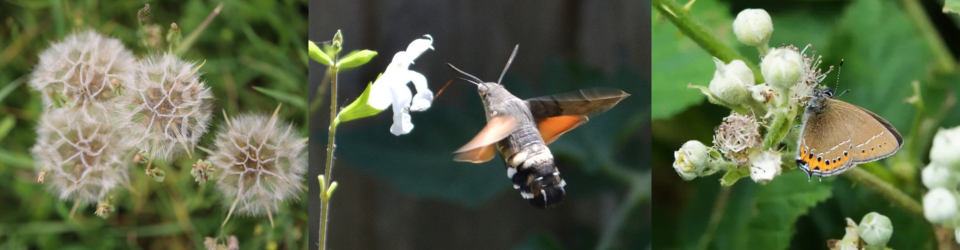
The mild autumn has kept our garden flowers blooming and we are still enjoying bumble bees and the ocassional butterfly. It was also really lovely to see this Hummingbird Hawk-moth (Macroglossum stellatarum) feeding on our Salvia in mid October.
Walk through any park, street or woodland in Milton Keynes and you’ll find them quietly thriving: lichens. They are everywhere—on tree bark, stone walls, pavements, rooftops and even metal street signs. Yet most of us pass them by without a second glance.
Lichens are extraordinary organisms, formed through a partnership between fungi and algae (or sometimes cyanobacteria). This collaboration allows them to survive in places where few other life forms can. They play a vital ecological role: creating microhabitats for insects, providing food for slugs and snails, supplying nest material for birds, and even helping us understand patterns of air pollution through the species that thrive or decline in different conditions.
Fig. 1-6 A tree trunk holds far more than its bark suggests. Look closer and a living mosaic comes into view: the fine grey rosettes of Physcia tenella, the golden patches of Xanthoria parietina and the pale crusts of Lecanora chlarotera s.lat. Together they form a miniature community, showing how much life thrives on a single tree. Click on the images for a closer look. (Image credit: Jagoda Zajac)
But here’s the challenge—identifying lichens is notoriously difficult. Their shapes are subtle, their colours shift with moisture, and many species look deceptively alike. Proper identification often requires chemical spot tests to see if colours change, microscopic examination of spores or crystals in fruiting bodies, and even checking their reactions under ultraviolet light. To make things trickier, lichens are constantly being reclassified as scientific understanding evolves, with names and genera shifting in the taxonomic system. For beginners, this can feel daunting.
The good news? Some lichens are distinctive and easy to recognise once you know what to look for. These “gateway species” are perfect starting points for anyone curious about the hidden biodiversity around us.
Over the coming months, I’ll explore ten of the most common lichens found on trees in Milton Keynes. Each article will highlight a species, offering tips on recognition, ecological significance, and the stories they tell about our environment. I’m still learning myself but I hope this series will be a chance for both you and me to discover more about lichens together.
Jagoda Zajac, December 2025
Top photo: Ramalina fastigiata catching November sunshine (Credit: Jagoda Zajac)
Lichens of Milton Keynes: Discover the 10 Most Common Species on Trees
The season has changed so quickly. The severe drought which started in early spring and lasted through the summer has now been followed by an onslaught of torrential rain and thunderstorms. The rain did not come soon enough to save our lawn though which is now a soggy mud pit with grass seeds sprinkled on top in an attempt to revive it.
New species have arrived along with the rising summer temperatures. The Hummingbird Hawk-moth Macroglossum stellatarumis is now a very common visitor in our garden. The first time I saw one was over 20 years ago in Somerset. I’d never seen or heard of one before and believed I was looking at a real Hummingbird. How embarrassing.
The best sighting this month was our first Willow Emerald Damselfly Chalcolestes viridis resting on an Oak in Rushmere Park. This Mediterranean species of Damselfly was first recorded in the UK around East Anglia in 2007 and is now quickly spreading through the country. They lay their eggs on Willow or Elder near water so there is a very good chance that they could be breeding in our wood.
There have been a good number of Crossbills Loxia curvirostra locally too. They are a large finch with, as their name suggests, a crossed-over bill which has evolved to extract seeds from conifer cones. We have regularly seen a flock of 17 feeding in the Scots Pine behind our garden and in Rushmere too.
There have been a good number of Crossbills Loxia curvirostra locally too. They are a large finch with, as their name suggests, a crossed-over bill which has evolved to extract seeds from conifer cones. We have regularly seen a flock of 17 feeding in the Scots Pine behind our garden and in Rushmere too.
It has also been a good summer for seeing Hobbies Falco subbuteo over our garden. Hobbies are a large Swift-shaped falcon which feed on Dragonflies and Swallows. We always know when we hear the Swallows alarming that there is a good chance that a Hobby is about. Hobbies are summer visitors so will soon be following the Swallows and Martins on passage back to Africa for the winter.
We were walking along one of Rushmere Park’s sandy bright orange and yellow paths which stretched across a felled area between the Birch, Bracken, Bramble and drought-stunted Foxgloves. There was a huge array of insects for us to search through because, despite the relentless heatwave, the insects were having a good year. Rob called it first, “Green Tiger!” and our excitement suddenly rose. The Green Tiger Beetle Cicindela campestris was very much on our want-to-see list. While it was hunting for food it flew and scuttled about erratically at great speed, making it very difficult to photograph. It even flew into my hair. This charismatic metallic green and iridescent copper armoured warrior was just as beautiful as we had hoped, which isn’t always the case.
There were also many dug-out holes along the path which could easily have Green Tiger Beetle pupae inside, listening for unsuspecting prey to ambush and devour.
Another fantastic discovery for us was a huge colony of approximately 500 rare-for-Buckinghamshire solitary bees. The Pantaloon Bees Dasypoda hirtipesalong are situated along the banks of Heath Road. They are usually found along coastal areas but because of our ancient sandy soil they have chosen to nest in our village. They are another species which is in decline because of loss of habitat and pesticides. They cannot sting humans, which is true of nearly all bees except honey bees, and they have the most fabulous furry legs designed for collecting ample pollen and digging into the soil. They are classed as solitary but tend to tunnel beside others of their kind in a neighbourhood. We have never come across Pantaloon Bees before and though they are difficult to misidentify because they are so specific in habits and looks, we had the species confirmed by experts. We then sent our record to the County Recorder.
Members of the Society recently promoted MKNHS at Emberton Country Park as part of its 60th anniversary celebrations. On the Saturday afternoon Jagoda, Linda, Bob and myself were wilting in the heat when we met a very nice family who live nearby in Emberton. A lady with an Hispanic accent (we didn’t ask her name) came into our gazebo with her two young daughters. The children were clearly very enthusiastic about nature and enjoyed seeing our live caterpillars as well as the rocks and plant materials which we had on display. The mother explained that they leave much for their garden wild to encourage wildlife and showed us pictures of some of the dragonflies and butterflies in her garden. She then asked us to identify a couple of caterpillars from her garden. The first of these was a picture of a fully grown Vapourer moth – common enough on a host of trees and shrubs. It was the second photo that left me open-mouthed!
This was a picture of a fully grown, fifth instar larva of Monarch butterfly Danaus plexippus. Most naturalists will be familiar with this as the great migratory butterfly of the Americas, famed for its huge, multi-generational migrations. It does occur in the UK as an accidental migrant – in most years just a few individuals cross the Atlantic and are found in SW England and Ireland. But since the larval foodplant is Milkweed Asclepias spp., a group of plants which do not occur in the UK, the caterpillar is virtually unknown here. In fact, there is just one documented case of breeding from Kew Gardens in 1981, where milkweeds are grown.
So how on earth did a Monarch larva turn up in Emberton village in April 2025? I asked if they had visited a butterfly house (such as the one at Whipsnade) recently but they had not. Is it possible that the specimen had been imported on a plant, either as an egg or young larva? This is probably the most likely origin but few garden centres stock Asclepias. What happened to this specimen? It is tantalising to wonder if it made it through to adulthood, if it had anything to feed on. I really should have asked more questions but did not want to overwhelm the lady and her children! She took one of our leaflets and seemed quite interested in becoming a member – so perhaps we will get the full story in due course. In the meantime, the mystery of the Emberton Monarch remains…
I am busy building Swift boxes at the moment. We have an RSPB box which we purchased and erected last year. It has been quite an active station for our local birds already. First we had a Great Tit roosting in it through the winter. Once he left in spring, some Blue Tits showed interest and busily cleaned out his droppings. Surprisingly they didn’t stay long but the House Sparrows moved in and nested instead (maybe the House Sparrows kicked the Blue Tits out?). They may not have been our target bird but we were still pleased as they are a very much declining species too. Just before they fledged we saw some Swifts swooping above the fields and woodland high in the sky catching insects by our house. They were hunting amongst a family group of Swallows which have nested locally every season since we have lived here. Much to our excitement the Swifts also circuited our house and flew past our box several times. According to Rob, they were definitely prospecting our nest box for next year!
So now the race is on to provide more boxes for the following season in the hope that another one of our wishes comes true and we have Swifts breeding beneath our eaves. I remember having House Martins nesting on our modern estate house during the early 70s. My family very much enjoyed having the privilege of seeing these birds returning from Africa to our house each year. I don’t remember anyone else on the estate having these amazing mud-built fairy-sized huts glued to their gables but I do remember it breaking my heart to hear neighbours reporting how they had bashed the nests down to destroy and deter their breeding attempts. They were a common sight back then but are now Red-listed and protected by the 1981 Wildlife and Country Act. We will be erecting some House Martin simulated nests we purchased to try to encourage these birds next year too.
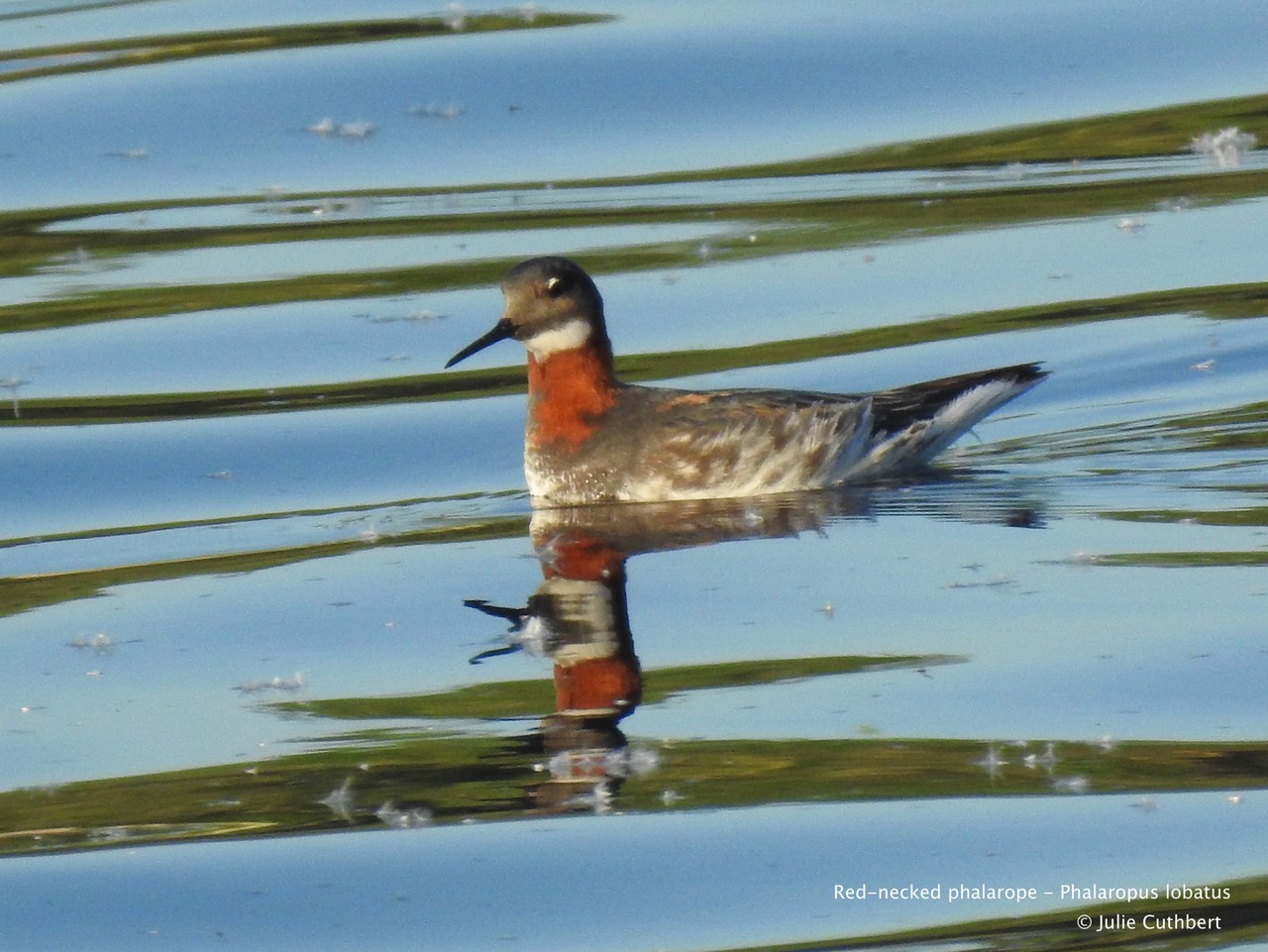
Red-necked Phalarope (f) – Phalaropus lobatus – Caldecotte Lake
Rob took me to see a rare wading bird at Caldecotte Lake during May. It was a beautiful little female Red-necked Phalarope that was stopping off on her way to breeding grounds in the Arctic region. The female has the brightest plumage which is unusual for birds and their roles are reversed. The males incubate the eggs and rear the chicks while the females look for another male to breed with before heading off on migration to wintering grounds as far away as the Pacific Ocean off South America where they spend the winter out at sea.
The Cuckoo has been singing its heart out all week over Rushmere Park. I tried to find him in the wood on a dog walk. I know I came close at times because his song became so incredibly loud. Louder than I’ve ever heard a Cuckoo sing before. Every time I reached the part where I believed him to be singing from, the sound stopped and then began again somewhere else. While on my hunt I came across a Squirrel taking it easy and enjoying the sun.
Our nesting Blackbirds are still sitting on eggs. Watching their diligent devotion is fascinating and a delight. When we relax in the garden, after a while, the male makes his presence known and lands in front of us to give us his stern message, “Can you go now, my wife needs to feed and drink.” We make our way inside and watch them through the open French doors.
He calls to let her know it’s safe now and she arrives on the lawn immediately. She then scans around and feeds. She is scruffy. Her feathers are all out of place from sitting still on the nest. She feeds on tiny fragments of fatball which have fallen down from the feeder. It is so hot and dry this spring that it would be impossible for her to extract any worms from the baked lawn. He watches over her, occasionally taking a few mouthfuls too. After a short while he becomes impatient and goes over to the pond and starts to mime to her to take a bath. She comes over and drinks from the waterfall, then pops herself into the bathing area and, after checking around again, she really flaps about and relishes the moment. Droplets of water spray everywhere and catch the sunlight like diamonds. We can hear the splashes of her wings beating the water surface. She then hops out and preens. The male is watching over her all the time. It is plain to see how much better she feels after having fed and bathed, then off she goes back to her duty on the nest, brooding.
Wild Guides ‘Trees of Britain and Ireland’ by Jon Stokes (Princeton Press, 2025) – Book Review by Mike LeRoy
Jon Stokes has provided us with a remarkably useful and portable field guide to trees and more, with background about each of them, and wise guidance about doing tree identification. Read the full review here.
We saw clusters of Mayflies flying above the Great Ouse on our circular route around Stony Stratford Nature Reserve on Tuesday evening’s site visit, 13th May 2025.
Watching Mayflies in May is an extraordinary and brief event. We watched them ‘dancing’ above the river, in the shadow of the A5 viaduct, with the fallen lying still on the surface of the water but we saw no fish gobbling these up. Although they are known as Mayflies, some appear at other times throughout the year, though May is a good time to watch them.
There are 51 British Ephemeroptera or ‘up-wing flies’ species. These are not True Flies, of the much larger Order of Diptera which has over 7,000 British species. Mayflies are one of a group of species, together with Stoneflies (Plecoptera) and Caddisflies (Trichoptera), informally known as ‘Riverflies’. Alderflies (Megaloptera) also frequent rivers and other water bodies but the Riverfly Partnership do not include these three British species in their surveys. Although Alderfly wings look similar to Mayflies, they do not have the double or triple tails of Mayflies.
It is not only naturalists who take an interest in Mayflies: they are of particular importance to fly-fishers who use imitations of real Mayflies as their lure at the end of their fishing line. Each of these has a popular name such as: Purple Dun, Turkey Brown and Large Green Dun.
The life of an adult Mayfly is brief, but it is only the last of four stages in its life-cycle. The first stage is the Egg from which the Nymph hatches. Nymphs live longest, up to two years, feeding at the bottom of the river on algae and river plants, dead organic matter and detritus, and pass through several sub-stages (Instars) at each of which they moult before finally emerging as adults. Emergence as an adult is in two stages: first as a ‘Sub-Imago’, or in fishing terms a Dun, then as an ‘Imago’ or Spinner.
The Sub-Imago stage is when the mature nymph frees itself from its ‘Shuck’, its nymphal skin, and emerges onto the surface with wings lowered. In its dark adult shape, it finds a shrub on which to dry. Soon it sheds its skin again to emerge in brighter colour as an Imago, the complete adult with wings upwards, but without mouthparts, so it never feeds and its adult life is brief. Mating starts with a cluster of mature males swarming above a river and the females flying into the swarm to be mated while in flight. The fertilised eggs are dropped into the water to stick to stones or plants, and the cycle starts again.
One aspect that looks distinctive about Mayflies is the reason for their other name as ‘up-winged flies’. Their wings look huge and are held close together and upwards. Many have dark, thick and prominent veins. They are also distinguished by having either a pair of ‘tails’ (Cerci) or three, used primarily as sensory organs. Other features that are important for identification are the sets of external gills by which they ‘breathe’. Mostly these stick outwards from the body. Their number and shape are key features for identification.
There are excellent sources from which to identify British Ephemeroptera and their larvae:
A Pictorial Guide to British Ephemeroptera by Craig Macadam and Cyril Bennett (an AIDGAP Guide) Field Studies Council (FSC) 2010
There is a brief key in: Guide to Freshwater Invertebrates by Michael Dobson, Simon Pawley, Melanie Fletcher, Anne Powell Freshwater Biological Association 2012
Mayfly Larvae (Ephemeroptera) of Britain and Ireland: Keys and a Review of their Ecology. Freshwater Biological Association 2010.
Britain’s Insects (Wild Guides): A field guide to the insects of Great Britain and Ireland by Paul D Brock
Princeton University Press 2021 This has a key to the ten families and photos and distribution maps for nine of the 51 species.
Which spring flowers can you expect to see during May?
Spring flowers in May in woodlands, hedges and beside paths [AWI stands for Ancient Woodland Indicator]
First, a cautionary note: When you are examining or photographing flowers, especially less common ones, please avoid creating a trampled path, because this makes them more vulnerable. If you must get close, please reach them by an indirect, more concealed route. Better still, consider making do by taking your photo from further away. Last week, in one of our Ancient Woodlands, a heavily trampled off-path route was created through vegetation, which has drawn excessive attention to a small and declining number of an uncommon flower, putting them at risk.
Herb paris Paris quadrifolia (AWI)
Herb paris is a strange-looking almost ethereal plant. Mostly, it has four (occasionally 3 or 5) broad leaves, almost diamond-shaped, slightly-rounded but pointed and dark-green. All the leaves are towards the top of a slender, hairless stalk and lie flat. In the centre of the leaves a spike holds an unobtrusive, small, single, greenish flower which looks more like a double whorl of pointed leaves. It has eight slender long pale-yellow stamens, at the centre of which is the ovary, a small purple bauble. ‘Is that it?’ you think, when looking at such an understated flower: yes, but that is its mystery. It is largely found in Ancient Woodlands, in MK in Linford Wood in particular. It is a ‘shy’ plant, often partially hidden in the underwood and at edges of woodland rides and there is a delay before the flower shows above the leaves. Paris in the name is not about France but from the Latin ‘par’ meaning equal, which is probably to describe its symmetry. It is in the Lily family (Liliaceae) which has other one-offs, including Lily-of-the Valley, Snakeshead Fritillary, Butcher’s Broom, and Grape-Hyacinth Muscari neglectum; this or its garden-escape version Muscari armeniacum, has also been on show in MK grasslands through April into May.
Yellow Archangel Lamiastrum galeobdolon (AWI)
Think of a white Dead-nettle and imagine it with yellow flowers, but the Yellow Archangel is a far less common Dead-nettle and is mostly found in Ancient Woodlands. The leaves are oval and pointed, with coarse teeth. There are several flowers with each pair of leaves up the stem, Each flower is hooded and with a lower lip. They are bright yellow, with slight red or orange streaks on the lip. The plant’s presence can tend to indicate old woodland banks or ditches. I know only a couple of patches of this in Linford Wood, and they are next to the wood’s boundary banks and ditches. You may also find it in Howe Park and Shenley Wood. One potential confusion is a garden-escape which is very similar but with variegated leaves: Lamiastrum galeobdolon ssp. argentatum (if you know heraldry terminology you may recognise that argent = silver, which is the colour of the streaks on the leaves). I have seen a few of this sub-species on the west bank of the Loughton Brook, in Bancroft valley. It is well worth submitting records of either of these plants, with their exact location. [To know how and where to submit a record of this, you can check the MKNHS website Reference section and click on Recording.]
Herb-Robert Geranium robertianum (AWI)
Herb-Robert comes into flower usually in late April or early May, but the leaves emerge well before that and sometimes remain through the winter. Although it is an Ancient Woodland Indicator it is also common more widely by hedges, in woods and on disturbed ground. It is in the Geranium family (Geraniaceae) and the leaves have a strong mousy smell when you get close. It is one of the Crane’s-bills, so-called because the shape of the seed-head is like the beak, narrow head and long neck of a Crane. Its stem tends to be dark red and hairy. Its flower has five pink petals which have a smooth edge all around. The anthers in the flower are orange or purple. Who was Robert? Probably ‘Robin Goodfellow’ aka Puck, the mischief-making house goblin of Shakespeare’s The Tempest. A different account is that it used to be called St Robert, or St Robert’s Wort, after an 11th Century monk who used it medicinally.
Lords-and-Ladies Arum maculatum Here’s another strange, one-off plant. You have probably been seeing its large shiny green leaves ever since January, beside paths and in woodlands, sometimes in dense clumps. Lords-and-Ladies has three distinct stages, so you may not realise that they are one and the same plant. A single, broad, large and pointed, shiny, arrow-shaped leaf springs upwards from ground-level, and some plants have dark streaks on these leaves. The leaf remains without flower for months until late April and early May when a paler leaf-like structure called the ‘spathe’ emerges and, within it, its purple ‘spadix’. This is stage two, followed by a third stage in July or August, when a cluster of orange-red berries emerge on a spike, from which the spathe and spadix have gone. This flower emits a slight odour that attracts insect pollinators: birds also carry its seeds away. It is a common plant in damp and well-drained shady places and usually numerous where you find it. An old name for it is Cuckoo-pint, but it has many other names, mostly innuendoes. It looks poisonous and it is.
Bugle Ajuga reptan There are quite a few plants that look a little like Bugle: bluey-purple with quite small leaves, so this one needs careful attention to several of its features. Some people assume that identifying flowering plants is all about the flower, but other parts of a plant are just as necessary for identification. With Bugle, try starting at ground level. Here, its lowest leaves (known as ‘basal’ leaves) are in a circle (‘rosette’) around the base of the plant, and these lower ones are larger and have long stalks. The leaves up the stem are in opposite pairs and are smaller than the basal leaves and tend to be dark-green. None of the leaves have toothed edges. When the plant first emerges, it is scrunched up before the stem stretches fully and the pairs of leaves become spaced out from each other. The stem is distinctive, so feel it. It is square and is hairy on only two opposite sides. The flowers are grouped in stages on the upper sections of the stem. Beneath each group are small leaf-lookalikes called ‘bracts’ which tend to be more purple-green than the leaves further down. The flowering parts (‘corolla’) are usually powder-bluey-purple, but occasionally these are pink or white: their colour has no significance. The shape of the flower is of connected lips, with a tiny top one, two-lobed side ones and a lower lip which is longer. Because this plant spreads through runners, it tends to be in clumps. It is usually in damp and shady grassland or in damp woods or by hedgerows. If you check each of the features above you will be able to avoid any confusion with other plants such as Self-heal, the Woundworts, or the Dead-nettles.
May Spring flowers of grasslands, waysides & grid-road verges
Common Bird’s-foot Trefoil Lotus corniculatus If you don’t know this plant, it is worth getting to know as you can find it in some meadows and other grasslands in MK, including on some grid-road verges. It is popular with bumblebees and other pollinators, and a sign of good grassland management to benefit wildlife. In this instance, the colour of the flower is significant to distinguish it from other species. The flowers are a rich, deep yellow and often with a tinge of red or orange, which is why some people call it ‘eggs & bacon’. The plant is low down because its habit is creeping, with its stalks lying down, and the stems are solid. But there are other Bird’s-foot Trefoils, including a taller one, Greater Bird’s-foot Trefoil Lotus pedunculatus, with longer narrower leaves; and a variety in some commercial seed-mixes Lotus corniculatus var sativus which stands up more but has a hollow stem and lacks the red or orange tinge to the flower. So look at a good identification book to check for these similar species.
Bird Cherry Prunus padus Although Bird Cherry Prunus padus is an indigenous shrub or small tree, it is native mainly in northern Britain, but has been widely planted in towns and cities further south, including Milton Keynes. Perhaps it is popular because its long white clusters of flowers follow, in late April or early May, the other white-flowering spring shrubs of March and April such as Cherry Plum Prunus cerasifera and Blackthorn Prunus spinosa. The shape of the Bird Cherry’s white flower clusters remind me of the general shape of the mauve flower clusters of Buddleia davidii, but the proper description of such clusters is ‘raceme’ and these ones either droop or stick out sideways. The leaves of Bird Cherry are elliptical and have fine saw-teeth. Its black cherries emerge in July, but don’t try them, they are bitter. Our member, Alan Birkett, suggests that this is why ‘bird’ is in its name as birds do eat these. [See Alan’s Field Guide to the Trees of Britain and Europe which has several photos of every tree, showing more of their features than most other tree guides.]
Lesser Stitchwort Stellaria graminea Lesser Stitchwort Stellaria graminea tends to flower in May, which is later than Greater Stitchwort Stellaria holostea. Lesser Stitchwort tends to prefer more open woods, grasslands and rough grass area. It is the smaller of the two, but a critical feature to look for is that the five petals of the flower divide well over halfway down. Take care not to confuse this with other five-petalled white flowers such as Chickweeds or Mouse-ears which are also in the Campion family (Caryophyllaceae). This is where a good field guide is needed so you can see illustrations of these similar plants and compare the descriptions of their features. Just comparing photos is more likely to confuse you. If you search the MKNHS website under Reference and click on Identification Guides, then on Plants, you will find several recommended field guides to flowering plants.
The following should also come into flower in MK during May, in grasslands or beside paths and some in woodlands: Ragged-Robin Lychnis flos-cuculi Red Clover Trifolium pratense Lady’s-mantle species. Alchemilla vulgaris agg. Self-heal Prunella vulgaris
You can let MKNHS website Sightings know where you see these. Just send a note, and photo if you can, to: sightings@mknhs.org.uk
It’s been a sensational sunny spring so far and our garden has been full of life and colour. The Swallows have returned to Great Brickhill from Africa and our garden Robins have already fledged young. They nested in our next door neighbour’s barbecue again.
This week we have watched a pair of Blue Tits collecting tufts of our dog’s hair which I leave around the garden. We try not to use chemical flea treatments on her but regularly use a Flea comb instead which so far has been effective and keeps wildlife safe. The Blue Tits have chosen to nest in one of the nest boxes that doesn’t have a camera in it. This happens every year.
We also have a pair of Blue Tits nesting in our Swift box and another single Blue Tit taps away every evening in our Bat box. This has been going on for months. We can only guess that it is trying to enlarge the space for a nest. The Bat box is next to the empty nest box that has the camera inside it.
A pair of beautiful red-listed Starlings have also been collecting grass and sticks from our garden for their nest which they built beneath a neighbour’s roof tile. It took them over two weeks to complete their build. I saw one of the Starlings carefully pick some of the blossom from our cherry tree which it then took to its nest. A few years ago I watched a male Starling waving a Dandelion flower about like a flag by the entrance of his gutter nest site. He was trying to entice a female in to pair with him. Maybe they use flowers to decorate the inside of their nest too! They use our pond each day for their morning bath and then patter about the lawn looking and listening for things to eat.
A couple of Blackbirds are presently also making a nest in our hedge. This suggests that their first attempt failed as it is quite late for Blackbirds to be still building. I took a crop of fibrous compost from the bottom of our compost bin and spread it over a dry sandy bed which the Blackbirds gathered up to add to their home along with a lot of green algae from our pond. I’ve never seen these materials being used by Blackbirds before.
At night we go out with a torch and shine it into the pond and count the newts. There are lots in there which is great news considering the pond is only a few years old.
This article was first published on the website in April 2023. It is still very relevant, so we are re-publishing it to help your identification of Spring flowers. This is one of a three articles about what you may see in March, April and May which we are re-posting for the appropriate month.
Which spring flowers can you expect to see during April? When you see these, how about letting MKNHS website Sightings know where you see these come into flower? You can send photos too: sightings@mknhs.org.uk
April Spring flowers in woodlands, hedges and by paths
We have three ancient woodlands within the City: Linford Wood, Howe Park Wood and Shenley Wood and they have many of what are known as Ancient Woodland Indicators (AWI). The usual March ground flora have come into flower in these woods, but it has been a slow and lingering Spring, so some plants have bided their time. For instance Wood Anemone Anemone nemorosa (AWI). The leaves of these started emerging in early March, but only recently have they begun to flower in quantity. These plants are mainly on the sides and edges of ditches alongside paths, but also deeper into the woods. But do remember that their flowers close up in the evening and need sun on them to open up. Its flower is a star-like spread of six (or more) brilliant white petals, with a light splash of pink beneath. This plant spreads by creeping rhizomes so is in dense patches. There will be bright carpets of them in Linford and the other woods as they all come into flower.
Primrose Primula vulgaris(AWI)
Some Primroses Primula vulgaris have been flowering in the woods since the end of February, but there are more now and they are ‘lasters’ so we can enjoy them in their isolated clumps for many more weeks. The ancient woodlands are where to see them at their best.
Barren Strawberry Potentilla sterilis / Wild Strawberry Fragaria vesca (AWI)
If you have Strawberries Fragaria ananassa in your garden, it will be months before you can pick them. But in our Ancient Woodlands you can find two species of wild Strawberries, and both of them are indicators that a woodland is likely to date from before 1600. You can find them most easily in Linford Wood, beside main paths and on the edges of ditches. Neither of these are as large as garden Strawberries but they look like them. They are Barren Strawberry Potentilla sterilis which flowers earlier than the other, which is Wild Strawberry Fragaria vesca.
Later on you may see a tiny red strawberry fruit on Wild Strawberry, but Barren Strawberry lives up to its name and bears only a tiny dry fruit. Before Wild Strawberry fruits, what distinguishes these two species are that: Barren Strawberry is a smaller plant, with short runners; it has smaller flowers in which the petals tend to be well separated from each other, while the petals of Wild Strawberry overlap; there is a subtle distinction between the leaves of these species: the end tooth of a Wild Strawberry leaf sticks out, but on the Barren Strawberry it is slightly set back from the adjoining teeth; finally, the Barren Strawberry leaf is matt, not shiny, and a dull bluish-green, while the Wild Strawberry leaves have a longer stalk and look glossy green. Perhaps distinguishing the two of these would be a good test of the reliability of any App you may use?
Barren Strawberry is in the Potentilla family, which is mainly Cinquefoils. Wild Strawberry is in the Fragaria (Strawberry) family, together with the Hautbois Strawberry Fragaria moschata which was introduced to gardens from mainland Europe and has become naturalised in the wild. As far as I know the Hautbois Strawberry is not present in Milton Keynes, which is helpful as it is sometimes wrongly identified as one or other of the native species.
Bluebell Hyacinthoides non-scripta (AWI) Hybrid Bluebell Hyacinthoides x massartiana Spanish Bluebell Hyacinthoides hispanica Everyone knows what a Bluebell Hyacinthoides non-scripta looks like, with its deep blue colour and drooping flower-head. But the thicker-stemmed Spanish Bluebell Hyacinthoides hispanica was brought to this country, escaped into the wild and hybridised with the native as Hybrid Bluebell Hyacinthoides x massartiana. So it is possible to see all three in the wild, though Hybrid Bluebell is much more common than the Spanish Bluebell. All three species have occasional variant colours of pink or white flowers.
Key points about the native Bluebell Hyacinthoides non-scripta are: the flowers are straight-sided and do not gradually widen out; all the flowers are on the same side of the stem and droop down; their anthers are cream (but some of the hybrids’ are too); the leaves are slender and their tips are hooded, a little like the prow of a slender boat.
For the next most common, the Hybrid Bluebell Hyacinthoides x massartiana, look out for: broader leaves; flowers spiralling around the stem; blue anthers (or cream in the white form of this flower); the tips of the petals are slightly curled back; and the stamen is fixed to the inner side of a petal half way up.
The Spanish Bluebell Hyacinthoides hispanica is similar to the Hybrid Bluebell, but: the stamen is fixed to the inner side of a petal low down; and the tips of the petals are not curled back.
You can find plenty of Bluebell Hyacinthoides non-scripta in our three Ancient Woodlands, along a few hedgerows, and in few grid-road landscapes. The leaves have been emerging throughout March, ready to flower later in April and into May. Why drive all the way to the Chilterns to see Bluebells when we have fine displays in our local Ancient Woods, including Little Linford Wood? (Note that you can still access BBOWT’s Little Linford Wood but not by car. The bridleway north from Little Linford village takes you into the Wood. It is a 20-30 minute walk each way from the village.)
Early Purple Orchid Orchis mascula (AWI)
Our Ancient woodlands will have the earliest of our common orchids coming into flower during April. Early Purple Orchids Orchis mascula should appear on some ditch edges, beside paths and under trees. One identifier to look for is dashes of dark blotches running up the leaves. Apparently at night they smell of tom-cats. You can download a guide to all the British orchids from the Natural History Museum website, the ‘Orchid Observers Identification Guide’: https://www.nhm.ac.uk/content/dam/nhmwww/take-part/identify-nature/orchid-observers-id-guide.pdf
Greater Stitchwort Stellaria holostea (AWI)
The crisp white flowers of Greater Stitchwort Stellaria holostea should be emerging soon. The five petals are divided to half-way or less, and are on a slender square-shaped stem with slender pointy leaves in opposite pairs, with each pair of leaves at right-angles to the next pair up the stem. Lesser Stitchwort Stellaria graminea is a smaller plant and tends to flower in May, with its petals divided more than half way down.
Cow Parsley Anthriscus sylvestris Soon the leaves of Cow Parsley Anthriscus sylvestris will be accompanied by the tall stems, crowned by umbels of creamy-white flowers, so characteristic of roadsides, edges of ditches and damp slightly shaded places. There are many other white umbellifers, so do check identification (i/d) in a good field guide. Don’t confuse it with other similar species such as the deadly poison Hemlock, or Hemlock Water-dropwort or Fool’s parsley. When you are sure of your i/d, it is worth searching where side-branches meet the stem. You may find quite a large round black leaf beetle Chrysolina oricalcia whose larvae feed on Cow Parsley. I have found the adult on Cow Parsley by the Bridlepath that runs alongside Old Farm Park and would like to hear of them in other MK locations, as they used to be known as rather scarce, but perhaps they were under-recorded because they hide rather well on Cow Parsley.
Ramsons / Wild Garlic Allium ursinum (AWI)
Ramsons Allium ursinum tend to grow on calcareous soils, such as over limestone. In MK this is largely a narrow band along our northern edge and in a few parts of the Loughton valley. They can be seen in a couple of our smaller woods and few other places in MK. If you see anyone collecting these in large quantities, please let The Parks Trust know, as I have heard from a resident that some people have been collecting them in quantity, perhaps to sell them commercially. You can just enjoy the garlic smell (if you do) as you look at their cluster of delicate white flowers on top of a long stalk, surrounded by two or three tall, straight bright green leaves.
April Spring flowers of grid-road landscapes, waysides and grasslands
The following should also come into flower in MK during April, in grasslands or beside paths and some in woodlands:
We had a change of scenery recently and took a trip out of county to Bedfordshire where we had some great views of Grey Partridges (Perdix perdix.) We haven’t seen any Grey Partridges around the Brickhills and would love to know if anyone else has. They are a ground-nesting farmland bird that have seriously declined by over 90% in the last 50 years in the UK and since 2015, they have become a Red Listed species (Birds of Conservation Concern 5*) due to farming intensification, disturbance and habitat loss.
We do have Eurasian Skylarks (Alauda arvensis), another ground-nesting farmland bird which is Red Listed for the same reasons. They are beginning to sing above the fields up from Cuff Lane and I managed to photograph one on the ground recently. It’s not a great photo because I didn’t want to disturb the bird in any way and kept my distance. They are definitely preparing to nest in these fields again. I so hope they are successful.
Skylarks are one of my favourite birds because of their high-pitched melodic warbling song. This beautiful sound always transports me back to my childhood when they were common and going on long summer walks around Chartridge and the Lee with my dog. I would amble for hours exploring the countryside around this area and would regularly return home with fossils in my pocket and a feather in my hand, something I still love to do to this day.
In 2017, having already vigorously covered the Tattenhoe area in birding and photography of other wildlife for nearly 10 years, I started to share my local findings and records more widely with other local birders and field naturalists. Through social media with such like-minded people, I was introduced to the concept of ‘nocmig’, the recording of nocturnal migration in birds through sound recording.
Aside from late evening walks occasionally producing wintering thrushes and the odd wader or two, this was very much uncharted territory for me but with a goal to record as many bird species in and around the Tattenhoe area as possible, it was something that I was keen to investigate further. Findings by others, like Bitterns and Common Scoters from the comfort of their own homes, made it all too exciting to resist.
As with wildlife photography, there are countless ways in which nocmig can be carried out. In 2020 I went for a fairly simple setup: a Tascam DR-05 sound recorder left running overnight on a small tripod in a bucket, placed in the middle of my garden. Providing temperatures kept near or around double figures with no precipitation, the recorder would usually run all the way through the night until I would pick it back up the next day.
Recording and reviewing sound recordings (in brief)
After retrieval, the recordings are imported and amplified in Audacity, a free piece of audio editing software, which provides a visual representation of the audio known as a spectrogram or sonogram. No single night is ever without the sound of traffic here but as the time progresses towards midnight and into the early hours of the next day, a much calmer suburban soundscape allows for fleeting calls and vocalizations to be at their most detectable, forming bold dots and streaks.
Picking out calls from late at night and into the early hours is usually quite easy even on brief scroll-throughs of the files (when magnified). However, singular flight calls or those of more distant birds can be very easily missed, so the recordings are always worth giving careful review, especially during the peaks of migration in spring, late summer and early autumn. In spring and summer, Blackbirds and Robins gently start off the dawn chorus, adding a few more consistent patches of song into the spectrogram, which gradually progresses into a more jumbled, convoluted collection of multiple species combined with increasing traffic noise. Trying to find the vocalizations of scarcer species in such high activity within the immediate area can be a gruelling process but patience can be rewarded in listening out for unusual early daytime flyovers. Even familiar species can make odd-sounding calls in the night but websites like Xeno-canto.org focusing on vocalizations can be a great help.
The species
Coots and Moorhens, especially the latter, are familiar sights on daytime walks in Tattenhoe and around the city’s larger waterbodies. Sticking close to their freshwater homes, their flights in the daytime are usually short distance, seeing off others from their territories or evading potential threats. By night however, they have become surprisingly regular garden birds for me in these recordings, in the flyover sense. With 11 recordings so far, Coots have been detected passing by the recorder as early as 20th February to 14th July. As with the Moorhens, it’s likely that late winter and early spring records involve birds departing from wintering flocks to head for breeding grounds elsewhere, while records further into the spring and summer are more likely to involve local breeders patrolling their surroundings. Another species I’d never expect to see over the garden in the daytime, the more elusive Little Grebe, has also been detected several times between early June 2020 and late February 2025.
Aside from the odd Mallard, Greylag and Canada Goose, other waterfowl have had little presence on the audio, but Common Scoter was a much-hoped-for target species achieved, with several calls caught at around 1.35am on 22nd March 2021, coinciding with their seasonal cross-county movements by night. Waders of any kind are always a treat in Tattenhoe these days. With the exception of the graceful, slow-flying Lapwings, record shots of them in flight are usually the best means of illustrating their often fleeting appearances here but nocturnal migration recordings have offered much clearer means of documentation.
Oystercatchers have made few-and-far between appearances on my daytime walks across the Tattenhoe area, though nocmig has increased their recording rate here, ever so slightly. Two years after my previous daytime record, one was picked up calling just before 1am on 5th April 2020, another at 01.13 on 15th June 2020 and lastly in 2023, a single call at around 03.47 on 18th July. Golden Plovers have been scarce autumn and winter flyovers, with 3 nocturnal recordings adding to a handful of patch records. Several of their calls were picked up between 23.00 and 23.20 on 9th and 11th October 2020 and more recently, several more just before 20.00 on 19th March 2023, which is currently my latest winter/spring date for them here.
Both Ringed Plover species have also joined in on the action, with the largest of the two being an entirely new Tattenhoe bird for my records. Exactly a month after one flew fast and low through Tattenhoe Park, two calls from a Little Ringed Plover were caught at around 1.34am on 15th July 2020. Much more recently, the sombre-sounding Ringed Plover provided two August records, with four calls picked up around 1.53 on 23rd August 2023 and almost a year later, two calls at around 2.20 on 11th August 2024. Another one of the much scarcer daytime flyovers here, Curlew, kindly provided a single loud and clear call at around 23.21 on 10th August 2023.
Preferring the larger lakes and wetland sites of the city, Common Sandpipers haven’t exactly lived up to their name in the Tattenhoe area with only one previously seen in the daytime in 2016 and one heard over Howe Park Wood on the night of 25th August 2018 – but in just three weeks in 2024, nocmig added three additional records. A single call was caught at 01.42 on 24th July, a series of overlapping calls undoubtedly from multiple birds around 01.15 on 12th August and another single call the next morning at 02.33. Strangely, Green Sandpipers which have produced several more daytime records here, including some grounded individuals, have alluded the recordings so far. The highlight of 2024’s nocturnally moving waders came in the form of a Dunlin, another all-new Tattenhoe bird for me, making a single call at 04.07 on 11th August.
Aside from Redwings and presumed continental Song Thrushes and Blackbirds arriving in the autumn, passerines have contributed very little to the recordings outside of the dawn choruses, though there have been a few birds of note well into the night. A Blackcap was caught giving a short burst of song nearby at 23.49 on 14th April 2020 and just over a month later, interestingly a Lesser Whitethroat was also caught briefly singing just after midnight on 21st May, at a time when none seemed to be holding territory nearby, so perhaps a late-moving migrant? A Dunnock also gave a single burst of song at 01.17 on 1st May 2021. One of the area’s scarcer passage migrants, the Tree Pipit, was recorded twice on 24th August 2023, with calls at 01.05 and 02.02.
Along the way, two of the city’s more elusive and cryptic species have also made themselves known by sound. Tawny Owls have been perched nearby and calling on several occasions, while the Water Rail has been caught in passing, making an unusual late spring record with two calls caught at 00.41 and 1.53 on 31st May 2021 and an autumn record with a single call at 00.52 on 22nd October 2023.
One of the personal highlights so far was the first Quail I’ve recorded in any capacity, calling loud and clear as it passed over at 2.47 on 28th May 2023 but easily the biggest surprise of them all was one of the earlier findings, a European Nightjar “churring” in the dawn chorus on 31st May 2020. On the sonogram, its song formed large thick bars, which I thought were probably a helicopter until I pressed play, completely and utterly failing to contain my excitement when I realised what it was. This was in fact my second record of the species in the Tattenhoe area, only a few months after filming one hawking around an oak tree on the late autumn date of 2nd October 2019 but I never thought I would get another one so soon, let alone singing in the vicinity of my own house. It seemed to sing nearby for about 4 minutes but was not found again in any subsequent recordings, so presumably another passing migrant, rather than a fully territorial bird calling my garden home for the season.
Conclusion
So far I’ve been blown away by the results from these recordings. While being in a landlocked area means it is more a case of quality over quantity, even in the best of nights, nocmig has generated records of species I never even thought I would see or hear from the comfort of my own home (if I was awake at the time!). Amid the rapid expansion of MK and changes to the local landscape not far from home, it’s provided some reassurance that there is still huge potential in the array of species coming and going locally.
Unfortunately I haven’t been able to record on anywhere near as many nights as I would have liked to, mainly due to weather or simply forgetting to recharge the batteries (doh!), but it is something I’ll definitely stick with into the future, whether I am in Milton Keynes or further afield. If you’re also a keen patch birder or just curious as to what you might catch in the night, I highly recommend giving it a go!
This article was first published on the website in March 2023. It is still very relevant, so we are re-publishing it to help your identification of early Spring flowers. Similar articles about what you may see in April and May will also be re-posted when April and May come around.
Which spring flowers can you expect to see during March? How about letting MKNHS website Sightings know when and where you see the first of each of these come into flower and include photos too: sightings@mknhs.org.uk
Early Spring flowers of woodlands, hedges and beside paths In our three ancient woodlands within the City – Linford Wood, Howe Park Wood and Shenley Wood – the Spring ground flora have started to come into flower.
Dog’s Mercury Mercurialis perennis One of the earliest Spring flowers to emerge is Dog’s Mercury Mercurialis perennis which began to flower here in February. Although there are extensive lines of it alongside woodland paths and dense swathes of it on the woodland floor, it tends to be overlooked because its flowers are unobtrusive and it is only the dense patches of dark green leaves that stand out. It is worth a closer look because the male and female flowers are not on the same plant (‘dioecious’). If you search for Dog’s Mercury online on the wildflowerfinder.org.uk website you will find a sequence of photos: of the male flower opening up and on separate stems the female flower, part-hidden by leaves. Dog’s Mercury also spreads vigorously by rhizomes, and it can compete for space with Bluebells Hyacinthoides non-scripta, which come into flower later. Dog’s Mercury is poisonous and amongst other effects is an emetic. Some dog-owners seem to think that the flower’s name is because dog’s like it, which is not why some wildflowers have ‘dog’ as part of their common name. Even so, some dogs are said to seek it out and eat it.
Wood Anemone Anemone nemorosa A later arrival in March is the Wood Anemone Anemone nemorosa. It’s ‘show’ can be almost as impressive as that of Bluebells. There are path edges in Linford Wood where it covers the ditch edges and spreads into the woodland. The flower is a star-like spread of six (or more) brilliant white petals, with perhaps a light splash of pink. This too spreads by creeping rhizomes.
Primrose Primula vulgaris Another that flowers mainly in March is Primrose Primula vulgaris. Although we tend to see cultivars of these first on the banks of some of the grid-roads (such as V8 alongside Fishermead) it is also an ancient woodland flower. Small clumps of these in woodlands can stay in flower through to June. But notice the differences between Primrose Primula vulgaris and Cowslip Primula veris (which tends to flower in April) and beware that there is a hybrid of these two around as well, Primula x polyantha = False Oxlip, often as a garden escape. The Primula family can be even more confusing locally because there are planted Oxlip Primula elatior at Woolstone and these have led to another hybrid in that area, Primula x digenea. Oxlip is largely found in the wild in Essex and Suffolk.
Dog-violets Two dog-violets in particular are found in our ancient woodlands, also by hedges and paths and amongst shrubs elsewhere in MK. Violets are small flowers, soon hidden on the woodland floor by later-flowering plants, so a 10x lens is useful for identification. They are: Early Dog-Violet Viola reichenbachiana and Common Dog-Violet Viola riviniana. You can find an identification aid for these and two other violets on wildflowerhouruk.weebly.com under dinkymoira. You should find a page there, illustrating the differences between each of these. Early Dog-Violet Viola reichenbachiana has rather narrow upper petals that do not overlap, the veins on its lower petal don’t tend to branch much, and the spur at the back of the flower is un-notched. Unfortunately Common Dog-Violet Viola riviniana can be rather variable in appearance, depending on what habitat it is in. But look out for its broad overlapping violet coloured petals, the much-branched veins on the lower petal, and the pale-coloured spur at the back of the flower, and the notch in this. Both of these flowers have pointy green sepals below the petals. Do let MKNHS Sightings know when you see these dog-violets coming into flower and where.
Early Spring flowers of grid-road trees, waysides and grasslands Our grid-roads have a sequence of white-flowered trees and the first is not Blackthorn Prunus spinosa: it is Cherry Plum Prunus cerasifera. The Development Corporation landscapers knew what they were doing: they planted a sequence, with Cherry Plum flowering from early March and Blackthorn following a few weeks later, followed by the two – more pinky – hawthorns in April and May: Midland Hawthorn Cretaegus laevigata and Common Hawthorn Cretaegus monogyna. The Cherry Plum is also known as Myrobalan Plum. It was introduced but is widely naturalised in the UK. With the Cherry Plum the flowers emerge at the same time as the leaves, but on Blackthorn the flowers appear before the leaves. The Blackthorn has many, long, sharp thorns on its grey-brown twigs, but the Cherry Plum has glossy green twigs that are often spineless. There are many other horticultural plum and cherry varieties of tree elsewhere in MK, but also the native Wild Cherry or Gean Prunus avium, sometimes found in woodlands.
Lesser Celandine Ranunculus ficaria There is another March arrival: the bright yellow flowers of Lesser Celandine Ranunculus ficaria stand out, and are often in small groups. They have at least eight quite narrow but long petals, each flower on a long stalk, with long-stalked leaves arising around it from the base of the plant. Early Lesser Celandine have been seen in flower already in Great Linford and on Bradwell Common.
Speedwells and other flowers Another group of tiny flowers that have been flowering for a while are the Veronica family, Speedwells. I have Speedwells in my lawn and they are found in other grasslands. Dinkymoira has an identification page for some of these too at: wildflowerhouruk.weebly.com – look under resources/dinkymoira. You will find it lower left, below a Violet. Other plants coming into flower locally in March include: Garlic Mustard Alliaria petiolata and Ground Ivy Glechoma hederacea. You may see these at woodland margins, by hedges, on waste ground and in gardens.
Gusting winds and heavy rain dominated the weather over the Christmas period while the new year brought freezing temperatures. I definitely prefer it to be cold and dry, especially when the countryside is magically transformed with a peppering of Crystal white fur. It is also a relief not to have to plough our way through the drudgery of churned-up mud everytime we go out for a dog walk. I’m sure our dog feels the same too!
We have hardly heard any Owls calling to declare their breeding territories for the coming season while out on our night walks through Rushmere Park this winter, just the occasional guttural barks of the Muntjac (Muntiacus reevesi) and Chinese Water Deer (Hydropotes inermis). We sometimes see the latter in the day across the Parish, alone or in small groups.
Chinese Water deer are special. They are often called Teddy Bear Deer because they have large round ears, black noses and black button eyes. They don’t grow antlers but can have tusks that grow up to 7cm. They originally came from Eastern Asia and were released in the UK from Woburn Park and maybe Whipsnade Zoo in the late 19th century and early 20th century. It is rumoured that civil servants often forgot to close the Woburn Abbey gates over the war period after they returned from a revelrous night out.
Due to over hunting and loss of habitat they are now on the critically endangered list in Asia but in the UK it is estimated there are 3-4,000, 40% of the world’s population and some of these are in the Brickhills! Scientists have also tested the UK Chinese Water Deer’s DNA and found it to be from an ancestral lineage that is now extinct in their native country of China. This makes the UK Water Deer more genetically diverse and an important group to aid in a reintroduction program in Asia. It is also thought that Chinese Water Deer are possibly one of the most primitive living examples of the Cervidae family. So maybe we should celebrate this particular deer species found in our local area as they are rare worldwide and worthy of our protection.
We haven’t had much success recording wildlife this month as the weather has been dull and stormy, but we have enjoyed trying to photograph a Water Rail (Rallus aquaticus) which is over-wintering along the stream that runs beside Rushmere Park. This is ideal for the Water Rail as it is well vegetated and fenced off from the path. It is also perfect habitat for a Nightingale which Rob dreams of one day finding here. I have failed to capture anything other than the scene from which the bird has shot off. Rob, on the other hand, has only managed to get a blurred record shot so, for the first time, I have used an image from another county, year and month to illustrate my article.
Water Rails are sought by birders because of their secretive nature. They are a freshwater wetland bird and are in the same family as Coots and Moorhens, but much smaller, daintier and with more attractive markings. They have a comical pig-like squealing call which is mostly heard in the breeding season. When we glimpse ours, out in the open, it will instantly lift up on its long legs and scoot across the water’s surface at great speed like the cartoon character, Road Runner as it heads for cover.
I am also enjoying winter walks through the wood when it’s beginning to get dark. It feels so magical at this time particularly when the mist is falling and the Tawny Owls are calling. My dog and I will take a moment on each walk to just stand and listen to all the many sounds that can be heard around us. At these times, I also like to watch my Collie’s huge upright ears pivoting, as they follow the directions of the rustles and the diurnal birds’ last calls before they go to roost.
MKNHS members may find this article about Oxley Mead to be of interest. It is about management of one of MK’s SSSIs and written by our member, Carla Boswell. It’s published on the Floodplain Meadows Partnership’s website.
A regular article written by Julie Cuthbert for The Brickhills Parish News
I usually never find the perpetrators of the scuffling noises in the undergrowth but on this occasion I got lucky. I was walking down the path into Rushmere Park, off Cuff Lane, when I first heard the rustling sounds amongst the fallen leaves and nettles. As I crouched down I instantly saw, by the side of the run-off stream, a Bank Vole Myodes glareolus. My collie and I remained unnoticed by the vole because it was so engrossed in devouring a freshly caught slug. It clutched the slug in its delicate hands and rolled it around whilst munching intently, like a leg of lamb in the hands of Henry VIII at a banquet. I could hear the slurping sounds from its tiny jaws as it chewed. Then, after having its fill, I watched it return to hunting for a while before disappearing down a hole.
On another of our autumnal walks through the wood, I found this beautiful caterpillar coyly curled up round a twig. It was out looking amongst the leaf litter for somewhere to pupate. When I researched it later I found it to be a Pale Tussock Calliteara pudibunda caterpillar which would transform into a subtle brown moth with a really woolly body, head and legs.
As always, Rob has been very busy recording the birds on Autumn migration. He reports to me each morning the highlights of his count from the early morning dog walk. Bramblings, Siskins, Linnets and Redwings often get a mention but this year’s star in the UK has been the Hawfinch numbers. So far Rob has seen 12 flying over Great Brickhill, which is a fantastic count for North Bucks.
I wrote the article below for our local parish magazine in rural Suffolk, as I felt it would be of interest to many in the parish, a benefice of five churches in five rural villages of different sizes. I was invited to the launch meeting after doing a simple water survey of our local river, the Glem, as part of WaterBlitz on 22 September 2024. This was an international survey of water quality. They supplied a simple kit to test for nitrate and sulphate in the water.
It involves the Suffolk Wildlife Trust, working with DEFRA and with some Government funding, to implement re-wilding projects at landscape level in an area around Sudbury, Suffolk. It’s being called Connecting Constable and Gainsborough Country, after two famous local landscape artists. This project takes re-wilding efforts beyond nature reserves only, involving 60 farmers in two established clusters, assessing their carbon footprint, planning what they could do in their own context, and seeking funding from both government and alternative sources.
I found it very encouraging to see that this work is going on and thought MKNHS members might be interested too. We hear so much about the problems, and here is a creative solution at landscape scale.
All the best, Alison Peace (MKNHS member, now based in Suffolk)
Connecting Constable and Gainsborough Country
On 22 October 2024, there was a launch meeting for this ambitious project, working at landscape scale, involving over 60 farmers in the Wool Towns Cluster and the Stour Cluster, and led by Suffolk Wildlife Trust.
DEFRA has provided significant funding for a 2-year development phase for this 20+ year initiative. The aim of the project is to enhance habitats and create connectivity corridors across the landscape for biodiversity and the benefit of wildlife, and for carbon sequestration, essential for reaching climate change mitigation goals.
The project is also supporting farmers to – reduce carbon emissions from farming – improve water quality of streams and rivers, and – increase the resilience of their farming business
Completing individual farm carbon audits will help the farmer or landowner assess the carbon footprint of their enterprise, examining both inputs and outputs, carbon used in production, and carbon sequestered in the soil, hedgerows, or woodland. Methane quantities will also be calculated. This will provide a baseline from which the farmer’s possible choices or changes can be considered.
It is proposed to fund improvements by a mixture of public and private finance, with the suggestion that in the near future there will be a demand for investment in ‘tradeable units of biodiversity’, like carbon credits, which can be proven to benefit the environment, by providing investment in the landscape. DEFRA has rigorous monitoring requirements. Both public and private investment could be involved in plans to sequester carbon.
Other outcomes could include improvements to existing public rights of way and increased attractiveness of the area to tourists, bringing benefits to local towns and villages.
This is the beginning of the journey, and I look forward to keeping readers informed on developments.
Recently Rob came home with a very dead looking, 2-metre high, Holly tree stump. He was sure that we could resurrect it if we gave it some love. I wasn’t convinced but planted it in a large pot and hoped for the best too. Every week we scoured the stump for signs of a bud breaking through but it stayed unchanged, gnarled like elephant skin and tinged green-grey with lichen.
While we were performing one of our inspections, Rob suddenly noticed the tiniest blip near to the top of the trunk and said excitedly, “It’s a bud!” When I went in closer with my glasses on, I could see what looked like a scuffed-up mound of lichen around the size of half an apple seed. While I was studying the area, it suddenly raised up and then started running about. “It’s definitely not a bud. I’m getting the cameras.”
Once we had our macro lenses focused on the strange alien thing we were amazed, as we had never seen anything like it before. Its body part was amassed in Lichen and tufts of bristly hairs. It had fierce red pincers and ran about like crazy. After some research we were able to identify it as a Common Green Lacewing larva Chrysoperla carnea and learnt that they cloak themselves in anything they can find to deter predation. Lacewing larvae will use plant debris, lichen, insect shells and anything else they can find; these they cache on their back bristles.
I have always appreciated the delicacy of the adult Green Lacewing and remember them to be everywhere when I was a child, but I rarely see them now.
It’s unlikely the Holly will come to life this late in the season, but it has still acted as a good host to this creature. It’s also had several Toadflax Brocade caterpillars Calophasia lunula marching up it, searching for somewhere ideal to pupate, so maybe we’ll be keeping our dead Holly tree after all.
At the Summer Review meeting on 3 September, our first evening back at the Cruck Barn this autumn, Martin Kincaid showed a photo of a Snakefly he had seen while away in Scotland. Locally, these insects are not recorded often but one has been recorded from Little Linford Wood and Tim Arnold has had one ‘come to light’ when he has been moth-trapping.
These are strange-looking insects with two pairs of long oval overlapping wings that are translucent but with slender and intricate black veins, rather like the shape of wing of Lacewings. The wings extend well beyond the body and the female has a long slender ovipositor (egg-laying tube) extending even further back than the wings. At the front, the Snakefly has a very long black pronotum (prothorax) with a head that can rear up, looking like a miniature cobra ready to strike.
They have a four-stage life cycle of: eggs, larvae, pupae, adult (‘holometabolous’). The adults are active in the day, mainly in woodland, are significant predators of aphids and mites and their larvae are also carnivorous. The adults are food for woodland birds such as treecreeper, great spotted woodpecker, wood warbler, and nuthatch.
Snakeflies are not Flies (Diptera): they are in a separate Order called Raphidioptera (rahpis = needle. pteron = wing). Species recognisable as from the origins of this Order appeared during the Early Jurassic (201-145 million years ago) and were most diverse during the Cretaceous (145 to 66 million years ago) since when they have declined considerably.
There are four (and a possible fifth) Snakefly species in Britain. Three of these are south of the Scottish Border: Oak Snakefly Phaeostigma notata, Small Snakefly Xanthostigma xanthostigma, and Scarce Snakefly Subilla confinis. One, the Pine Snakefly Alantoraphidia maculicollis is in Scotland and in southern England & Wales. The possible fifth species, Raphidia ophiopsis occurs widely in Fenno-Scandinavia and Central Europe so may yet be found in Scotland. The Oak Snakefly is the largest of the British species with a body length of 10-15mm and wingspan of 20-30mm; the smallest is the Small Snakefly with a body length of 7-9mm.
There are photos of all four species of Snakefly in Paul Brock’s field guide ‘Britain’s Insects: A field guide to the insects of Great Britain and Ireland’ (Princeton University Press: WildGuides 2021). That book is worth every pound for 608 pages at £25, but mostly at under £20: it covers 1,653 species of insect of the 24,000 British insects but is about the best-illustrated field guide you can get in a single volume and will cover most of what you are likely to see.
Peter Barnard, a member of the Royal Entomological Society, has written about Snakeflies that ‘Adults are not often seen as they spend much of their time high in the tree canopy; newly emerged specimens can be found at lower levels, and the females descend to oviposit, but otherwise any snakeflies seen by the casual observer have probably been dislodged from the canopy by strong winds.’ (Peter Barnard, RES Book of British Insects, 2011, p.317).
In Milton Keynes we are in the area for the largest of these species, which is the Oak Snakefly, and the smallest, the Small Snakefly which inhabits Oak woodland. There is a record of Oak Snakefly Phaostigma notata on the National Biodiversity Network website map at Little Linford Wood and another north of Finmere Wood between Romer and Balmore Woods. Could they also be in Linford Wood and Howe Park Wood?
This year I was determined to spend at least one night out of doors observing wildlife. I was delighted therefore to read about the Higgs/Redford mothing night on the MKNHS website. My knowledge of moths was minimal and dated from childhood when they were viewed as inveterate and alarming pests. I remember on hot summer nights when doors were left open and lights switched on, giddy monsters would hover around lightbulbs casting huge terrifying shadows on living room walls.
When the day came (20th July) I anxiously observed the weather hoping for a dry evening. It had been quite warm all day, but overcast. As instructed, I packed a torch, a camping chair, some water and a sweater for later in the evening. Instinctively I added my raincoat, a necessity on almost every outdoor event this year.
As I drove away from my home around 8.30pm I was dismayed to note some spots of rain on the windscreen, but happily nothing more sinister materialised. Reaching the rendezvous point I got a warm welcome from a member of the Bucks Invertebrate Group, this event being a joint venture between themselves and MKNHS. Then it was a slow drive up a narrow lane to reach the chosen site, a small clearing in College Wood. I parked up and after saying hello to the select group already assembled, I got out my camping chair and sat down to wait. It was still light and I was glad I had bought my book to pass the time.
There were several moth traps set up around the site, consisting of white cloths lit by lamps. Another more sophisticated type consisted of a tent-like structure with a light in the middle designed to attract moths from all angles.
Soon after sunset my first moth presented itself. It was Epinotia tenerana. (Although encouraged to use the Latin names, as a novice I found the colloquial names both charming and easier to remember). Epinotia tenerana is otherwise known as the Nut Bud moth, a beautiful little creature with forewings the colour of a hazelnut. After this initial sighting, the moths came in thick and fast and, overall, I was introduced to twenty-three different species, many quite stunning: Deilephila elpenor – the Elephant Hawk moth, for example, with its big colourful splashes of golden-olive and deep pink, or Leucoma salicis – White Satin with its soft, glossy white wings reminiscent of a sumptuous hooded cloak. Not only was each moth uniquely interesting to observe, I was captivated by the variety, the subtlety and the fragility of these frequently overlooked invertebrates. As an added bonus I saw my first ever glow-worm!
The evening went all too quickly and at around midnight it was time to say farewell. This was a night I shall always remember, and I am very grateful to those present willing to share their time and expertise with a keen but very amateur MKNHS group member. A list of the moths I had the pleasure of getting to know is given below.
Joan Hughes
Nut Bud – Epinotia tenerana Garden Grass-moth – Chrysoteuchia culmella Drinker – Euthrix potatoria Chinese Character – Cilix glaucata Brimstone Moth – Opisthograptis luteolata Dark Umber – Philereme transversata White spotted Pug – Eupithecia tripunctaria Red Twin-spot Carpet – Xanthorhoe spadicearia Large Yellow Underwing – Noctua pronuba Green Oak Tortrix – Tortrix viridana Oak Knot-Horn – Phycita roborella Clay– Mythimna farrago Yellow Shell – Camptogramma bilineata Clouded Border – Lomaspilis marginata Elephant Hawk moth – Deilephila elpenor Buff Arches – Habrosyne pyritoides Black Arches – Lymantria monacha White Satin – Leucoma salicis Bordered Beauty – Epione repandari July Highflyer – Hydriomena furcata Spectacle– Abrostola tripartite Coronet– Craniophora ligustri Burnished Brass – Diachrysia chrysitis
See also Andy Harding’s report of the evening, which includes a link to the full Species List prepared by MKNHS and BIG
On the evening of July 20th we held the annual (weather permitting) mothing event in memory of George Higgs and Gordon Redford. As was most appropriate, Frances Higgs and Rachel Redford were both there. This is a joint event between MKNHS and the Bucks Invertebrate Group (BIG) and has traditionally been held in College Wood, Nash. Martin Kincaid and I, the MKNHS trappers, were outnumbered by the BIG trappers of Phil Tizzard, Martin Harvey and Neil Fletcher. The night was hugely enhanced by their contribution since Martin brought an amazing trapping ‘tent’ of overhead height and Neil had a large vertical and horizontal sheets, both of which allowed terrific views of both moths and all the other flying invertebrates which throng the wood.
So it was most unfortunate that only two other MKNHS members turned up to enjoy these new features. Perhaps last year’s cancellation due to very poor weather and a discouraging weather forecast, which included a thunderstorm, three days before this year’s event, contributed to the low attendance.
Fortunately the latter forecast proved completely erroneous and the moths really did the business with about 60 macro species and 50 micros and counting. There was no doubt which species was numerically dominant: Drinkers were everywhere, crashing about sheets and in traps. There were a few of the much larger and yellower females to compare to the very numerous males. Other regular crowd-pleasers were Black Arches and the commoner Hawk-moths. Mere Wainscots are common nowhere, but several put in a welcome appearance, even if not the most visually exciting. Seeing moths in immaculate condition sometimes allows easier observation of the important identification features, which virtually disappear in worn individuals. This was the case with 3 or 4 White-spotted Pugs in excellent condition.
One which did its best to hide its features was a near-melanic Engrailed. Two slightly scarcer species attracted much interest. A Small Rivulet was nice but the star was arguably the Kent Black Arches. Until the 1980s this moth was ‘Nationally rare category B’, but has gradually spread north from a few south coast enclaves. It is still not common, since I’ve not yet seen it in my Old Stratford garden.
So, a really excellent night and early next morning. Thanks are due to the Woodland Trust for permission to hold the event in College Wood, and to Linda Murphy for sorting out all the paperwork with the WT, to the BIG trappers who were absolutely essential for the viability of the event, and particularly to Neil Fletcher who undertook the species list, to which there is a link below. Given the interest among MKNHS members in a wider range of invertebrates, than just moths, Neil has compiled a more comprehensive list than usual, which consists of:
155 species so far, of which 110 moths, 59 macros + 51 micros. – The Gelechid, Birch Grey Carpatolechia alburnella was new for me, there are less than 20 county records, a first for College Wood.
45 non-moth species of the total 155 (c.30%) is a very good count.
9 bees/wasps is very good, not had anywhere near that many this year. – Several rarely recorded species, including Cratichneumon flavifrons and Lissonota lineolaris which appear to be new county records.
As well as the list link, here is an interesting footnote from Neil Harvey: ‘One of the Craneflies, Diogma glabrata, is currently listed as ‘Nationally scarce’, although to be honest it is quite widespread across the UK. But it isn’t common, and the only other Bucks record I can find was from near Rushmere Park in 2005.’
Finally, may I apologise for the tardy appearance of this piece, but less than twenty-four hours after I left the wood on Sunday morning, my wife was taken to hospital, and has returned home only two days ago: that has been my priority.
Andy Harding 20 August 2024
Another perpsective on the evening, see Joan Hughes report here.
This is a book full of unusual photos. They are all of bird nests and bird eggs, but there is not a bird to be seen. It is not an ecological study, but it has ecological insights. It is not a history of egg collecting but there is fascinating history within it. The variety of nests illustrates the extraordinary variety of life: different shapes and a wide range of materials, displaying the skills of their nest-builders.
The book is almost square. Each double-page is about the nest and eggs of one bird species. Each spread has one large photo with text alongside it providing the common name, scientific name, followed by a caption to photo & text, with the main text above. Each page spread tells us: the size of the nest, the species’ egg clutch size, when, where and by whom the nest and egg/s were collected, the conservation status of the species, and more. There are over a hundred pairs of pages, each for one species. The sequence is taxonomic, starting with Syrian Ostrich and ending with White’s Thrush, followed by a Taxonomy list of orders and families which mentions the common and scientific name of each species found in the book. Jonathan Jackson’s photos on every page are sharp and beautifully presented.
All these nests and eggs are held by the Natural History Museum. If you have walked its galleries in London, you will not have seen this collection because the bird, nest and egg collections are held at the Natural History Museum at Tring in Hertfordshire. Some of the bird nests and eggs in the book belong to extinct species, and you will find out why. Others are of ‘Conservation Concern’ and some explanation is given. There are species commonly found in the UK such as Blackcap, Dunnock or House Sparrow, but most are not British species: some are very uncommon, others are extinct.
Many nests & eggs were collected in the age of worldwide exploration, when unknown plants, animals, birds and their nests and eggs, were brought back to Britain by collectors. Some of these have significant historical connections. There is an egg of the Emperor Penguin that was collected by members of the 1910 British Antarctic Expedition led by Captain Scott. The Brown Noddy is represented by nest & egg collected on Ernest Shackleton’s final expedition. The ‘bag’ nest of an African Broadbill was collected by Sheffield Airey Neave, whose son Airey Middleton Neave was an MP, killed by a bomb in his car at the House of Commons during Margaret Thatcher’s time as PM. I was curious about another collector, who brought back nest & egg of a Red-faced Mousebird. He was William John Ansorge. His name is unusual, so I was not surprised to find that it was his son who was the renowned Buckinghamshire amateur entomologist, Sir Eric Cecil Ansorge, whose macro-moth Ansorge Collection is held by Buckinghamshire Museum. This information is from captions and text in this worldwide-ranging book.
This is a book you can dip into or deep dive into. It is not necessary to read it from end to end like a book of chapters, though you may find yourself working your way right through the book when you discover the fascination of the information it presents. I would have liked an index by common names, so I could re-find The Brown Noddy without having to remember its scientific name, Anous stolidus stolidus, essential as that is for sharing information internationally and for biodiversity records.
It is worth reminding ourselves of the good and bad aspects of egg-collecting. Until the UK’s 1954 Protection of Birds Act some bird watchers still collected bird eggs to ‘blow’ them empty, so they could display these in an egg collection. Since Oology became illegal, a few persistent egg-collectors have been caught, tried and subject to substantial fines. But the study of eggs collected before 1954 have enabled important scientific breakthroughs. The conservation value of being able to study eggs was shown when Derek Ratcliffe found a connection between use of pesticides such as DDT and Dieldrin and the thinness of egg-shells of Peregrines and other birds of prey, contributing towards their rapid decline. This, alongside Rachel Carson’s book Silent Spring informed the growing resistance to the widespread use of damaging pesticides. Perhaps a future edition of Douglas Russell’s book could set the value of historic egg collections in this context.
What this book does is open a window on the era of scientific collection, in which Charles Darwin and Alfred Russell Wallace and many lesser-known scientific explorers played significant parts. It is a treasure trove of moments in the lives of pioneering naturalists and the growing body of natural history knowledge and wonders. They were part of the centuries of rapid increase in scientific knowledge of nature and wildlife. But the accounts in this book make clear how many species have gone extinct and how many others are declining. The extraordinary number of ways in which birds made their nests is shown by this book, as is the large variety of their eggs.
Interesting Bird Nests & Eggs – Douglas G D Russell The Natural History Museum, London: 2024 ISBN: 9780565095529 Hardback only £12.99 Available now from The Natural History Museum https://www.nhmshop.co.uk/interesting-bird-nests-eggs.html Available through other retailers from 26 September 2024
Four moss species new to Pitsford identified by MKNHS member Frances Higgs and fellow bryologist Rachel Carter
The latest edition of BCN Wildlife Trust’s e-newsletter contains an interesting story item about the identification of 4 moss species new to Pitsford Water Nature Reserve in Northamptonshire during a survey day in May
The two bryologists, Frances Higgs and Rachel Carter, discovered these four species new to the site: Hypnum jutlandicum, Polytrichyum juniperinum, Thuidium tamariscinum and Pleurozium schreberi. The last of these hadn’t been recorded in Northamptonshire since 1899! Many of you will know Frances as a long-standing MKNHS member.
It’s been a few months since I finished my Practical Conservation Traineeship at the Yorkshire Wildlife Trust’s Spurn National Nature Reserve. I came to the area determined to use my newly-gained conservation skills and knowledge back home in Bucks but I soon fell in love with the area and admittedly was not prepared to leave it so suddenly in October 2022! Fortunately though, with thanks to the Yorkshire Wildlife Trust, I have been able to return in 2023 to lead some of their Bespoke Birding Tours across the Spurn area.
Spurn’s Bespoke Birding Tours are tailored for small groups of up to 6 people, spending the day on the lookout for the many birds the area has to offer while providing guidance and tips on their identification, by sight and sound. With reserve transport for part of the route, the entire length of the Spurn area is covered, including the Spurn peninsula and its neighbouring reserve, Kilnsea Wetlands, from 9.30am to 4.30pm. You can find out more about them, including upcoming dates for the autumn tours here: https://www.ywt.org.uk/bespoke-birding-tours
My first set of the tours this year took place around mid-April, with a mixture of winter stragglers and newly arrived spring migrants spotted across the area. Dark-bellied Brent Geese, one of Spurn’s familiar winter visitors, were very slow to leave this year, with them still being present past mid-May. They gather here in the hundreds every year, mainly between September and early May, spending a lot of time feeding around the mudflats of the Humber estuary before heading back to their breeding grounds in Siberia. A lone Fieldfare was seen feeding near the southern tip of the reserve and a late wintering flock of 7 Pink-footed Geese were seen landing at Well Field, near the northern edge of the reserve on 18th April’s tour.
As a few remnants of winter lingered, small numbers of Yellow Wagtails and Sand Martins were a sign of warmer times ahead, while some of the remaining Bar-tailed Godwits around the wetlands were gathering their stunning fiery breeding plumage. By early May, many of the familiar summer migrants had returned. Common Whitethroats were singing across much of the Spurn area, while a few Wheatears were still dropping in on passing visits. Whinchats seemed thin on the ground this spring, so it was good to point out a couple in the last week of May, one at Parade Ground near the southern tip of the Peninsula and another by Well Field at the northeast corner of the reserve.
A photogenic oddity in the later tours of the season was a suspected Gadwall x Wigeon hybrid at Kilnsea Wetlands, seen side-by-side with a male Garganey on spring passage on 30th May. All other birds on 31st May were overshadowed by the arrival of Spurn’s 6th Great Snipe, which was spotted landing in Clubleys Meadow by Jacob Spinks, a short distance from the Spurn Discovery Centre. A rare vagrant for Britain more likely to be found in northwestern Europe, it soon attracted a crowd. There couldn’t have been a much better end to a birding tour with it still being on show in the late afternoon, favouring a small pool where it continued to delight countless more birders from the local area and further afield to 3rd June.
Great Snipe, Spurn 31.05.2023 – Harry Appleyard
Not quite of the same calibre as the Great Snipe but mid-way through my last spring tour on 15th June I spotted my own rarest Spurn bird, a Nuthatch! It was given away by calls as it flew over Burrow Pit at the north end of the reserve, mobbed by 2 Meadow Pipits as it made its way south. Though they are a familiar sight in many of our landlocked woodlands, they have so far generated less than 25 records in the Spurn area, making them an even rarer visitor than some of the more exotic migrants like Hoopoe and European Bee-eater! It was re-located shortly afterwards by two others at the Warren Cottage but not seen to leave.
Some of Spurn’s other inhabitants took the spotlight throughout the season. It was a productive year for the Green Hairstreak butterfly, which are plentiful across the Spurn peninsula but a few were also present further north near Kilnsea Wetlands this year. Several species of odonata were on the wing on the warm sunny afternoon of 16th May, including a male Red-veined Darter which was the first recorded at Spurn since 2021. Initially looking like a very early Ruddy Darter at first glance, its suspiciously blueish lower eyes were apparent in a low fly-past and its identity was quickly confirmed by Adam Hutt and Tim Jones, who also noted the subtle reddish-veins in the wings from my images. It is believed to be both a resident and migratory species here, with this one possibly being a recent arrival from continental Europe.
This spring certainly didn’t disappoint, with a wide variety of both Spurn’s regular and scarcer species being on show. You can never quite fully predict what you will find on these tours, so there’s always a thrill in pointing out a species that has just arrived or is not often found there. It’s always a pleasure to talk about the area, the changing landscape and the conservation work in its many forms being undertaken to maintain it. Again, many thanks to Yorkshire Wildlife Trust for bringing me back to this amazing little part of the world and the Spurn Bird Observatory for their hospitality and local knowledge.
The Big Meadow Search (BMS) is a citizen science project which aims to encourage people to record plants in an area of grassland of their own choice. The idea is to get them outside, to look at what they’re walking through, and to learn to identify the plants they find, thus raising awareness and interest in grasslands and their importance. It began in 2021 as an initiative by the Carmarthenshire Meadows Group in West Wales, and was at first only intended to be carried out within our county; but it generated interest beyond Carmarthenshire and beyond Wales too, so we soon expanded it to cover the whole of the UK.
The BMS species tick list is based on the National Plant Monitoring Scheme grassland indicator species, plus additional species of interest from meadows and grasslands – but all plants found should be recorded, whether on the BMS species list or not. Any type of species-rich grassland can be searched; meadows, churchyards, road verges, amenity grassland. Obviously, if it’s not public access land, make sure to get permission!
To take part:
Select your grassland
Record the location name, grid reference and date
Walk around and write down all the plants you can see
If you aren’t sure on a species, take photographs from multiple angles of the flower heads, basal and stem leaves, upper and lower leaf surface, leaf base shape and either post on our social media or email to us and we will try and help to identify the species
Enter your results on our website and once we have finished our BMS analysis, we will send them on to your local environmental record centre (LERC)
You can find lots of information on our Facebook page Big Meadow Search, or on our Twitter account @bigmeadowsearch, or you can get in touch via email on bigmeadowsearch@gmail.com.
We have produced a book based on the social media posts containing ID tips using vegetative features for plants on the BMS tick list, and information on some of their associated invertebrates, galls, and fungi. It’s available by mail order and costs £10 plus £2.70 p&p. If you would like a copy, contact us on bigmeadowsearch@gmail.com.
Our website (www.bigmeadowsearch.co.uk) has lots more information, and you can enter your findings directly on the website. This year’s BMS will run from June 1st until August 31st.
Winter locally was generally mild with East Anglia having the third warmest November on record. In December, however, we experienced icy weather for half the month, similar to January. In March we suffered one day of snow which changed to rain and created floods. Varied weather conditions throughout – so how did it affect our wildlife locally?
Mammals:There were records received for otters at a variety of sites around Milton Keynes including one photographed walking on ice during December at Willen Lake.
Oher sites during winter where otters were recorded included the Floodplain Forest, Caldecotte, Stony Stratford Reserve, Linford Lakes Reserve, Stony Stratford Mill and Loughton Brook. A Chinese Water Deer was noted at Magna Park.
Insects – The first butterfly recorded in 2023 was a brimstone observed in a member`s garden at Stony Stratford. One interesting record was from a lady living in Wolverton who discovered a caterpillar in a cauliflower she purchased in February from a supermarket. She placed it in a jar and fed it cabbage until it changed into a chrysalis. Mid-March it emerged as a moth, dark brown with black spots. Any ideas?
Plants – The first signs of spring were records of snowdrops early February beside Little Linford Wood and at the same site in March there were signs of primrose and celandine in flower. At the end of March cowslips were noted at Caldecotte.
Birds – Throughout the UK birds have been affected with the avian flu and the RSPB have reported that over200 million birds, and at least 60 species, have died from the infection. There have been reports of three mute swans found dead at Caldecotte Lake and several geese at Furzton.
There was a large murmuration of starlings performing over the `Mutual Fields` at New Bradwell from mid-February to mid-March at 5 pm to 6 pm, and enjoyed by many of my neighbours
Whilst there has been an understandable lack of items to report on insects and plants during the winter months there has been an abundance of sightings of unusual bird species locally. Here are a few:
November – Floodplain Forest: pair of Egyptian goose, Willen Lake a pintail duck and two ringneck parrakeet, Linford Lake Reserve a long-tailed duck, and Tattenhoe Park a great northern diver in flight.
December – Linford Lakes Reserve: a bitten; Flood Plain Forest: great white egret, goosander, and pintail duck; Tongwell Lake: a short-eared owl, and 8 goosander; Emerson Valley: a willow warbler and 2 chiffchaff; Willen Lakes: a hawfinch and black swan; Mount Farm: Mediterranean Gull; Furzton Lake: a Caspian Gull; Linford Manor: 2 ring-necked parrakeets – and the highlight, a Siberian chiffchaff at Tattenhoe.
January – Floodplain Forest: a little owl, great white egret, goosander, 17 snipe, and a garganey; Willen Lake a Mediterranean gull and woodcock Furzton Lake and Blue Lagoon a Caspian gull and Magna Park a peregrine falcon.
February – Floodplain Forest : a Caspian Gull, peregrine falcon, little owl, great white egret, pintail duck and oystercatcher; Linford Lakes Reserve: a barnacle goose; Furzton: Cetti’s warbler; Little Linford Wood: 5 marsh tits: and Tattenhoe: 2 common cranes in flight.
March – Linford Lakes Reserve: goldeneye, a ruddy duck and a shelduck; Caldecotte: scaup and a pair of mandarin ducks; Howe Park Wood: a Firecrest; Tattenhoe Park: a chiffchaff and stonechat, and at Willen Lake: sand martin.
Just outside the Milton Keynes boundary two waxwings were photographed at Cranfield and a wheatear was recorded at Great Brickhill during March.
The sounds and signs of spring are now upon us so, as a task, try and observe the 6 most common bumble bees locally. They are buff-tailed, white-tailed, red-tailed, early, common carder and, the once rare but now very common, tree bumble bee. But as usual, look out for all forms of wildlife and observe, record but most of all, enjoy.
I have been here for nearly six months now and I still have to pinch myself that I am actually living in this beautiful, dramatic part of the country.
As I am writing the cold weather has returned and the snow is falling outside. But overall we haven’t had a bad winter up here: one wet windy couple of weeks and that lovely cold icy period before Christmas with snow on the tops.
I walk nearly every day either down in the valley and along the Lowther river or up onto the fell behind where half an hours trek up hill on good paths and you reach the wonderful view down along Ullswater to the mountains at the end, the highest being Helvellyn. Looking north you can also see my favourite local mountain Blencathra with its twin peaks and east across to Cross fell and the Pennines.
Autumn saw the beautiful colours in the local woods which are a mix of parkland trees of lime, beech and oak and the native woodlands of ash, oak, scots pine and hazel with alders and willow along the rivers. The woods are full of roe deer which are regularly seen as well as the beautiful red squirrels. We seem to be on a dividing line here where red squirrels predominate but there are the occasional greys around which are shot by the local ranger – sad but necessary.
I completely missed the salmon going up the river to spawn but did see them as they came back down afterwards, sad fungal-covered monsters lurking in the side eddies of the river waiting to die. But they had accomplished their mission and hopefully the tiny fry up in the headwaters will continue their lineage for many years to come.
When the rains came Haweswater reservoir gradually filled up and during one particularly torrential storm it topped the dam and the river below became a raging torrent for a few days. The local dippers must retreat to the side streams when this happens.
The valley is full of geese in the winter, mainly noisy greylags flying around in the fields near the river but occasionally the pink footed geese fly overhead in their V shaped skeins calling out with that lovely wild musical song. Lets hope most escape the bird flu which is in the local poultry flocks up here and has been seen in the wild birds at Ullswater recently.
The other sound of winter is the local jackdaw roost which is huge! Every evening they congregate in black clouds of noise cackling settling in nearby trees until they dive down en masse into the conifer belt just above the village. Then all goes quiet for the night until early the next morning when they are up and off to the local fields to forage for breakfast.
The snow when it came was so exhilarating – not enough to make travelling impossible but enough to entice me up onto the fells behind to crunch through the icy crust and breathe in the cold crisp air. The jagged outlines of the distant mountain were breathtaking in the silence of the morning and when the local fell ponies came over for a nose rub I was in heaven!
One of the moorland ponds was fascinating in that it had iced over just after a very wet spell when the ponds were brim full, however as the snow and ice lay there for a few days the level in the pond slowly dropped causing the ice to sink almost two meters and crack along the fault lines.
Spring is not far away now the snowdrops are up and over and it’s the turn of wild daffodils and pungent wild garlic now.
Mike LeRoy has written a review of a new book by Richard Lewington which was published in February: Pocket Guide to the Bumblebees of Great Britain and Ireland (Bloomsbury 2023)
Mike says: “Bumblebees look as though they should be easy to identify, but often they are not. This new book is far better at aiding accurate identification than any I have ever used – which is many!”
In my youth, way back in the early seventies, my birdwatching exploits took place mainly within the parish boundaries of the little village of Flamstead, not too far from St. Albans. I was a lucky lad as the bird life around the village was prolific and it wasn’t difficult to see many different birds on a day’s walking, perhaps taking in five or six miles of strolling across the fields and through the woods which thankfully, are still present to this day.
I would delight at the abundance of some species and bemoan the absence of others… Sparrowhawks were very rare, Buzzard, Raven and Kite non-existent, whereas Tree Sparrows were abundant as were Yellowhammers and Skylarks with House Martins nesting under many old and newer eaves, not something seen there today sadly. Some of the older villagers used to refer to these birds by their familiar country names; so for instance, Tree Sparrows were Hill Sparrows (the scientific name of Passer Montanus gives a clue to this name), Skylarks were sometimes Laverocks whilst Fieldfare were Jack Birds or even Felties.
Wood Owls and White Owls were there; Wood, Brown or Tawny Owls nested regularly in the old chestnut trees bordering the churchyard as well as some of the tall beeches in one of the local woods whilst White or Barn Owls were in a very few of the old farmyard barns.
Most of the old villagers were former egg collectors so would tell me where they had collected clutches of Butcher Bird eggs (Red-backed Shrike) amongst the furze and hawthorns near to Trowley Bottom, the next village along, whilst several pairs of Cobweb Birds (Spotted Flycatchers) nested back then within the village itself. How to locate difficult-to-find nests of Nettle Creepers (Whitethroats) or Titlarks (Meadow Pipits) was explained to me, as well as locating the commoner birds’ nests of species such as Dishwashers (Pied Wagtails), Ray’s Wagtails (Yellow Wagtails), Scribblers or Scribbler Larks (Yellowhammers – from their egg markings) and Ebbs or Common Buntings (Corn Buntings) who nested only upon the ground in the corn fields there and required careful and prolonged watching to find their little nests.
These were very observant people and whilst we cannot see their egg-collecting obsession as being either justifiable or acceptable, they did provide an indication of just how much field observation and patience went into their understanding of these birds’ habits and habitats.
Bottle Tits or Oven Tits (Long-tailed Tits) were clearly named from their beautifully constructed nests but Least Willow Wrens (Chiffchaff or Willow Warblers) were more well-known through their size and habits. Nested in the same Beeches as the Tawny Owls, there was even a pair of Yaffles or Rain Birds (Green Woodpeckers) – named after their familiar yelping calls and perhaps the clarity of those calls prior to rain showers.
Older publications gave regional country names as well as many more and a copy of Reverend J.C. Atkinson’s British Birds and Nests, which an uncle gave to me when I was around eight years old, has a wonderful collection of these.
Some as mentioned, stem from descriptions of the nests or eggs whilst others refer to size comparisons, plumages, habits and songs; Night Warbler you will not be surprised to learn is the older term for both Reed and Sedge Warblers whilst the Dunnock or Hedge Sparrow, the latter a name not often used these days, was also known as the Shuffle-wing from the female’s habit of surreptitiously doing just this when advertising herself to a male who may not actually be the father of her current clutch of eggs!
Many of you will undoubtedly know of the Norfolk Plover or the Thick-knee – the Stone Curlew – as well as Johnny Frenchman – the Red-legged Partridge – from their origins and distribution in this country. But who would guess that the Holm Screech was a Mistle Thrush (in early literature spelled as Missel Thrush) or that the Mavis or Throstle was the Song Thrush! The Tinkershere was the Guillemot whist the Curlew was the Whaup, presumably from its brief alarm calls – what wonderfully evocative names!
Some of the older names are now making a resurgence too. The Northern Wheatear is a name once used in Victorian times (along with Fallow Smack, Clodhopper, Fallow Finch and Chackbird ) and is now the modern name for the same bird. The Northern Fulmar is another such name making a comeback as opposed to simply the Fulmar whilst the Victorians’ Barn Swallow is the currently accepted name for the Swallow.
But it is the Snake-Bird or Emmet-hunter – the Wryneck – or the Fern Owl, Jar Owl, Evechur or Goatsucker – the Nightjar – which stir the boyish imagination in me still of ornithological treasures now largely lost to us or rarer yet than they were. The origins of many names are steeped in the history of our countryside.
The Goatsucker name, incidentally, referred to the Nightjar’s believed habit of creeping up upon sleeping goats and using its extraordinarily wide gape, latching onto and then sucking the milk from their teats and of course, causing it to go sour in the process! They were often killed because of this!
Even modern names have historically interesting backgrounds; Barnacle Geese were so named because it was thought even until the mid-nineteenth century that they over-summered at the bottom of the sea and that the black, white and grey Goose Barnacles often found attached to washed up driftwood were in fact the geese hibernating in a larval form prior to hatching out into the adult birds. This was actually believed by several eminent naturalists including the great Gilbert White of Selborne fame no less who also recorded the fact that Swallows hibernated in winter at the bottom of ponds because they were seen skimming across the water surface prior to disappearing in late Autumn.
The origins and explanations behind these old names give a fascinating insight into the thinking of our ancestors and their beliefs about the habits of species which they couldn’t possibly have known about other than through their own observations. In many ways it is a credit to their detailed observations which gave us these older names and, although we think now that we have the definitive names, family orders and species nomenclature readily available in the myriad publications available to us, who can possibly say what these same birds will be known as in another century?
We should remember too that similar such names exist for many insects, plants, mammals and fishes and that a whole history of observation and recording from as far back as the fifteenth century awaits examination, much of which is as relevant today as it was when it originated from the naturalists of old.
I like to think that by referring to many of the older records and publications still available, understanding what they are referring to with regards to habitat, habits and perceived abundance, then applying just a few of the older and wiser methodologies to maintaining our countryside, it may be possible to bring some of these species’ declines back to more acceptable levels and assist too in the preservation of habitat and especially breeding success.
It is not only our modern more scientific approaches to species management which can assist in these recoveries; look at the success birds such as Nightingale and Turtle Dove are experiencing at re-wilding projects like as those at Knepp in Sussex and Wild Ken Hill in Norfolk, sensitive habitat management from far back re-establishing a naturally controllable balance between managed farmland and nature.
Muir Fowl (Red Grouse) are now managed so intensely on shooting estates to the almost total exclusion of other moorland species that their habitat is now often described as ‘moorland desert’! If these fragile moorland ecosystems are kept in such parlous states, it is entirely possible that the very grouse they are designed to cater for may well die out due to the lack of the bio-diversity so essential for maintaining a balanced environment…no variety, no heather! This wasn’t the case even only fifty years ago when the moors were more sympathetically maintained.
It was in a publication from the nineteenth century where I first understood how Turtle Doves nested in small, loose colonies and that their breeding success depended upon such relationships. I can recall clearly finding groups of up to ten pairs nesting within a few yards of one another but never singly in the woods around Flamstead during the seventies, but failed to connect this behaviour to breeding success as our early naturalists with their quaint beliefs in hibernating Barnacle Geese and Swallows had done.
The RSPB were unaware of this when I contacted them about their own Turtle Dove management schemes some years back. They drew comparisons to the Passenger Pigeons of North America who eventually fell to extinction, with the last lonely bird being Martha who was kept in Cincinnati Zoo until she died in 1914 after the last known males had died in 1910. They had ceased breeding several years before because of their inability to nest alone; there being a finite number of pairs required for successful reproduction in the tiny and sparsely separated colonies, they were forced to try and breed in – with extinction being the inevitable result!
I leave you with the thought that whilst Cushats (Wood Pigeons), Harry Redcaps (Goldfinches), Aberdervines (Siskins) and Cobblers-Awl Ducks (Avocets) are still in a relatively stable position with some species such as Buff-backed Herons (Cattle Egrets) and Mire Drums (Bitterns) actually increasing in numbers, it is a sobering fact that the majority of familiar British bird species are now in decline, some on what would appear to be a straight line leading to extinction here! The Wrekin Dove (Turtle Dove) and Solan Goose (Gannet) as well as the poor old Bonxie (Great Skua) are having a very hard time here now through both habitat loss and change, shooting pressures and latterly, Avian Influenza … all conditions brought about by modern, intensive land-management practices in one way or another.
We know so much about our birds that it is a travesty that we are seeing such huge declines now. Perhaps we can find more clues to assisting their recovery based upon older references in historical natural history literature where our forbears gave names to species reflecting their close observations and association with the countryside. May the Yeorling, Black Bonnet, Sheep-Stare and Lint-White continue to thrive and prosper as they did over a hundred and fifty years ago and indeed, only thirty years back too!
Just as the threat of human virus SARS-Cov-2 is thankfully diminishing, at least in our corner of the world, there is a terrible avian viral disaster raging. This is BIRD FLU ie the virus H5N1. This isn’t the time or place to explore the subject in detail but in case anyone is wondering what they should do if they spot dead birds (or indeed dead mammals as it appears transmission has started occuring) this government webpage may be of assistance:
I have now been up in my new home the Lake District for a couple of months and am absolutely loving exploring the area around my temporary rented home in the beautiful village of Askham near the Lowther estate which is just south-west of Penrith. It’s good to have a new cast of wildlife characters to get to know and I have been getting out and walking as much as I can before the winter weather sets in.
Looking towards Ullswater from Askham Fell
From my home I can go up onto the fell where wild ponies, sheep and shorthorn cattle roam and across to Pooley Bridge. Up here I have already seen a large flock of golden plover and am on the lookout for the hen harrier which also haunts this moorland. The short grass is ideal for waxcaps at this time of the year and I have some nice photos of the scarlet wax cap.
Scarlet waxcap
Askham bridge over the Lowther river
I can also go down to the beautiful Lowther river with its backdrop of stunning autumn colours. This river is a salmon river but I have yet to see one of these amazing fish but I did hear a high-pitched calling one early morning and looking down into the river below I saw a young otter making its way upstream calling to its mum – it may well have been lost or rejected so it might not have been a happy ending but it was good to see nonetheless. I have seen dippers, kingfishers and goosanders on the river and one evening watched a female sparrowhawk pluck a woodpigeon she had killed – she knew I was watching her but it was too heavy for her to take off so she tolerated my presence. Red squirrels abound locally but I have also seen a couple of greys which is not good news.
I am sure as the year progresses I will add to my list of sightings and learn more about the natural history of my new surroundings. I will keep in touch and hope to see you all again when I am down visiting Milton Keynes in the future.
Wild Fell: Fighting for nature on a Lake District hill farm
by Lee Schofield (Penguin/Doubleday, 2022)
I thought you might be interested to read the following book which gives an insight into the natural history of the area where I now live.
Lee is my son-in-law’s colleague and they both work at the RSPB’s Haweswater Reserve. Lee came to their wedding a couple of years ago and played the guitar and sang wonderfully which was a great treat. He is a humble modest man but very likeable and extremely knowledgeable about the wildlife of the Lake District. His book is brave, poignant and ultimately hopeful.
I grew up visiting the Lake District regularly for holidays but over the years the pressures on this beautiful place have increased exponentially. Overgrazing of the fells, pollution of the lakes and also the huge numbers of tourists who visit every year have resulted in a degraded landscape with very little wildlife.
This book is an appeal and a justification for change by a man who really knows his subject. He has been working with others to trial and refine ways to run a viable upland farm in a manner that enriches the landscape in Haweswater and allows nature to creep back slowly but surely. He describes how by planting trees, re-wetting peat bogs and re-wiggling rivers they are slowly making progress. It is understandably not easy for other land managers such as farmers who have lived in the area for generations to accept these changes as a necessary movement towards a healthier more sustainable and ultimately more productive landscape. But Lee looks into the pressures they have faced and the confusing and changing political landscape they have had to contend with and is always broad minded in his writing.
This book has a serious message but is also a fascinating and enjoyable read about the wildlife to be found and the characters who work in this corner of the Lake District. I thoroughly enjoyed reading it, and alongside James Rebanks’ two books A Shepherd’s Life and English Pastoral, I think you get a very balanced view of the pressures and challenges of farming in this beautiful corner of our country as well as a lot of background as to how we have got ourselves into our present nature-depleted state.
It was certainly a summer to remember with this area of the country suffering with the temperatures achieving 40C, the driest on record, and the driest July since 1911.
So how did it affect the wildlife locally?
It would appear from the records submitted to our website that it did not deter members of our Society from venturing forth around Milton Keyes and enjoying the wildlife.
Mammals – In May a fox suffering with mange was regularly seen in the streets of New Bradwell and a month later accompanied by 3 cubs. A further sighting of this fox was with a dead magpie in its jaws. Otters this summer were recorded in Willen Lake, Linford Lakes Reserve and Caldecotte Lake. An unusual record was one seen in a Bletchley Garden. Surveys continued for dormice in Little Linford Wood and Linford Lakes Reserve both by using boxes and footprint tunnels to identify footprints. Both recorded only woodmice using the tunnels, However, during the October Box survey in Little Linford Wood a single Brown Long-eared Bat was discovered. In July a Chinese water deer and a brown hare were seen in Magna Park.
Reptiles – The Parks Trust have been carrying out two reptile surveys using mats or corrugated iron placed on the ground. The Railway Triangle at Blue Bridge has been checked for several years and always been successful, and has continued to be so this year. In June as many as 9 slow worms were recorded during a single visit. The new site is at `Joan`s Piece` beside the canal at New Bradwell and has been quiet this year with only one toad observed in June.
Plants – The vegetation has probably been affected by the long hot and dry conditions this summer. However, members of our Society have been recording different orchid species. Early purple orchids have been noted during May in Linford Wood, Shenley Wood, and Little Linford Wood, common spotted orchid in Little Linford Wood. In June bee orchids were recorded in Emerson Valley, beside Teardrop Lake, and on the embankment beside the V6 Grafton Street. Just outside the MK area a southern marsh orchid was observed near Great Brickhill in July
Insects – Butterflies were well recorded this year, particularly the painted lady. Other unusual species included the white admiral, black hairstreak, and dingy skipper in June, and silver-washed fritillary, purple emperor, purple hairstreak and the clouded yellow in July.
Dragonflies and damselflies were well recorded with white-legged dragonflies seen in May, emperor dragonfly in June, and willow emerald damselfly in July.
Moths – October ended with several unusual moths. Top of the list was a Crimson Speckled moth from southern Europe or Africa that appeared in a member`s garden in Wolverton and appears to be a first sighting in Bucks. This is a rare migrant to the UK with most annual records coming from the south coast.
Autumn 2022 has been relatively good for moths {especially migrants} with the unseasonal warm weather in late September and October a major factor. The Hummingbird Hawk Moth is reasoned to have had its best ever year in the UK according to Butterfly Conservation. Martin Kincaid has seen more in his home garden in Oldbrook this year and several were still visiting valerian flowers in mid-October. The spectacular Cliften Nonpareil continues to increase locally. Ayla Webb caught one at home in Newport Pagnell in September and two were recorded at Linford Lakes Nature Reserve. Martin also recorded his first ever Cypress Pug at home on 22nd August and his second on 15th September. The beautiful Merveille du Jour is one of the joys of autumn mothing and Andy Harding and Martin both caught this species at locations including Old Stratford, Little Linford Wood and Linford Lakes. However, I have had a box tree moth in my moth trap regularly from July to October, a new moth for my records. It is worrying to learn it was introduced from South-east Asia and the larvae are considered a pest, feeding on various species of box tree.
Birds – During May at the Floodplain Forest reserve two avocet were recorded together with a shelduck. At Willen Lakes the first swift was observed, a cuckoo heard, and a ring-necked parrakeet flew past. At Linford Lakes Reserve common tern and a wood sandpiper were recorded. In June sand martins were observed entering Linford Lakes Reserve`s `sand castle` built by the volunteers; also two Egyptian geese were noted at the same site. During the same month, ruddy shelduck and redstart were recorded at the Floodplain Forest together with a special red-backed shrike. At Willen Lake a Caspian gull was recorded in July, and another ring-necked parrakeet reported in a garden in Stony Stratford. During August at the Floodplain Forest Reserve a marsh harrier and a redstart were recorded and at Willen Lakes a black-tailed godwit was seen. Two peregrines were noted in September at the Floodplain Forest, and garganey and a rock pipit at Willen Lake. Also, a mandarin duck was observed at Furzton Lake during the same month. October attracted mash tit and raven at Little Linford Wood; stonechat at Willen Lakes; brambling, fieldfare, redwing, and hawfinch at at Tattenhoe; and red=crested pochard at Linford Lakes Reserve.
Winter will soon be with us but don`t let that deter you from wrapping up and reporting your sightings through the Society`s website. As usual I ask you to watch and record – but most of all, enjoy!
I’m ashamed to say that when Kenny (Cramer) opened up his invitation to non ringers to spend a week on Skokholm, Pembrokeshire, I knew very little about the island. I had visited Skomer (not far away but much bigger) very many years ago and was delighted by the colours of the bluebells, thrift and the gulls nesting among them. I signed up to go, then started planning the week’s food as the island is off grid, so you need to take food, but the system of communal cooking and eating for those who wanted to, kindly planned by Helen, one of the ringers, and the very well planned kitchen made it straightforward. Skokholm is a bird observatory, so there are a number of research projects taking place and it has a magnificent natural history library and resource room.
We had a week on the island; and as many do, I left a bit of my heart there. It’s small – just over a mile long, and beautiful. If you have walked along the Pembrokeshire coast, then the geology of red sandstone and volcanic rock on Skokholm might be familiar, and, aligned with the lichen (including the orangey lichen in the photo below of a young stonechat – I think!), made for lovely colours.
As a non-ringer my interest was the wildlife and photography, although the ringing was always an opportunity to learn and see birds close up. Being off grid there are no showers but the sun shone most of the time giving plenty of hot water from the solar panels. I guess the stars of the island must be the puffins. In 2021 11,245 puffins were counted and it feels as though much of the island is covered with puffins – very attractive and at times seemingly comical birds. In one area, Crab Bay, they’re very used to people and will often come right up and jump onto you if you sit still and pull at your shoelaces or steal your lens cap, but I didn’t take the risk of letting them touch bare skin. Those beaks!
I was also hoping to photograph choughs. What magical birds! There was a family group of 4 that were often seen on Skokholm, sometimes joined by birds from elsewhere, but they were hard to photograph. The very dark colouring plus the fact that they move around very quickly made it challenging, although often easy to find as they are sociable and noisy. Ravens also live on Skokholm and I have to say I am very fond of ravens but I didn’t get to see any of these ravens very close up. Like many crows they hang around in family groups.
Other ‘daytime’ seabird colonies included razorbills, guillemots and fulmars. (There are no gannet colonies on Skokholm but plenty of gannets fly past).
Greater blacked back gulls, lesser black backed gulls and herring gulls nest on the island. The lesser backs harrass you as you walk through their colony but they don’t attack. Some greater black backed gulls do torment the puffins, waiting near the burrow entrance and sometimes managing to catch one or a puffling or at least steal the catch that has been brought in for the young. They also tormented and attacked the Manx shearwaters as they flew into their island burrows at night. The number of corpses in the morning showed that coming in at night didn’t make them safe. From my bed I could hear both the sound of the shearwaters (quite difficult to describe, but mesmerising) and the gulls – who don’t necessarily roost at night. The estimated number of shearwaters in 2018 in an article by Perrins and colleagues (Latin name, oddly, puffinus puffinus!) was 90,000 . I didn’t get to see these properly as I’m afraid I prioritised sleep over the night walks to visit and ring shearwaters.
The final stars of the island are the storm petrels: again I didn’t see these as you need to be up after dark. It is very hard to know what the population of nesting birds is: one of the wardens’ blogs comments on how they try to monitor and count the storm petrels: quite challenging. The amazing wardens post a blog each day, and it is well worth reading. Each night there is a roll call where everyone comes together to note and discuss what has been seen that day.
In terms of some smaller non-sea birds, Skokholm is full of wheatears, and there is an ongoing research MSc project by Ian Beggs who tweets about the project at @fatsnipe. I was really happy to see so many as they are a bit of a novelty in MK, and generally only seen on migration. Stonechats were less common but there was at least one pair. I had never thought of wrens as island birds, but they are; and ferreting around amongst seaweed, plants and stones etc must expose many insects. Other small nesting birds include (but are not limited to) many meadow pipits, some skykarks, wagtails and various warblers such as the sedge warbler. Swallows were nesting in one of the buildings and were amazingly successful, with two broods – I think 15 young altogether.
There are few mammals on Skokholm. Rats have been successfully kept out, though mice live there and are being studied. Rabbits were introduced centuries ago and there is still a good population, including some darker coloured ones, as different kinds were introduced at various times. The hide in front of the lighthouse where the wardens live, is a great place to sit and seawatch. I was not fortunate enough to see a dolphin when I was looking, although common dolphins are often seen, but I did see porpoises. The classic book about the island, which is a great read, is Lockley’s Dream Island. R.M.Lockley, ornithologist and naturalist lived on Skokholm from 1927 until forced to move by the war. His account of island life is delightful.
It is definitely a trip and island that will stay with me and thanks of course to Kenny for not only organising the trip but also giving me a lift so I could get there!
In October 2021, I was given the chance to join the Yorkshire Wildlife Trust as a Practical Conservation Trainee at Spurn National Nature Reserve. With my boots firmly in the ground as a watcher of my local patch in Milton Keynes, recording birds, odonata and carrying out yearly butterfly transects, the idea of travelling 200 miles to spend most of a year in a totally new environment was initially very daunting but after some lengthy consideration, I decided it was an opportunity that was too good to miss for my career aspirations.
Spurn is located at the tip of the east Yorkshire coast, about 45 minutes’ drive from the city of Hull. One of the country’s most renowned sites for birding, it delivers scarcities and rarities on a regular basis. The sea and the Reserve’s habitats are closely monitored by a dedicated band of local birders and recorders. Located just outside the reserve is the Spurn Bird Observatory, working in association with The Yorkshire Wildlife Trust for a wide variety of projects across Spurn and its neighbouring reserve Kilnsea Wetlands.
While it may be as close to the sea as you can get, Spurn’s traineeships are tailored to develop highly transferrable knowledge and practical skills that can be taken to a wide variety of landscapes. Whether you are already familiar with coastal areas or coming from a more inland setting, it’s an ideal place to kickstart a career in conservation. Trainees are quickly given hands-on experience with a variety of tasks including livestock management, site maintenance and use of reserve vehicles.
Some of Spurn’s livestock include Hebridean Sheep and the popular Highland Cattle, which are frequently checked and moved across the site between autumn and early spring. Their grazing helps to prepare the reserve’s wildflower meadows for spring and summer, protecting root systems which could be damaged by machinery and supporting ground-nesting bird species including Meadow Pipits and Skylarks.
A large portion of the autumn and winter work involves site maintenance, trimming vegetation near the footpaths and increasing access to the Reserve’s features. There is also the Population Control of Brown-tailed Moths, a species that has had a strong foothold on the Reserve for many years. With their highly irritant hairs they are rarely eaten by birds, prevent the growth of berries and present a health risk to the general public as their caterpillars emerge in early spring. Thought to have arrived from Lincolnshire, the parasitic wasps that typically prey on the species are unfortunately yet to colonise the area, meaning controlled human intervention is currently the best way forward on this SSSI.
A more exclusive task for Spurn over the past few months has been Eelgrass Restoration. Now present in just a small portion of the Humber after a significant decline many years ago, the Yorkshire Wildlife Trust’s Marine Team have been hard at work to get this unique species. Some of the rainier days of the autumn were spent making Sea Grass bags, small sacks of Hessian with the tiny seeds and sediment wrapped inside, ready to be planted at the edge of the Humber at low tide.
The everchanging washover is a good place to practise off-road driving. Once holding a road connecting the northern half of the reserve to the southern half, it is now only accessible by the Spurn reserve team and the RNLI, based at The Point. On some days it can be largely flat and smooth with a thin layer of shingle, on others it can be more rocky but negotiable with the Reserve’s 4×4 vehicle.
A more recent task has been installing electric fencing on the Reserve’s thinnest section of beach, the washover, protecting Ringed Plovers and Oystercatchers from ground-based predators and preventing human disturbance. Carrying out beach patrols in this area has been a good way of interacting with visitors, raising awareness of ground-nesting shorebirds, talking about other recent finds on-site with the bonus of possibly seeing a seal, porpoise or even a dolphin!
As I write this in early June, just over halfway through the traineeship, I can happily say this was one of the best decisions I’ve ever made. It’s already given me so much knowledge and new skills that I never initially saw myself gaining! With thanks to on-site LANTRA training and practice with Spurn’s Reserve team, I recently passed my Brushcutter training, meaning I and the other volunteers who participated will be gaining a license for using them across other parks and reserves nationally.
It’s also been a massive eyeopener to the everyday running of a nature reserve throughout the year in so many ways – seeing how tasks are co-ordinated around weather and tide times, how events are planned and promoted and the interactions between regional teams within The Yorkshire Wildlife Trust. It’s an access-all-areas opportunity, so trainees are at the forefront of the fieldwork and behind-the-scenes projects at the Reserve and heavily integrated with the rest of the team. There’s also the opportunity to partake in external training hosted by The Yorkshire Wildlife Trust at other Reserves in the county.
On days off you are free to your own devices but there is so much to explore and do across Spurn and its neighbouring reserve, Kilnsea Wetlands. For birding the possibilities are nearly endless here, with scarcities and rarities being found on a near daily basis especially around the peaks of spring and autumn migration. Some of my favourite “firsts” from here have included Brown Shrike, Red-backed Shrike, Temminck’s Stint, Glaucous Gull, Red-rumped Swallow, and just days after I started in October, Britain’s 10th Two-barred Greenish Warbler which lingered for several days by the Discovery Centre.
I cannot thank the Yorkshire Wildlife Trust enough for giving me this amazing opportunity. It’s been well worth while for gaining confidence in travelling further afield and working in new and exciting parts of the country. The ride isn’t over yet though and I can’t wait to see what the next few months bring!
The results of the first ever national turtle dove survey have been published. Whilst the survey is as a result of fantastic effort from volunteers, the population now stands at around 2,100 territories, down from an estimated 125,000 in 1970. Although the results are sobering, there is hope for this ‘sound of summer’ resident.
Volunteers are wanted, to help find dormice in the tree-tops at Little Linford Wood. Our MKNHS member John Prince founded the North Bucks Dormouse Group in 1998, when dormice were successfully reintroduced to this Wood. Ever since then, volunteers have worked with John to check dormouse boxes monthly through summer to autumn.
Now John is taking this to the next stage with dormouse boxes mounted on platforms that are hoisted to the tree-tops. The platforms have been made. They are ready to be hauled up. The Dormouse Group need more people to manage and monitor these dormouse platforms, so we know where dormice are.
If you would like to find out more about how and when you could help, please contact Gwen Hitchcock by e-mail: gwen.hitchcock@wildlifebcn.org, or by phone on 07872 418281.
Thank you.
Photo: Dormouse in Little Linford Wood June 2020 (courtesy of John Prince/Joyce Taylor Moore)
The trees are turning green with some in blossom, some plants are in flower, birds are singing, and there is frogspawn in the ponds – yes, it`s spring again; but before we get too excited, how did our local wildlife fare during the past winter?
Generally, it was a mild winter with a few exceptions. The end of the year recorded the warmest New Year`s Day on record, January was the sunniest and driest for East Anglia, and during January we suffered three storms, Dudley, Eunice, and Franklin.
Once more our society members have been using our website to record their sightings and this is a summary of these records during the period October to December 2021, and January to March 2022:
Mammals – During the first three months of this year there have been records of otters at Great Linford Reserve, Stony Stratford Reserve, and the River Ouzel near Caldecotte, During December last year a water vole was seen in the Stony Stratford area and at Little Linford Wood a hare was recorded. Both myself and my neighbours have been blessed with regular nightly visits with badgers to our gardens throughout the winter, and during March two young ones were reported.
Butterflies and other insects – On the 6th October a Painted Lady was seen at Caldecotte, a species that unusually there were very few records of in 2021. The bright sunny days in February attracted a variety of butterflies starting with brimstones and during the following weeks tortoiseshell and comma. Other unusual insect records included a Buff-tailed bumble bee in my garden as late as 30th December and a western conifer seed bug at Bradwell Common on 10th October. It would appear that this bug was first recorded in the UK in 2007.
Birds – The winter months attract numerous sightings of birds passing through the local sites particularly the lakes. There were numerous records of large white, little and even cattle egrets, pintails and goosanders. But during the last three months of 2021 the following unusual local records were submitted: Willen Lakes – rock pipit, black redstart Siberian chiffchaff and Mediterranean gull Floodplain Forest – 3 whooper swans, and a ruddy duck Caldecotte -great northern diver Furzton – Slavonian grebe Newport Pagnell – hen harrier Back Wood, Brickhills – 3 crossbills
During the first three months of this year the following special birds were recorded locally: Floodplain Forest – marsh harrier, peregrine and curlew Linford Lakes Reserve – bittern and marsh tit Stony Stratford Reserve – oystercatcher Walton Hall, River Ouzel – 4 Bewick swans Willen – avocet Caldecotte – mandarin duck Magna Park – Siberian chiffchaff
A fantastic selection of wildlife sightings locally during the past winter – congratulations.
With spring and summer ahead of us there will be a plethora of species to enjoy, So share your records on our Society`s website, and as usual look, learn, record – but most of all, enjoy.
On the first weekend in March I joined a Naturetrek group for a short trip to the New Forest.
I am very fond of this area as my Grandparents had a thatched cottage and beautiful garden backing on to the forest enclosure in a village called Woodgreen. I have many happy memories from my childhood spent in this area so it was a real joy to go back and be shown some of the special areas for wildlife down there.
We visited areas in the forest itself and also spent a morning down at Keyhaven marshes, situated next to Hurst Castle spit on the Solent, with fine views across to the Needles on the Isle of Wight.
At Keyhaven we saw lots of beautiful ducks in their breeding finery including pintails (lots), teal, gadwall, wigeon and quite a few nice waders. We were hoping for a glimpse of a stray white-tailed eagle ranging across from the island but it was not to be J
The first place we visited in the forest was Acre Wood where we were very excited to see distant but good views of displaying Goshawk. We then went on to several other sites.
But the highlight of the weekend was the next morning when few of us got up early and went back to Acre Wood and much to our delight were treated to a duet by a pair of beautiful lesser spotted woodpeckers (a first for me). We had very good views of both the male and female and came away on a real high – it was difficult to wipe the smiles off our faces when we met the rest of the group for breakfast.
I don’t have a good camera for photographing birds at the moment so didn’t get any good photos but I did take an audio recording of them both drumming which I hope will be of interest:
E. O. Wilson, 2003 via Wikimedia Commons -https://commons.wikimedia.org/wiki/File:Plos_wilson.jpg
On Boxing Day, a great naturalist came to the end of his days aged 92. He was Edward Osborne Wilson. He was often known simply as EO Wilson.
EO was not just a scientist. He was: a biologist, a botanist, an ecologist, an entomologist, a close observer of life with plenty of fieldwork skills. Some compared him to Charles Darwin because of his ability as a synthesiser and as a close observer of living things. His respect for Darwin is evident from his introduction to his compilation of Darwin’s writings in From So Simple a Beginning: Darwin’s Four Great Books (2005).
EO was also an assiduous writer who wrote science in ways that anyone can understand, but also an environmentalist alerting others to the loss of species. He wrote more than 35 books and was still writing them through his eighties. Here is a selection of them. Most are readily available second-hand:
The Theory of Island Biogeography (1967) with Robert H MacArthur
The Insect Societies (1971)
Biophilia (1984)
The Ants (1990) with Bert Hölldobler
The Diversity of Life (1992)
Journey to The Ants: a story of scientific exploration’ (1994) with Bert Hölldobler
Naturalist (1994, new edition 2006) his autobiography
In Search of Nature (1996)
Consilience: The Unity of Knowledge (1998)
The Future of Life (2002)
The Creation: an appeal to save life on earth (2006).
In his 80s EO wrote a trilogy of books:
The Social Conquest of Earth (2012)
The Meaning of Human Existence (2014)
Half-Earth (2016).
EO carried out field studies in: New Guinea, the South Pacific, the Amazon and Florida Keys, though he cut his entomological teeth as a child in Alabama where he discovered all 42 species of ants and produced a report about them, then told the authorities about the arrival of the invasive fire ant.
EO was brilliant at identifying insects, at observing them and understanding their behaviour. One reason he concentrated on ants was because at age seven he blinded himself in a fishing accident. But he retained his vision in the other eye and this led to him focusing on little things as he lost his stereoscopic vision but could still see fine details on insects. His book The Ants written jointly with Bert Hölldobler led the field in understanding the complex world of social insects.
EO worked on studies of how new species evolved. He was also a clever and deep-thinking scientist, and developed several new theories not just about insects but also about ecology and the future.
While a Director of WWF, EO met Tom Loveday who worked for WWF. They both went on explorations to major wildlife areas such as the Brazilian rain forests and began to realise the scale at which species were being lost. In the 1970s they discussed the need for new terminology to describe what they were studying and came up with the term ‘Biological Diversity’ which they later abbreviated to ‘Biodiversity’.
EO’s book The Diversity of Life (1992) shows the immense span of his understanding of the origins of life, its evolution, and the amazing range of living things in our own times. EO also developed controversial ideas about Sociobiology and human nature, so controversial that a protester poured a jug of ice-cold water over his head when he was a speaker at a major scientific conference. Less controversial were EO’s ideas about Biophilia, how we as humans feel an intimate connection with nature and animals.
EO was involved in launching the Encyclopaedia of Life to create a global database of all the 1.9 million species recognised by science and information about each of them. EO set up an experiment in the Amazon known as the Biological Dynamics of Forest Fragments Project, which increased understanding of how habitat fragmentation was accelerating the loss of species. He said: “Destroying a tropical rainforest for profit is like burning all the paintings of the Louvre to cook dinner.”
EO became increasingly disturbed about climate change caused by humankind and our burning of fuels and consumption of materials. About this he said: “Only in the last moment in history has the delusion arisen that people can flourish apart from the rest of the living world.”
He also became more and more troubled by the extinction of species and said: “The one process now going on that will take millions of years to correct is the loss of genetic and species diversity by the destruction of natural habitats. This is the folly our descendants are least likely to forgive us.”
Jenny Mercer has been trying to get reports together of local curlew sightings but as they are sadly few and far between it has not been an easy task. However, she has produced this report below and I have added information provided by Martin Kincaid, Kenny Cramer and Linda Murphy. Thank you for all of you who contributed and keep the information coming in for 2022 and hopefully we can give an update at the end of the year. Julie Lane
Jenny Mercer (11 January 2022)
It has been a disappointment to me that so few reports of Curlew reached me in North Bucks in 2021. However, thanks to my interest being rekindled by Mary Colwell’s book Curlew Moon– which I reviewed for the April 2020 edition of the Magpie, I have found my way onto web-based events on Waders and have kept updated nationally from the charity Curlew Action website https://www.curlewaction.org founded by Mary Colwell.
Locally within Milton Keynes reports reached me of one curlew which called in at Willen Lake for a few days and another curlew was heard then briefly seen by Julie Lane at Olney. Both thought to be on migration. Bucks Bird Club may have recorded other sightings.
Two nature reserve sites, not too far from Milton Keynes, have had curlew attempting to breed in 2021. They are located in the Upper Ray river valley, a tributary of the Thames river system: BBOWT’s Gallows Bridge reserve and the RSPB’s Otmoor reserve
The update from Gallows Bridge is of failure to breed in 2021, though there was one nest which was predated this year. There is a proposal to protect any nests next year with some kind of security system. One of our members saw three curlews at Gallows Bridge, lucky man! I hope to get over there at the end of February/early March this year when the curlews return and start displaying.
Martin Kincaid (24th November 2021) I haven’t seen or heard a curlew in MK for quite some time. They were semi-regular at Manor Farm/FPF when it was being excavated and I saw 2 or 3 not long after it was opened as a nature reserve, but none for about 4 years. I think Willen is the only other local site where I have seen them.
Kenny Cramer (23rd November 2021) I don’t think I’ve ever seen a curlew in Milton Keynes! Looking at goingbirding.co.uk, I found two reports from Willen Lake in the last year, on 11th March and 13th July.
Linda Murphy – updates from volunteers meetings, RSPB Otmoor:
Curlew Update 2019 The curlew project continued to monitor breeding birds in the core areas of the Upper Thames Tributaries. Where breeding pairs were identified attempts were made to locate their nests. In total 15 nests were found, of which 11 were on the Otmoor basin. On the Otmoor Basin 5 nests hatched, two nests were predated by badger and the other 4 failed. Two of the nests were successfully protected with electric fencing. Five fledged birds were recorded on the Otmoor basin which was then the most ever recorded.
Curlew update 2021 13 nests were located altogether (3 were probably re-lays after initial failure)
8 nests were fenced to keep out predators (6 hatched)
5 nests were unfenced (2 hatched)
9 curlew chicks fledged compared to 6 in 2020 and 5 in 2019. So considered a good level of success this year. This improving result has attracted interest from reserves in other parts of the country.
The volunteers managed to ring three chicks (apparently it is extremely hard to catch them…) and the rings have small ‘flags’ attached with letters, HP, HY, HA, nicknamed after plants on the moor – Pepper (after Pepper Saxifrage); Yarrow; Angelica.
Pepper has already been sighted on the west coast of Ireland in Co Kerry. They had not expected that the chicks dispersed so far.
As birds tend to return to and favour similar breeding places, they hope the numbers breeding in the area will gradually increase.
Curlew are a major focus for land management work being carried out on the land tenancy the RSPB have taken over from the MOD, and will be a focus for the land they hope to buy through the Otmoor appeal.
As a group member of Bucks Fungus group the Society has received a report on this autumn’s activities. If you have found any interesting fungi the pictures and descriptions on the ‘Finds’ site may help you identify them. http://www.bucksfungusgroup.org.uk/ “
Dear members,
I thought I’d round off our extraordinary autumn season with a quick report. We have seen a remarkable and unprecedented increase in membership this year with 42 new applications,18 of which were for household membership, and I now have well over 100 addresses on the BFG circular list. Support for our autumn programme of walks has been consistently and considerably higher than previously, necessitating the introduction of our booking system kindly managed for us by Jenny Schafer, and we thank you all for your patience and understanding in complying with this. It remains to be seen whether we need to continue the system next year.
Our 14 autumn walks were held with one every weekend from August 29th to November 20th and produced a total of 1150 fungi records, including 12 new species for the county. Numbers were notably low until the latter half of October when fruiting began in earnest, with our last 6 walks averaging 108 species per event. This is a remarkable statistic on several counts: attendee numbers averaged around 30 per event until mid October but were limited to around 20 thereafter, yet it was at this point that the record numbers suddenly increased. Furthermore, in previous years we have ended our programme in early November – when fungal fruiting is often more or less over – but this year we extended it until November 20th to take advantage of the continued late fruiting and mild conditions.
All in all this has been an odd six months for fungi, to say the least! June and July saw many species starting to appear much earlier than normal (this reflected in our ongoing Members’ Finds webpage), but things then came to a halt and though we have often struggled with dry Septembers in recent years the prolonged dearth of fruiting this year has been extraordinary – likewise the prolonged later fruiting which is still continuing.
Since our programme kicked off at the end of August, Members’ Finds has been continuing on our website, thanks to the indefatigable efforts of our webmaster Peter Davis, though limited to those finds made by members over and above those on our walks. Last year – with no BFG walks – Finds topped 500 species from late August to.the end of December. This year we shall probably be considerably down on that figure despite starting in July. The reasons? I’m guessing here: The novelty is wearing off and life has returned to nearer normality with regard to Covid and Lockdowns (though it is evident that we are clearly not out of that particular wood yet). The lack of BFG activities last year coincided with arguably one of the most prolific fungal fruiting seasons in Britain for decades – sod’s law! Consequently folks were fascinated and went out looking and wanting to know what they’d found. Many rarities and species new to Britain were recorded from all over the country – it was a phenomenal year in more ways than one. Moreover this season members have possibly focused on attending our walks in preference to going out on their own, and clearly there has generally been less around to find in any case.
Nevertheless, please keep your photos coming in for Finds! There are plenty of fungi still out there despite the ending of BFG events. Yesterday (Dec 1st) I found Volvariella surrecta (Piggyback Rosegill), a real rarity and only the second time it’s been found in the county – the photos are on Finds. So this is definitely one to look out for at the moment but it only grows on rotting Clitocybe nebularis (Clouded Funnel) which, however, is in plentiful supply everywhere. It would be great to have more records of the Piggyback and I suspect it’s ‘having a good year’ unlike some other things.
We’ve decided against holding our Christmas Walk and Lunch this year: Covid is on the warpath again and our programme was a long and arduous one this autumn. So I’ll conclude by wishing everyone a Happy Christmas and a Healthy New Year and, as I said in my final report, we hope to do it all again next year! I’ll be back in touch if / when we plan any springtime walks.
Thank you all for your support. Keep safe and very best wishes,
Penny
PS If you’re interested in learning about truffles, you might like to sign up for truffle expert Carol Hobart’s online talk entitled ‘A truffler’s tale – Hypogeous Historical Snippets & Truffle Fungi in the UK’ hosted by the BMS but open to all. This is on December 15th at 19.30. Go to www.eventbrite.co.uk/e/217950514857 for free tickets.
For several weeks now, a fully mature adult Great White Egret with green lores[1] has been feeding daily on Little Willow Lake (behind Asda). He is a very expert fisher and is catching plenty of food. The other day he pulled out a very large bit of weed with a very small fish attached to it. He was determined not to lose the fish and preserved, eventually getting his reward.
Also on the lake is a pair of swans with their three now well-grown young. The male swan will not tolerate the presence of another adult swan on the lake. As soon as the intruder lands, he water-skis across the surface of the water, wings flapping at top speed, to send the intruder on its way. I have never seen a swan move so fast. The male is nevertheless quite happy with the presence of the egret, which is giving many local people much pleasure on their daily walks. In 2020 this pair of swans raised eight cygnets to full adulthood.
Also note that there are several hundred gulls at Newton Leys on the large lake in Guernsey Road (no cars) by the waste-processing facility. There is also a large additional group on the playing fields of the Sir Herbert Leon Academy (Lakes Estate- Drayton Road/Fern Grove) just across the other side of the railway line.
Colin Docketty
November 2021
[1] ‘lores’ – the area between the eye and the beak
The focus of the presentation was on the loss of biodiversity globally and in the UK and linked to Climate Change causes and effects. Mervyn asked the question ‘What can we do?’ The Climate Change Summits will take place in Glasgow, COP26 31 October – 12 November and COP15 Kunming, China, from 25 April-8 May 2022.1 Both Summits include goals related to biodiversity, especially the Summit to be held in China next year which is billed as the ‘Biodiversity Summit’.
Other reports mentioned during the talk and which might be of interest to members are the International Panel on Climate Change (IPCC) Report and the UN Global Assessment Report. Summaries can be found at:
Mervyn has written a supportive and encouraging letter to Sir David Attenborough who is the ‘People’s Advocate’ for the COP26 Summit. Should any member wish to write a similar letter to Sir David, his address is: Sir David Attenborough, People’s Advocate COP26, David Attenborough Productions Ltd, 5 Park Road, Richmond, Surrey TW10 6NS. Mervyn is also writing to his MP and Alok Sharma, President, COP26.
Mervyn gave an example of one unusual way to highlight the importance of the COP26 Summit: a pilgrimage. Right now, groups of walkers (pilgrims) are making their way to Glasgow from cities and towns throughout Europe. On 12 September, one such group walking from London to Glasgow had an overnight stay in Milton Keynes. As they were leaving on the next stage of their pilgrimage walk, the group gave a card to their hosts which stated:
‘…..and we make our way in kinship with the peoples and the creatures of the earth who are suffering and displaced by climate change and ecological breakdown. We do so peacefully and lawfully, ready to engage and learn, because we care and we have hope.’
Members might be interested in keeping in touch with progress at the Summits in Glasgow in November and in China April-May 2022.
The following story is from a first-hand recounting I was privileged to be present at some forty years ago and it concerns the account given to me in person in 1981 by the superbly named Mr Ulysses A. Vincent, affectionately known as ‘Vinnie’, a botanist who specialised in the recording and photography of Hebridean flora in the 1930s and 40s.
I was involved with the setting up and establishment of Pitstone Fen reserve in Buckinghamshire, near to Tring in the early 1980s; this reserve later morphed into College Lake Reserve which lies adjacent to (but split by the railway from Euston north) Pitstone Fen and is probably familiar to quite a few of us now. Pitstone Fen has been left to return to nature in favour of the larger College Lake but still has a good colony of Marsh Helleborines as well as Small Blue butterflies and Water Shrews amongst other little gems.
The late Graham Atkins was the principle driving force behind this project. Graham worked as a cement lorry driver for the then Tunnel Cement company who owned the rights to quarry this location and he persuaded Tunnel Cement that they should consider their ‘green credentials’ and allow him to develop a small, abandoned piece of their quarry into a wildlife haven…Pitstone Fen. He was subsequently responsible for the founding, setting-up and running of the College Lake reserve. He was an exceptionally energetic and knowledgeable ecologist and we formed a lasting friendship.
During our conversations, Graham kept on mentioning ‘Vinnie’ and thought I ought to meet him as he had such wonderful accounts of his days in the Hebrides. He was, I believe in his early nineties by then and although fully compos mentis, was nonetheless a physically frail person living in sheltered bachelor accommodation and unable to venture out on his own, much to his chagrin. Well, we finally arranged a meeting one Saturday afternoon in late 1981 and along I went with Graham to see Vinnie in his charming little almshouse in Princes Risborough.
He was a wonderfully enthusiastic botanist still, full of anecdotes and recounting his adventures in the Scottish islands, in particular the Outer Hebrides where he spent most of the 1930s and 40s cycling around the various islands having got up there by train, bus and ferry and then bicycle. He would take his heavy and unwieldy square-format camera, lenses, glass plates and other paraphernalia along with his botanical recording books, etc., with him and stay at various guest houses up there, braving inclement weather, midges and other privations for several weeks at a time, two or three times a year and all at his own expense as far as I am aware.
Graham kept asking Vinnie to tell me his ‘big seal’ story, to which Vinnie would laugh and self-consciously look down muttering “he doesn’t want to hear that old nonsense” which meant of course, the more they bantered, the more I did want to hear it! He eventually gave in to Graham’s pressure and said he would tell me the story but on the strict understanding that I was not to consider him anything less than fully sane and he then proceeded with the following incredible account which I have tried to recall as accurately as possible after some forty-one years and without any embellishment.
Vinnie was at his usual haunts one year, he didn’t say which year but it must have been in the late nineteen thirties by virtue of his most active period being then, on one of the long chain of Outer Hebridean islands but with no definite or precise location given. He had gone out to count Grey Seals on a beach colony overlooked by steep cliffs. If he mentioned the location, I cannot recall it. Grey Seals were nowhere nearly as abundant as they are now and monitoring their populations at known breeding sites was carried out by many naturalists who otherwise specialised in different disciplines of natural history.
The time of year was not given but in view of the fact it was a Grey Seal colony, one may assume it was possibly in September or October as he would probably not have been looking for Hebridean flora throughout the winter pupping season.
He had a fair walk to get to the viewing location so went lightly equipped and once there, settling down on a grassy cliff overlooking the seal colony, Vinnie commenced his counting. He had finished one count and was in the middle of a second confirmation count when he noticed an unusual looking seal and brought his binoculars up again to check it.
His description went as follows “…it was the same size, roughly, as an adult Grey Seal and was laying on top of a flat rock with a couple of seals nearby and with a slip-off access to the sea; it was mid-grey in colour, possibly with darker blotches, again, similar in appearance to the surrounding seals but had a tapering neck about half as long as the body with a small but well-defined head attached. It had two sets of flippers but these were clearly set at right angles to the centre-line of the body, totally different to the seals and a short, conical tail…it looked like a picture book illustration of a Plesiosaur. I watched it for about an hour with good light using binoculars but didn’t have my camera so reluctantly left and went to fetch it. By the time I returned, the creature had of course gone and I never saw it again, despite many repeat visits, both on that trip and subsequent ones“.
Sadly, Vinnie passed away a few months after this meeting so I was never able to hear this story again or indeed, have another chance to meet this fascinating old man but of course, have never forgotten this account of his ‘dinosaur sighting’!!
I suppose we must take this as another unconfirmed report of a strange and unfamiliar animal with no photographic evidence and no other eye-witness accounts. Nonetheless, I feel this is an account worthy of note purely because when I met Vinnie, he was an experienced field naturalist, clear and concise in his accounts of Hebridean botanical treasures, was clearly totally aware of his frailties but also of his mental state which was in excellent order; finally, his story was short, modestly recounted and from Graham’s comments later, the same as it had always been and not added to for effect or to make it more believable. He was very bashful when starting the story but was absolutely convinced of what he saw.
I have tried to find Vinnie through various means both electronic and previously though library records, etc., but to no avail. I would love to be able to pin down his Hebridean records of course, but sadly, until now, I have remained unsuccessful.
I must confess to being somewhat sceptical when the so-called Loch Ness Monster is attributed to a long-lost, land-locked plesiosaur-like creature. Food availability, extremely low loch temperatures, a lack of numbers for breeding thus leading to inbreeding and eventual extinction make this improbable – and of course, the likelihood of a colony of large animals, reptilian or whatever, or their remains evading human sightings for thousands of years since the loch formed as a separate entity with no ready sea access and in such a restricted environment is so low as to be practically non-existent! However, a reptile used to the colder temperatures of the open oceans and who is either living in these northern latitudes or indeed, is perhaps a Gulf Stream stray who wandered away from its normal home and found itself in a seal colony miles from its normal home much as a rare migrant bird, sea turtle or cetacean turns up in unexpected circumstances, might well be more plausible.
Saltwater Crocodiles swim many miles in the south Pacific and must often experience low sea temperatures too, yet still manage to not only survive but turn up at locations where they are not expected…! I have seen for myself Monitor Lizards swimming to shore in Borneo from distant, barely visible shores and of course, Saltwater Iguanas have evolved a coping strategy for cold-water immersion, albeit for short periods in the Galapagos. I have watched Loggerhead Turtles in the cold waters of the Mediterranean as well as Leather-back Turtles heaving themselves out of the Caribbean onto remote northern Trinidadian shores. Reptiles and some very large ones, can and do thrive in our oceans.
I sent this account off to Adrian Shine, who is the president of the Loch Ness Project and has featured many times on television as the principal collector of ‘monster’ stories and in particular Loch Ness’s very own and well known phenomena. Although not able to take this account as being authentic, he is at the moment investigating Scottish west coast ‘monster’ sightings and felt this was noteworthy to the extent he has submitted it to the Highland Archive in Inverness. Plesiosaurs disappeared from the fossil records around sixty-six million years ago, the same time that Coelacanths disappeared … until they were ‘discovered’ in 1938 off the South African coast and latterly, the Indian Ocean too! They are absolutely identical to Coelacanth fossils set down four-hundred and ten million years ago – so why not Plesiosaurs too?
Something to ponder upon and perhaps indicative of what amazing creatures remain ‘out there’ for us yet to discover…who knows what may turn up on Rebecca or Alan’s trail cameras in Simpson Stream or elsewhere in Milton Keynes?!
This morning was one of those mornings when you wake up to a misty fog and feel like staying tucked up in bed (a heavy cold makes this idea even more appealing!). But our dog needs to be walked so I set off to a world of magic.
The local field is cloaked in a blanket of silken spider’s web. In the past I have seen this gossamer bathed in the morning sun which sets it afire in rainbow colours – one of the most beautiful sights in nature.
(All photos by Julie Lane)
I meet a man with a dog who says ‘I don’t like spiders ugh!’ – how sad. I meet another man who says ‘yes, the webs are amazing but watch out for the false widow spider!’ Human beings have such a deep ingrained fear of these creatures.
I wander up to the Barn field above Olney where the whole place is adorned with dew-covered silken web. This phenomenon allows me to see the different structures of the webs in great clarity. There are the classic orb webs strung across gaps between the bushes with large beads of dew weighing them down. There are the hammocks of funnel web spiders nearer to the ground with their occupants hiding down the funnels waiting to pounce. But also the dew highlights the incredible cloaking of the bushes and ground with what I think are the webs of what we call money spiders.
I remember reading a beautiful article by John Lister-Kaye in which he describes these tiny beings climbing up the stalks of grasses in their billions, lifting their abdomens and releasing their silken lines from their spinnerets – when the weight of this arc of silk becomes greater then their own weight they are whisked up into the atmosphere to be dispersed by the winds to other realms.
As I walk through the field and down to the river Ouse I marvel at the sheer volume of silk and number of spiders that are revealed on this Autumn morning. How on earth does any other insect avoid being tangled and consumed? It makes me wonder if nature has timed this glut of spiders to perfection. Spiders are most evident in the Autumn although there are many around in the summer. Is it possible that the insect world is allowed to get on with its living and reproducing in relative peace earlier on in the season but later on when they are coming to the end of their reproductive lives the spiders and other predators like wasps use this bonanza of protein to reproduce and produce their own progeny – wouldn’t that be neat!!
Some of us are not spider fans but if these predators didn’t exist in such huge numbers we might be overrun by other insects. Perhaps it’s all part of the wonderful balance that has evolved over the millennia.
Disclaimer J Any comments made in this article come from my own rather sparse knowledge and musings so may not be factually correct!
Julie Lane Olney 9th October 2021
Postscript:
The Sneaky, Greedy Spider
The sneaky greedy spider
creeps on eight hairy legs
She spins a web of silk
and fills a sack of eggs
She catches a tired fly
and wraps him like a mummy
Dinner is served
Her feast is rather yummy
Congratulations to Harry Appleyard on landing a much sought-after Conservation Traineeship at Spurn Nature Reserve, East Yorkshire.
In the run up to his departure, he gave a talk on Tattenhoe Wildlife for Bucks Bird Club and has provided a link for any MKNHS members who would like to watch it at https://www.youtube.com/watch?v=7uzXebBFRBE
He describes it as “A presentation for the Buckinghamshire Bird Club all about my local patch, the Tattenhoe area in Milton Keynes, featuring seasonal highlights from the past 13 years including my rarest bird finds, new species of insects for MK, elusive suburban mammals and more.”
Just because something has 8 legs and is running around your house or garden, it doesn’t mean that you are necessarily looking at a spider!
Harvestmen are part of the order known as Opiliones, a sister order to the spiders (Araneae) within the class Arachnida. Unlike spiders, harvestmen have a turret on their had (an ocularium) with a single pair of eyes. They also don’t have venom glands or build webs. It’s their long legs that give them away though!
There are 30 species of Harvestmen in Britain and Ireland and they’re not too difficult to identify (for an invertebrate group). The Harvestmen Identikit is an online interactive guide to help identify species or learn about the features that can be used to separate the different taxa in the field.
As we all know, moths need to be attracted. So, prior to the meeting, Janice Robertson and I, with the assistance of Martin and Margaret, the residents of ‘The Holt’, organised a mercury vapour lamp over a sheet (equipment courtesy of Rachel Redford) on the lawn of ‘The Holt’ and a Robinson trap on a white sheet with a similar 125w bulb in the overflow car park. With no great confidence, five trees were liberally daubed with a concoction of various alcoholic drinks, molasses and other sweet substances (courtesy of Ayla Webb): a process known as ‘sugaring’.
Because the meeting was scheduled for a 7.30 pm start, which is a while before moths could be expected to be on the wing, I had brought along a small viewing net (also courtesy of Ayla Webb) with a selection of the more striking moths I had caught the night before in my garden traps. I also had about a dozen moths in plastic pots, which I found particularly interesting and with which I made a desperate attempt to maintain the attention of the group. However, before any moths were discussed, the group were warned not to do any tree-hugging … the results would have been horrible to behold.
As the level of interest started to flag, we moved to examine the sheet below the light on the lawn, which held a small range of flying insects but no moths. To keep the circulation going we moved to the first tree, and to everyone’s surprise a Copper Underwing was feeding on the liquor. This and subsequent Copper Underwings have been recorded as Copper Underwing agg. (aggregated) because Svensson’s Copper Underwing and the equally common Copper Underwing are extremely hard tell apart without handling these extremely slippery moths.
The other trees were not so productive, but on arrival at the Robinson trap the first couple of the beautiful Green Carpets put in an appearance as well as the other most frequently encountered species of the night, a tiny micro, almost certainly Yponomeuta yvonymella. Again caution had to be exercised because of the other very similar ‘Ermine’ moths and attempting genital dissection of the poor creatures to confirm the ID seemed inadvisable, and not something I practise. Back at the lawn a striking moth, and a clear sign of autumn, was on the sheet and was successfully identified by a couple of the group since it was a species I had brought in the display net – Centre-barred Sallow. Several bright lemon yellow Brimstone moths also mirrored the contents of the net.
At this point some people were keen to get back to the tree trunks and we were all treated to up to 4 Copper Underwings on a tree, with the odd Square-Spot Rustic and Angle Shades. Much larger was an Old Lady Moth, not in great condition, but drinking eagerly.
It was now unclear which was the best spot to stake out and a couple more circuits produced a probable total of 10 Copper Underwings, a second Old Lady, and a third superbly marked one flying in and out of the Robinson trap. Common Wainscot, Setaceous Hebrew Character, White Wave, Large Yellow Underwing and the much scarcer Broad-Bordered Yellow Underwing were easily seen on the sheets. An intriguing moth proved to be a very worn Dun-Bar, rather than anything more exciting.
Several of the group left around 9.30 pm and, with things changing very little and the density of midges afflicting the throat passages around the Robinson becoming unbearable, things drew to a close at 10.30 pm.
A very successful evening, with thanks to those who came along and especially to Martin and Margaret, who live at the Holt, in tolerating, nay, facilitating, our mothing evening.
Postscript
The Robinson was allowed to shine all night and at 7 am the next morning Janice, Rachel and I opened a small actinic trap, which I had left in the reserve, as well as the reserve permanent trap and the Robinson. The result was 40 species of macro-moth, of which Common Wainscot, Setaceous Hebrew Character, Large Yellow Underwing, Common Wave and Small Square-Spot were in double figures; Square-spot Rustic and the Snout numbered over 20 and top of the pile was Green Carpet with 28 individuals. 8 micros were identified and 2 others were photographed but not yet identified … lazy me.
Mary Sarre has suggested this as an item of interest to MKNHS members. Monks Wood is a National Nature Reserve in Cambridgeshire, close to Alconbury Hill just north of Huntingdon.
Please see below information on the next up-and-coming Bucks Geology Group free Zoom talk on Thursday 1st July from 5-6pm
Dr Jill Eyers will be talking about “The best bits of Bucks geology “. A lively virtual field trip from top to toe of Buckinghamshire showing the best locations to see geology. The tour travels from tropical Jurassic seas to the freezing tundra of the Ice Age, and the tour bus stops at all your favourite places.
The details of the Zoom talk are copied below, please keep these somewhere safe as you will need them to log in!
Peter Meadows has suggested that the following news items from the Forest of Marston Vale (drawn from their monthly e-newsletter) may be of particular interest to members:
This should perhaps be more accurately titled ‘May bird sightings’, but there is clearly much more than birds to be seen in the park, as the second item reveals:
Dazzling dragons and damsels – a guide to these wetland wonders
A total of 11 species of dragonfly and eight damselfly species have been recorded at the park in recent years, and this article gives some information about their lifecycle, and the differences between them.
During the first three months of this year we, and of course our wildlife, have experienced a vast change in weather conditions. In January there was another “Beast from the East” causing floods locally and just a sprinkle of snow. In February “Storm Darcy” was followed by warm weather; March gave us clear blue skies and long periods of frosty nights; ending with April being recorded the driest and frostiest for 50 years.
Mammals – Otters were reported at Shenley Brook End, Linford Lakes Reserve and Simpson and in March three Roe Deer were observed near Little Linford Wood. There was also a report from a non-member that whilst travelling around the local country roads in April she counted over 20 roadkill Badgers. The Mammal Survey Group, under the direction of Carla Boswell from the Parks Trust, installed over 50 footprint tunnels around Linford Lakes Reserve to investigate the possibility of Dormice on the site. Carla took a walk around Furzton Lake and Tattenhoe Brook mid-May in the evening and recorded four species of bat; Common Pipistrelle, Soprano Pipistrelle, Noctule and Daubenton`s. Whilst checking mammal nest boxes at Little Linford Wood at the end of March, I found a single Brown Long-eared Bat. Normally they are not discovered in the boxes at that wood until May. Finally, a mink was observed at Caldecotte in April.
Butterflies and Moths- Whilst the warm, sunny days were ideal for butterflies, with Brimstone as early as February, the cold nights deterred the moths, although a Red-green Carpet Moth was reported by Andy Harding in February, a species not usually recorded until March. Owing to the continuous stretch of frosty nights in April, for the first time for many years I did not record any moths in my garden during that month.
Birds- During the first four months of this year there was a multitude of observations locally submitted to the Society`s website. Migrants such as warblers, hirundinidae and waders. For that reason, I will restrict this account to the more unusual species reported locally.
During January Great White Egrets and an Iceland Gull visited the Forest Floodplain, Caspian Gull and a Peregrine at Willen Lake, a Dartford Warbler at Hazeley Wood, a Black Redstart at Newport Pagnell, Common Crossbill and an Iceland Gull in flight over Tattenhoe, and a Great Northern Diver and Pink-footed Goose at Caldecotte.
February species included a Mandarin Duck at Willen, a possible juvenile Marsh Harrier at Linford Lakes Reserve, two Whooper Swans in flight at Gayhurst, a Caspian Gull at Caldecotte, and two Ring-necked Parakeets at Wolverton.
Unusual birds recorded locally in March included a Mediterranean Gull at the Forest Floodplain and Willen, an Osprey also at Willen, and a Brent Goose at Linford Lakes Reserve.
April produced a Siberian Chiffchaff and a Kittiwake in flight at Tattenhoe, a Hoopoe near Willen Lake, another Marsh Harrier at Linford Lakes Reserve, and a surprising Spoonbill seen in flight over Wymbush Industrial Site in Milton Keynes.
During 2019 six White-tailed Sea Eagles were released on the Isle of Wight, three remained around that area, one hit overhead cables and died, one disappeared, and one took flight. This last one was monitored with a tracking device and in 17 months covered 4900 kms. It was confirmed that during March this year that it visited Linford Lakes Reserve. Now that is a major tick!!!!!
Summer will soon be with us and I have a task for you. It would appear there are 240 species of dandelion in the UK – how many can you find?
The following information may be of interest about a new project about urban forests, woodlands and parks, which an organisation called Wild Rumpus has just launched in Milton Keynes (and eslewhere), in association with local radio stations – here, Secklow Radio 105.5. There are short talks by naturalists, as well as an opportunity to contribute sound recordings.
“We’ve brought together a network of community radio stations throughout England to broadcast a special series about urban forests and trees – looking at how important these green areas to communities living in and around towns and cities.
You can listen to the series as it goes out, via our website or tune into your local radio station, Secklow 105.5, for more info.
As part of the project, we’re creating a unique sound map of recordings from local parks, woods or forests. We’re inviting people to go to their local area of trees, record a minute of sounds on their phone and then submit it to be part of the map. It’s really easy to do and explained on the ‘Your Forest’ website https://wildrumpus.org.uk/yourforest/“
An online event aimed at those of you who’d like some positive news, which comprises a number of public events available through the Earth Optimism website – linked with Cambridge Conservation: https://www.earthoptimism.cambridgeconservation.org/
The event organisers say “In these unprecedented and difficult times, we need optimism more than ever – to uplift us, inspire us, and help us build a new path forward. The #EarthOptimism movement brings people together to talk about what’s working to protect the future of our planet. Through Earth Optimism, we invite you to learn what is working in conservation and why. Discover how every one of us can become more involved in the fight to protect the natural world.”
In early March 2018 I ‘penned’ a short note to Magpie1 about a moth, a Pale Brindled Beauty Phigalia pilosaria, which stayed in and around our porch from February 16th to March 3rd, sometimes exposed to inclement weather, but ignoring better days to fly off, until a definite thaw precipitated its departure.
This interesting (to me at least!) sequence of events has been paralleled in recent days by a different species, which stayed for 15 nights. The specific identity of this moth may give a clue to the reason for apparent inactivity, even if conditions seemed conducive to night time flight.
This year’s moth was first seen on the morning of February 21st: a Red-green Carpet Chloroclysta siterata, again adjacent to the outside porch light at around head height. Despite its strikingly vibrant green colour, I didn’t photograph it, since I have plenty of photos of the species. Had I known I was going to write this note, I would have done so!!
This individual, we can be sure, was a female. Males of this species do not survive beyond autumn, but females hibernate and expect to mate with males emerging from mid-March onwards. However this one was three weeks earlier than any I have encountered in Old Stratford in the last 12 years. So early, in fact, that when I entered the record in the 2020/2021 winter Garden Moth Survey spreadsheet, it gave me a warning that it was outside the normal flight period and the record should be checked again before confirmation.
The moth seemed not to have moved at all from night 1 to night 2, but for the next 4 nights moved a few centimetres in different directions and ended up in different attitudes on the same area of brickwork. A bright sunny afternoon then was presumed to force it inside the small porch, where it again moved nightly to different pieces of the brickwork and then to the glass on the front door. Then on March 2nd it moved to the solid (PVC) part of the front door and as far as I could tell it remained in precisely the same spot for 4 nights. After a single night back on the brickwork inside the porch, it disappeared. A check of the porch confirmed it had not simply succumbed in the porch.
The inside of the porch has a light on all night to accompany the exterior light to which it was first attracted. Maximum daytime temperatures varied from 9C to 13C and night-time minima from 5C to 0C, with frosts on three nights. During the period a very modest number of moths visited the two moth traps in the back garden (max of 4) so conditions were not entirely inimical to night-time moth flight.
So why didn’t she move any real distance. Of course, I don’t know, but here is my sixpennyworth, and this may be rubbish. Well, there are two lights very close to her position, so these might be so attractive as to ensure she did not go very far. However moths frequently pitch up adjacent to the lights in and around the porch but usually stay for just one or two nights. So I prefer the idea that this female moth instinctively ‘felt’ she had to move very little. Flight takes up energy which can be better used for egg production, so she may have been pumping our pheromones waiting to attract males, which sadly this early in the year were not likely to have emerged, or so I assume. As I complete this on March 12th we are not quite at mid-month, but soon male Red-green Carpets will be emerging. I like to think she can hang on somewhere for a few more days!
If anyone has more sensible ideas about what was going on here, please send those ideas in to webeditor@mknhs.org.uk.
Footnote: you may wonder why, although I did not photograph this moth when it first arrived, I didn’t do so when putting this little note together. While a brilliant bright green on arrival, it had lost much of its lustre in latter days, as is the way with all green moths!
Andy Harding
1 Andy’s earlier article about the Pale Brindled Beauty can be found in The Magpie April 2018
The report on The State of Britain’s Larger Moths 2021 is now available from Butterfly Conservation (link below). It summarises current knowledge of the state of Britain’s c.900 species of larger moths, presenting analyses of long-term change based on millions of records gathered through the Rothamsted Insect Survey (RIS) and National Moth Recording Scheme (NMRS).
Here’s a note taken from a Bucksbirding googlegroup posting from our County Bird Recorder about BUCKS URBAN PEREGRINE PROJECTS. This is such great news for us all, especially peregrine fans! So, we have two MK sites for people near enough to keep an eye on during local exercise walks and a webcam hopefully coming on stream at Aylesbury again that we’ll all be able to watch from the comfort of home. [Sue Hetherington]
I thought I’d bring you up to speed with our breeding/ territorial Peregrines as I’m sure we could all do with some positive news during these tough times.
StadiumMK
Pair in residence and little doubt they’ll utilise the platform inside.
Old Wolverton
On-going project to erect a platform on the chimney, currently at the meetings and planning stage, hopefully progress soon.
Aylesbury
New cameras are being purchased, one with sound and both with night vision. With the kind assistance of a local ‘internet’ firm we hope to have these up and running and a nice clean platform within a couple of weeks. I’ll update when there’s developments.
Marlow (Church)
Project being run by ‘Wild Marlow’, a platform is currently being constructed and the plan is to have camera’s on that too.You will not be able to see the platform from the outside.
High Wycombe (Church)
Project with Dave Parmenter, we added some gravel to a hoped for nest site last year, and have plans to improve the site but Church currently closed due to the pandemic.
There are Peregrines, including pairs at other sites in the county. A favoured nest site in rural areas is pylons (old crows nests), so please be careful when submitting records to GoingBirding database at times when the species is not ‘blocked’.
Putting a record in for the site/ area can be really useful, but if there’s a pair around then please leave out- Pylon.
I have loved having my allotment over the past 10 years or so since I retired at 60, and during lockdown it’s been my space for respite and recovery. It’s a place for me to get away from the dreariness and despondency of lockdown, long days with long patches of thinking “how can I fill my time?”. Actually I’ve always used my allotment to boost my mood; the only thing that changed during lockdown was that I decided not to plant up my greenhouse in 2020, just in case we were required to abandon visiting our plots (by government edict).
Also in my retirement I have always used my plot for ongoing exercise, in preference to housework, and in addition it has the advantage of being more productive! It’s also an opportunity to be sociable and to be as creative as I can to help wildflowers and wild animals. For me that includes wildlife-friendly veg and flower growing – I mix them together.
When I visit my allotment I generally take a book or magazine with me and a flask of tea. If I need to go shopping in Stony I often buy a newspaper and walk home to my house, by a slightly longer route … visiting my allotment on the way, pausing to read the paper whilst I am there. So as you can see, I’ve used my plot for recreation for a long time before the Coronavirus pandemic.
Usually I have a designated allotment bag by my front door with stuff to take to the plot on my next visit, e.g. vegetable waste for the compost bin, seedlings or seeds and sometimes a tool or two that’s usually kept at home. I frequently push a full wheelbarrow to and fro with potting compost, seedtrays and pots!
I operate a ‘no chemicals’ plot and have developed my own ‘no dig’ allotment project using green manure (especially phacelia) all the year round, and generally after clearing a crop. It stops the weeds and the insects love it. Some would say that the way I treat self-sown Swiss chard and Lambs lettuce are just like a green manure … but hey! they are deliciously edible and free too.
I always have a ‘fallow area’ for wildlife around raspberry canes and/or my strawberry bed with its mulch of straw from last year. I also generally leave just the last few of last year’s un-harvested parsnips and onions which have lovely flower heads and enhance insect life in spring.
Couch grass is a nuisance but I treat it as my rotation task each year; there is always a newly established area that it has invaded. I might put down cardboard to suppress it a bit and then I do have to dig or find a friend to help, as my back can’t stand the strain.
I usually put early potatoes in the former couch grass/newly dug over areas. Then I choose an area for legumes and plant climbing French beans, a few runners and token peas (usually sugar snap, as my grandsons love them for eating on plot). I try sowing roots – just a few carrots and parsnips, plus a few salad crops and most years I grow maize/sweet corn and buy in tomato plants and aubergines if I’m using the greenhouse. In mid-summer I search for brassicas and plant-out purple sprouting broccoli and most years I plant broad beans in the autumn for an early spring crop.
Flowers that I grow on the allotment to attract in the pollinators are self-sown chamomile and feverfew, borage (which grows like the plague but is wonderful for insects), sweet peas, dahlias, gladioli, verbena bonariensis, California poppy and nasturtiums. Oh and cardoons, a giant thistle-like plant that I grow in a dust bin!
I aim to dead head the ‘weed’ flowers before they set seed to keep my neighbours happy. I use hedge clippers and sometimes a high cut with my strimmer to do this but I am very careful if I use the strimmer and often use a rake to clear a bit first to give any small mammals due warning.
Last summer Andy Harding used pheromone traps in amongst the fruit bushes to lure in male clearwings with some good success (see previous article on this website). He says he will be back next year to hunt for more moths in the area of our old apple trees.
I often come across toads when I am working on the allotment and a young hedgehog was found on the site last year. Overhead we often see red kites and buzzards riding the thermals and we had a sighting of two ring-necked parakeets flying across the allotments this January.
During the first lockdown I donated quite a few plants to the Freebies table, near the Orchard. As my plot is so close to the table I often get first pick when other plot holders come over to donate and often they have a socially-distanced chat with me.
So my allotment helps me to keep positive at this difficult time, provides me with physical exercise, lovely organic food, company and the joy of knowing that it benefits wildlife as well.
The Duke of Burgundy Hamearis Lucina is the only European member of a large family of butterflies known as metalmarks – the Riodininae. In South America, these butterflies can be found in great diversity and numbers and species typically have iridescent, metallic colouring or patches on their upper wings. By contrast, the Duke of Burgundy is a rather modest insect with its chequered brown and black wings.
In England, this is an insect of sheltered, sunny hillsides and woodland clearings with abundant primrose or cowslip, which are its two larval foodplants. It has suffered a serious decline in Britain and is now considered a very rare species thinly distributed across southern England. However, a strong population is present at Totternhoe Knolls and Totternhoe Quarry and there are several populations in the Chiltern Hills. The species was lost at BBOWT’s Dancersend reserve but a re-introduction project, led by Mick Jones, is underway.
In early Summer 2018, a local naturalist told me that he had seen several Dukes (the popular shorthand) at Blue Lagoon LNR. Although I know Kevin to be knowledgeable about butterflies, I was sceptical at first and failed to find any when I visited Blue Lagoon in good weather. I did find the Latticed Heath moth, which is quite similar in appearance from a distance. I didn’t forget though and was delighted to find 3 Duke of Burgundy here on 26th May 2019 (rather late in their short flight season). One of these was clearly a male, typically aggressive towards any other passing butterflies and insects. They are pugnacious little creatures and will defend their favourite perch from anything that flies past. I was able to photograph both male and female Duke of Burgundy on this visit. The flight season in 2020 coincided with the first national Covid lockdown and although the weather was good throughout April I did not visit. Eventually, I did get to Blue Lagoon on 21st May. I did wonder if I might be too late given the high temperatures last spring, but fortunately I was able to locate two butterflies quite quickly. The area favoured by the Dukes seems to be the scrubby grassland to the south-east of the main pit.
Sadly, much of the habitat at Blue Lagoon has suffered in recent years from a lack of management. Several plant species have declined or been lost and with them some of the butterflies for which the site was known. The Green Hairstreak is still present but hard to find, the Small Blue much less frequent than in the past and the Grizzled Skipper has possibly disappeared. The discovery of the rare Duke of Burgundy is at least some compensation for these declines but it is crucial that management of the scrub resumes in the near future if one of Milton Keynes’ best spots for Lepidtoptera is to recover.
There are no records for Duke of Burgundy for Milton Keynes before 2018. It is possible that the species found its way here naturally from Totterhoe but we can’t rule out an unlicensed release.
My interest in this curious plant has been stimulated in the last couple of years, by coming across several occurrences locally, in Milton Keynes. This seemed to me quite odd, as I associate mistletoe with the apple orchards of the south-west, the orchards of Normandy, and poplar trees festooned with it in France (seen from the Autoroute).
So here is a little contribution to the botany of mistletoe, its distribution and association with certain birds, traditional beliefs and folklore, and some sightings here in MK.
Viscum album, to give it its Latin name, is a good indicator of its characteristics – it has the well-known white berries, which are viscous (sticky), in winter, giving rise to its traditional association with mid-winter festivities. White-berried plants are unusual except in MK where the ‘snowberry’ (symphoricarpus) is used massively in grid-road plantings. Whether the snowberries are consumed by birds I don’t know, but the flowers do attract pollinating insects. Mistletoe is dioecious, i.e. having male and female parts on different plants. The leaves and stems are light green, typically branched at each node, producing a new ‘fork’ each year.
Viscum album by Stella Ross-Craig, 1969 (see references below)
Mistletoe is semi-parasitic on a range of trees, but the main ones are Apple (Malus), Lime (Tilia), Pear (Pyrus), Hawthorn (Crataegus) and Poplar (Populus), occurring in orchards, hedgerows, parks and gardens. It is not generally found in dense woodland (Simon Harrap, 2013).
Mistletoe occurs chiefly in the south of England and Wales, in lowland areas. It is spreading from the old orchards of its Herefordshire heartland to different species of trees in parks and gardens in Hereford, Ledbury, Bridgnorth and Westbury-on-Trym (Mabey, Flora Britannica). South Bucks and Hampshire are also ‘hot spots’.
Dispersal
In medieval times mistletoe seemed ‘magical’ in its appearance high in the host trees, evergreen and of a curious growth habit, appearing to spontaneously sprout from the tree. For centuries, mistletoe retained its magical, folkloric associations (see Richard Mabey for a wide-ranging account), and today its medicinal properties are still under investigation.
It was Philip Miller, curator of the Chelsea Physic Garden, who discovered that mistletoe could be established by smearing the sticky seed onto a suitable branch.
However, it is famously resistant to propagation by human hands (“none of the seeds placed on 14 different apple species in Kew Gardens in 1996 ‘took’ but one grew on an adjacent Hawthorn”. (Dr Ken Thompson, Gardening Which?, December 2020).
For long it has been assumed that the Mistle Thrush (Turdus viscivorus) was the primary disperser of the berries, as it attempts to remove the mucilaginous outer coat of the berry, raking its beak along a branch of the tree, and leaving its droppings in the tree.
Mistle Thrush ‘guarding’ his patch (Photo courtesy of The Woodland Trust)
To quote Dr Ken Thompson again, it appears that the Blackcap may now be a more effective distributor of mistletoe. He notes that the mistle thrush swallows the berries whole, and ejects the seeds randomly in its droppings. The Blackcap however eats only the skin and pulp of the seeds, wiping the sticky seeds off their beaks onto a branch. Once the seed is attached to a suitable branch, it sends out a ‘root’, a ’haustorium’ which penetrates the xylem of its host. The seeds are photosynthetic, so they need to be in the light.
Blackcaps, formerly mostly a summer visitor, are now frequently spotted in UK in winter (MKNHS sightings, November 2020). According to an article by Helen MacDonald, in Vesper Flights, German Blackcaps that have started spending winters here rather than in Africa may be directly responsible for spreading mistletoe to new areas of the British Isles. Which brings us back to our local area.
Local distribution
My notes cannot claim to be exclusive, and I would welcome any sightings from members. The first time I saw any mistletoe was in Great Linford Manor Park, a couple of years ago, in the venerable old lime tree near the canal. There are two balls/orbs high in the tree, obviously more visible in winter time (the park is open all year round). Julian Lambley drew my attention to another occurrence – in Simpson village – several orbs in two old Lime trees. This made me wonder if the canal and the Ouzel valley could be the ‘corridor’ for extending the range of the Blackcap or Mistle Thrush.
A last sighting, in Central Milton Keynes, possibly on a young lime tree gave me pause – perhaps the mistletoe was ‘injected’ on a limb before planting, or a human hand was involved?
Mary Sarre
January 2021
Sources
Dr Ken Thompson, Plant ecologist, (Gardening Which?, Dec 2020 / Jan 2021)
Richard Mabey, Flora Britannica (Sinclair-Stevenson, 1996)
Stella Ross-Craig, Drawings of British Plants, Vol XXVI (Royal Botanic Gardens, Kew, 1969)
Helen Macdonald, Vesper Flights (Jonathan Cape, 2020)
Simon Harrap, Harrap’s Wild Flowers (Bloomsbury, 2013)
On 11th December whilst walking in Salcey Forest I saw a toadstool that was a bit different to others I had seen around the place. On closer inspection I realised that it was attracting large numbers of gnats (probably a type of fungus gnat). I took some photos and sent them to a very helpful lady at Bucks Fungus Group.
Penny Cullington very kindly had a go at identifying several fungi that I have photographed but she always makes it clear that she cannot identify a fungus from a photo and would need the actual specimen to make a definite identification. I am always rather loath to uproot anything as even a toadstool, which is only the fruiting body of the fungal mycelia underground, is still providing a habitat for something even if it’s only a tiny gnat!
Penny was interested in the darker spots around the rim of the cap and thought that it might be something rather rare, as there have been quite a few unusual fungi around this year, but she needed to know when the photo was taken, what trees were nearby, did it have gills or spores and if gills what colour they were, etc. After providing her with this information, she was still only guessing so on our next visit to Salcey I finally relented, uprooted it and took it home.
Once I had harvested the toadstool you could see the white spores actually tucked inside the gills of the cap (see below). Interestingly, I also noticed two little parasitic wasps on the cap which I assume were parasites of the gnat larvae (?) – another link in the chain of woodland life.
On Penny’s advice I carried out the following two procedures.
Sporeprint: Cut off the cap from the stem at the top. Set the cap gills-down on a piece of dark paper and cover it with a pot / bowl/ whatever to keep air currents out and leave it overnight somewhere cool (not in the fridge!). Next day, check to see if you have a thick deposit (we’re guessing it’s going to be pale cream to white, hence putting it on dark paper otherwise you won’t be able to see it!)
Drying: Now cut the cap into quarters and, together with the stem, put it spread out a bit gills up in the airing cupboard over the top of the hot water tank is ideal. The air needs to circulate around it so it’s best put on wire mesh – something like a cake-cooling rack as long as it’s not going to fall through! Then forget about it till after Christmas!
I managed to get a lovely sporeprint. I then cut it all up and dried it as requested and sent it to Penny.
Disappointingly, on receiving the sporeprint with its white spores and the dried material Penny now thinks it is most likely to be Clitocybe geotropa, the very common Trooping Funnel, and not the Clitocybe alexandri (now Clitopaxillus alexandri) which has only been recorded a few times in the country. She still says that she might send it off for DNA sequencing which is the next step for a definite diagnosis but I doubt that will change anything.
To be honest, it was what I suspected all along so I wasn’t surprised but I did find the whole process fascinating, from seeing the gnats swarming round the toadstool, to the process of getting a sporeprint and the final drying of the toadstool in my partner’s airing cupboard!! I will definitely try the sporeprints again in the future but still baulk at harvesting too many toadstools as they look so fabulous nestled amongst the leaf litter where they should be.
With many thanks for the help and advice from Penny Cullington of the Bucks Fungus Group. She’s the Secretary of the group and also the county recorder for fungi, so if you’d like more information about the group and its activities visit their website at www.bucksfungusgroup.org.uk/index.html.
Autumn has been generally mild locally but with heavy rain and floods in October and December. However, this has not discouraged members of our Society from exploring the local countryside and enjoying and recording the local wildlife.
This is a summary of members` observations noted mainly on the Society`s website from September to December.
Insects: Autumn is not normally associated with an abundance of insects, particularly bees, but in September Martin Kincaid observed the Ivy Bee feeding, appropriately, on ivy flowers in his garden at Oldbrook. This bee was only first recorded in the south of the country in 2001, and since then has spread further north. This encouraged members to search around this area and we had further reports from Olney and Stony Stratford. In October, Martin discovered a nest of the Ivy bee in the ground at Stonepit Field.
It is not uncommon to find 7-spot Ladybirds in groups in winter but a cluster of over 150 16-spot ladybirds was recorded at Wolverton Mill in December. Gordon Redford regularly provides monthly reports of the moths found at Linford Lakes Nature Reserve and even in November he still recorded a total of130 moths of 21 species.
Mammals: Otters have been regularly observed in local lakes this autumn, particularly Willen Lake, Linford Lakes Nature Reserve and in the River Ouzel in the Ouzel Valley Park, During October there was a report of an otter beside the canal at New Bradwell, then heading towards the balancing lake at Blue Bridge. In the middle of November there was also a report of a dead otter beside Childs Way, which passes beside Willen South Lake. During September there was a mink observed by Willen North Lake and 10 Chinese Water Deer seen at Magna Park.
Earlier in the year the group that record different species of mammal at Linford Lakes NR installed some more mammal nest boxes {the hole at the back not at the front as with bird nest boxes}. During late September there was a suspected dormouse nest in one of the newly installed boxes. In October Martin Kincaid inspected the box only to record what was believed to be a dormouse escaping.
Reptiles: There have been several reports of grassnake found this autumn and a young slow-worm was recorded in September at Linford Lakes NR. Whilst we are still waiting for the adder to be confirmed in the Milton Keynes boundaries, they were recorded last October in Stockwell Park.
Fungi: Autumn is a great time of the year for recording fungi and the Bucks Fungus Group (BFG) undertook a species count project during this period. It was encouraging to learn that they recorded 500 species, 32 species new to the county and at least 2 new to the UK {see the BFG’s article on the Society`s website}.
Birds: Autumn is also the time of the year for observing an abundance of bird species; and this was no exception. Several special birds such as goosander, short-eared owls, large white egrets {4 seen at once at Linford Lakes Reserve in November}, a cattle egret and even a pair of ring-necked parakeet have been observed in several areas during this time around Milton Keynes.
During September wood sandpiper, ruff and a redstart were recorded at Willen together with hawfinch and common crossbill at Tattenhoe. October attracted a ruddy duck at the Floodplain Forest NR, Old Wolverton; a mandarin duck and Egyptian goose at Linford Lakes NR, and a lesser spotted woodpecker and a yellow-browed warbler at Tattenhoe.
Highlights during November also included two ravens at Newport Pagnell, a common scoter at the Blackhorse Lake (next to the Linford Lakes reserve), and a great northern diver and an escapee Ross`s goose at Caldecotte Lake. The lesser spotted woodpecker was again recorded at Little Linford Wood. During this month Kenny Cramer, whilst bird ringing at Linford Lakes, recorded a long-eared owl. Records in December included a bittern at Linford Lakes, white-fronted geese and a possible Bewick’s swan at the Floodplain Forest reserve, and bearded tit at both Willen and Walton Lakes.
These records, collected mostly by members of the Society, are proof that during these present restrictions there is plenty of wildlife to enjoy. So, wrap up, exercise those legs, and enjoy the abundance of wildlife locally. Spring is not far away.
A photographer friend has also recommended the Nature 365 website to me. When you sign up you will receive one email a day for the whole of 2021 showing a video clip of wildlife in Minnesota and elsewhere around the world.
The following link gives a flavour of what to expect: https://www.nature365.tv/video/2021-01-14-hokkaido
Alternatively, go to the Nature 365 website, and select ‘Archives’, where you will find the video clips so far posted this year.
I am looking forward to it and think it is something that others might enjoy as well. We all need uplifting moments in nature at present and as we can’t travel far from our local patch this is a way of escaping into the wild without actually leaving our homes.
Some 41 years ago my wife Hilary and I had the opportunity to plan our garden from scratch: the area was an arable field growing barley immediately before development took place in the south west quadrant of Stony Stratford. The soil is a heavy loam over clay and is slightly alkaline. The original plan was not strongly influenced by the needs of wildlife but fortuitously it did include flower- and fruit-producing shrubs and trees (cotoneaster, pyracanthus, crab apple, holly, bird cherry, apple and plum) as well as buddleia and sycamores on one boundary (the last courtesy of MK Development Corporation). For the rest, it was planned as a conventional lawn with small flower beds and vegetable plot. The shrubs and trees are mostly still extant and have proven to be a good investment for wildlife providing cover and attracting winter bird species such as resident and winter visiting thrushes, tits, sparrows, finches, an occasional redpoll, and for one memorable period in spring 2017 a small flock of Waxwings. In spring and early summer, the blossom is also good for insects of all sorts particularly bees and bumble bees: the trees are visited by other common woodland garden birds all year round.
Gardens evolve over time and ivy has established itself as an important additional species for wildlife. Planned changes have seen the vegetable plot added to the lawn and the flower beds reduce in area as the shrubs and trees become dominant. It is the lawn itself which has taken my main garden attention over the past 20 years.
From lawn to mini ‘meadow’
Garden lawns grown from seed are usually made up of a limited range of the coarser grass species. My aim in converting to a meadow ecosystem was to increase the biodiversity of the area with more species of flowering plants, which in turn would attract more invertebrates (butterflies, moths, bees, beetles, grasshoppers, spiders, snails, slugs, and more), and again in turn more vertebrates (frogs, toads, and newts), and their predators (I do not have a pond so I must thank two of my neighbours for the semi-aquatic species). The main top predators to date have been birds, bats, Grass Snake (just once), and the occasional Hedgehog – a mini food chain. ‘Meadow’ is not a precise term but mine now provides some succession of flowering plants alongside the grasses over the early spring to September period: one area is in semi shade under fruit trees and the other in full sun with a mown lawn path between them.
It is an option to just let nature take its course and see what happens once you stop mowing and fertilising the lawn. My first venture into creating a meadow area was driven by a wish to include Snakeshead Lily (Fritillaries) which were purchased in flower and put into the ground during April. Some ten plants in flower were dug into the lawn in semi shade and these have multiplied very successfully from their seed since then. I have had similar successes with planting flowering Cowslips and Primrose; less so with Ragged Robin and Meadow Cranesbill, but I keep trying. In other cases. I have introduced wild seed either in the autumn or early spring having first scraped the lawn with a rake. The one ‘must have’ species is Yellow Rattle which will help to control the dominance of the existing grasses on which it is semi-parasitic.
I have been surprised by the variety of what appears on its own account. For example, Ox-eye Daisy, Sweet Violet, Germander Speedwell, Bulbous Buttercup, Self-Heal, Black Meddick, Cut-Leaved Cranesbill, Common Vetch, Marjoram, Knapweed and Wild Carrot have all established themselves without intervention. Others have appeared and, disappointingly so far, then disappeared including Bee Orchid, Pyramidal Orchid, Twayblade and Lady’s Bedstraw.
The succession with overlaps between them starts in early spring with Sweet Violet and Primrose; April, Snakeshead Fritillary; Cowslip in May; Ox Eye Daisy, Bulbous Buttercup, Yellow Rattle, Self-Heal and grasses through late May, June to early July; and finally, Wild Carrot and Knapweed through to September.
Depending on the weather I usually mow over the meadow areas not later than early March on a high setting. During the growing season I try to balance the need for ‘weeds’ to be controlled while at the same time avoiding trampling on the species I am trying to encourage! So, what is a ‘weed’ in a garden meadow? Since the primary objective is biodiversity I consider as a weed any species that will dominate if not controlled. This includes some of the coarse grasses even with Yellow Rattle well established (e.g. Rye Grass and Cocksfoot), Ragwort, Common Cleavers, Dandelion, and tree seedlings. In fact the plant which has proved most difficult to control is a highly invasive garden geranium species!
I cut the meadow after the seeds have set. For early flowering plants like the fritillaries this may be mid-July but for others it will be from mid-August to early September. Before cutting I collect the seed of those plants which I want to spread elsewhere. As to cutting, my preferred method is with shears on hands and knees. This has a number of advantages: you can control the height at which you cut; there is less ‘collateral’ damage to wildlife in the meadow (e.g. resident frogs); and it also allows selective removal of the ‘weeds’ that I have been unable deal with during the growing period. I let the cut material dry off for further seed fall and then compost. I do a high cut mow over the area during September and October before winter sets in.
Find out more and give it a try
Julie Lane offered some very helpful generic advice on Gardening for Wildlife on the website as a follow up to the 17th November Members’ evening on this topic. There is also much published material about gardening for wildlife and if you are interested in creating your own mini meadow you may want to follow one of these up (e.g. https://rspb.org.uk/get-involved/startawildlfowermeadow or just put ‘RSPB start a wildflower meadow’ in your search engine). It really can make a difference to your garden’s biodiversity and whilst it is not maintenance-free, it is for no better cause!
Obviously not a swift (they will be somewhere over central African airspace) but a blue tit! We have a nestcam fitted which in the swift season we monitor constantly but have never had a sniff of a swift. However, this little fella comes at dusk and leaves at daybreak. Pay no attention to the timestamp on the picture, it isn’t right but we can’t figure how to change it. This pic was grabbed a couple of mornings ago at daybreak, just before it flew.
Peter Meadows has suggested the following may be of interest to members:
The latest newsletter from the Forest of Marston Vale contains news of their tree planting plans, including two new sites adjacent to Houghton House (between Ampthill and Houghton Conquest), as part of the government’s Trees for Climate progamme. These will comprise a total of 54 hectares, the first 16ha site being planted with native trees and shrubs by March 2021. See: https://www.marstonvale.org/news/trees-for-climate-launch
And Bedfordshire, Cambridgeshire and Northants Wildlife Trust latest news contains news of ‘an exciting new landscape project’: Bedfordshire Chalkscapes. “The Chilterns Conservation Board has been awarded £232,600 of development funding by The National Lottery Heritage Fund to design Chalkscapes. This exciting new landscape project looks to inspire a wide range of communities in Central Beds, Luton and Herts to take action for nature and wildlife. You can read more at: https://www.wildlifebcn.org/news/bedfordshire-chalkscapes
Extract from a recent email sent by Penny Cullington to members of Bucks Fungus Group, of which MKNHS is one:
Though the group’s activities have been somewhat curtailed this year I just wanted to alert everyone to the amazing achievement of those members who’ve been contributing to our Members’ Finds Autumn 2020 project, ongoing since the beginning of September online. We seem to have reached the staggering total of 500 different species all photographed across the county!
Contributions have been sent in by 34 members, mostly requiring identification by me (with Derek’s advice at times), sometimes named by the sender either with or without the use of a scope and then confirmed by me, a few collections have even required molecular sequencing and have proved to be exciting finds. May I thank all of you who’ve sent me photos – it’s been a fascinating exercise which I’ve much enjoyed. On our lengthy list we have many species previously recorded only once or twice in Bucks, 32 species entirely new to the overall county list, two of which are now molecularly proven to be new to the UK and several more awaiting testing may prove to be equally significant. Wow, what an autumn season!
Dreaming of a holiday next year or perhaps just a nice day out? A selection of wildlife venues recommended by our members at the members evening on Tuesday 8th December is available to download through the following link:
Over the past few years we have developed the routine of walking the 4.6 mile circuit around Salcey Forest twice a week. This has been great for our fitness but has also meant that we get to see the forest in all its seasons.
Last winter was a bit devastating as they took 4000 tonnes of timber (a lot of it oak) out of the forest. The huge machines they use for this operation create so much damage and destruction and it was heart-breaking to witness. However, nature is so good at recovering and the extra light allowed into the canopy seemed to have provided opportunities for quite a lot of insects, especially butterflies, to thrive this summer. There were good numbers of silver-washed fritillaries, skippers, whites and speckled woods around and I saw a clouded yellow down one of the rides at the same time as a veritable swarm of hornets!
But I thought I would share with you a few of the autumn highlights in picture format as follows:
the trooping funnel toadstool which get its name as it tends to pop up in lines around the wood
a very large pumpkin dumped in the wood to feed the wild creatures 🙂
the red necklace beads of black bryony
the stunning pink berries of spindle with their bright orange seeds
a fallen oak leaf with its droplets of water
and finally, a harbinger of the Spring and happier times to come – the first hazel catkins
Following Tuesday’s members evening exploring how to make our gardens even better for wildlife I have put together a summary of our discussion, some ideas of my own and a few useful links and recommendations of books. Thank you to all the people who contributed and sent me information and thoughts afterwards. Please feel free to write in (via the Contact us link) and tell us about your own personal gardens and what you are doing to make them more wildlife friendly and include some photos. It will be a way of bringing a taste of spring and summer into our lockdown lives.
One of our members suggested that we could put together a list of ‘Star’ plants for wildlife so I would be very interested to hear about your favourite plant. Ann suggested ivy and comfrey and mine would be pulmonaria officinalis (common lungwort).
Martin K told me about a course run by the Field Studies Council on ‘Garden wildlife health, and what citizen science can tell us about the importance of gardens for biodiversity’. Here is the webpage: https://www.field-studies-council.org/biolinks-courses/
Sue sent me the following book recommendations:
The Royal Horticultural Society Companion to Wildlife Gardening by Chris Baines which is a revised edition of How to Make a Wildlife Garden. Published 2016, Frances Lincoln Publishers Ltd. (Currently out of print.)
Wild your Garden by “The Butterfly Brothers” (Jim and Joel Ashton). Published 2020, Dorling Kindersley.
Members Garden visits
It was mentioned that Joe Clinch has a lovely meadow in his garden in Stony Stratford and as I also know that there are others living in Stony with lovely gardens I wondered if it might be possible for us to have a day next summer when we can organise a visit to a few of these gardens. Joe has kindly offered for us to come and have a wander around his garden.
A summary of our thoughts during Tuesday’s discussion
Thanks to Mervyn and Martin F for taking notes.
Hedgehogs
It is especially important to set up hedgehog highways – small holes under fence. They don’t need to be big – 13cm x 13cm is recommended.
Hedgehogs love fallen fruit from fruit trees
Purpose-built homes for wildlife
Mixed success with swift boxes and artificial house martin nests. Swift boxes are often not occupied but they might take a few years to move in. They are often used by other birds such as starlings and sparrows. It was suggested that one could block the access until later on in the year when the swifts arrive. Artificial martin nests can be useful to attract martins into the eaves even if they don’t actually use the nests but build a nest alongside – they are communal nesters so are attracted to eaves with nests already present.
We also talked about bat boxes and it seemed that these too have limited use by bats.
Meadows
It was suggested that you can simply add seed to existing grass sward (this is not always particularly successful as the ranker grasses can out compete the resulting small seedlings)
Can provide useful cover for frogs, newts and grass snakes.
Ponds
Best times to clear out a pond is the autumn.
One member had obtained a good pond kit from the RSPB
Plants to grow
Ivy for pollen and berries and cover.
Holly for berries
Comfrey for nectar – it is also the food plant for the scarlet tiger moth
Pyracantha,
Cotoneaster,
Crab apple variety golden hornet
Fruit trees
Rowan for flowers and berries
General tips
Climbers are good for birds’ nests.
You can work with your neighbours in providing a range of habitats and sharing your interests
Sheds without windows can provide very good nest sites.
Can leave out chicken bones etc for foxes (this might cause a problem with rats!)
Wood mice love runner beans.
When tidying up for winter don’t overdo it: especially in green houses and sheds, there may be nooks and crannies which are hibernating places so be careful not to disturb.
Avoiding everything harmful to wildlife: one member stressed the need to avoid the use of chemicals in gardens. Also take care with netting.
Seeing wildlife: One member has recently used a wildlife camera to identify which animals are using his garden and was disappointed with the result – Identifying a rat, a cat and a wood pigeon J Although one member regularly saw foxes and badgers in his garden.
Birds such as robins and blackbirds can become very tame if fed – they love mealworms.
Rotted wood chip provides a good home for newts and frogs.
Nest boxes – pros and cons of different heights. Safety from cats and other ground predators.
Challenges
Corvids taking bird food and predating on birds’ nests
Several people are finding that they have fewer or no frogs in their gardens but more newts.
The right location for bug hotels is important – sunny is best?
Below are a selection of notes that I prepared for Tuesday. I thought they might be useful for others to read:
Introduction
So can we really make a difference to the fortunes of wildlife in our gardens?
Dr Jennifer Owen systematically recorded every living thing in her suburban Leicester garden from 1972 over a thirty year period and found 2,673 species including 7 insects new to the UK, 4 of which were new to science.
The presence of this huge diversity has been backed up by an increasing body of work and as the nation’s gardens cover about 4300square kilometres we can actually provide homes for a whole host of wildlife if we so choose.
This past year has demonstrated to many of us how much we need our outside spaces and how much healing and joy they provide in a restricted world.
There does not need to be a conflict between our personal requirements in a garden and those of wildlife – a well-designed and planned garden can cater for both. Diversity is important in terms of different habitats, having flowers and berries available for as long a season as possible and providing nooks and crannies for a wide variety of creatures to inhabit.
If you don’t have a garden then allotments are another option offering you the chance to manage a bit of space for your own personal produce but also for wildlife.
Gardens can be complex habitats and as we have designed them to provide shelter from the elements for ourselves so they provide shelter to many creatures. Many bird species now find refuge in gardens as the wider countryside is no longer so hospitable for them. Amphibians such as frogs, newts and grass snakes also often use garden ponds as these habitats are rapidly disappearing in the countryside.
Diversity and Design
Different features we could have for wildlife in a garden.
Ponds, bog gardens, water and drinking baths, spring and summer meadows, flowery lawns, beds for arable weeds, hedges, trees, shrubs, fences and walls covered in climbers, piles of stones or stone walls etc., log piles, compost heaps, leaf bins, homes for wildlife (hedgehog houses, bee and bug hotels, bird and bat boxes ) bird feeders, vegetable plots or allotments
If you were starting from scratch how could you create a strong design with wildlife in mind (what to put where, different garden shapes and sizes)?
Try to create a strong design on paper first so that the garden is pleasing on the eye and covers all the requirements you have for a garden as well as the wildlife (make a list first). Think about shapes, sightlines and divide the garden into rooms if you have the space. Try to have the wilder areas away from the house and at the edges of the garden but try to link up these habitats so that there are corridors between them. Think about the animals you are trying to attract and consider what they need for food, drink, shelter from weather and predators, safe places to have their young etc.
Meadows and flowery lawns
What are the different ways in which meadows and flowery lawns are important for wildlife? Pollen and nectar for insects, food for insect larvae etc, cover and food for small mammals, amphibians, they improve the soil therefore good for soil invertebrates
Types of meadow – spring (containing spring flowers and bulbs), summer (late summer flowering plants) and flowery lawns.
Establishment (soil fertility, seeding versus plugs plants or leaving to colonise naturally). Meadows establish better on poorer soils but if you have a fertile soil you can still have a meadow but you need to establish strong growing plants and introduce yellow rattle. Plug plants work best on rich soils but seed works on poor soils. Flowery lawns tend to be colonised naturally by flowering plants.
Management (when to cut, how much and what to cut with) Spring cut in June, summer cut in September. And remove all cuttings to reduce fertility – into a heap for grass snakes. Leave some areas long each year for butterfly larvae and cover. Use shears, a hand scythe or a reciprocating mower depending on area to be cut.
Plants to include for spring and summer – primroses, snakes-head fritillaries, cowslips, bugle, for spring. scabious, oxeye daisies, knapweed, meadow cranesbill for summer
Providing for wildlife all year round
Food – Bird seed especially important in winter and spring, hedgehog food especially important in spring, in dry spells and in autumn, plants for nectar and pollen for as long as possible throughout the year, berries for hungry winter birds. Lawns are good for worms and cranefly grubs etc. Do not use herbicides or pesticides as the balance will be upset and pests will become a problem.
Homes – trees, climbers and shrubs for nests, ponds, log piles, messy quiet corners, bird boxes,
Plants to grow for nectar pollen and berries – ivy is one of the best but it has to be left to fruit, wild flowers generally better for nectar and pollen but single flowers better than compound (some ornamental varieties don’t have any nectar or pollen).
Ponds and other water features
What are the different uses that wildlife has for water? Why is water so important. To drink, to live in either permanently or for some of the time, to bathe in, for catching prey.
List of possible ways to bring water into a garden. Ponds, bog gardens, water baths, moving water. The greater the number and variety the better.
Management of ponds (algae, invasive or alien plants). Only fill up and top up with rain water or algae becomes a problem, floating plants cut out the light to algae and oxygenating plants in the water reduce the nutrients. Lists of invasive plants online.
How to make the best wildlife ponds (location, profile of pond, plants). Best in the sun and away from shade and leaves falling in, but near cover, profile best with a big shallow end and a smaller deep end. Plants depend on size of pond – list online.
Finally, here’s a photo of Jenny’s allotment, for inspiration!
I was quite surprised to find this insect on the pavement of my street in Freiburg. It’s a Praying Mantis! My son Chris (who kept one as a pet a while ago) declares it an “adult, because it has wings”. Unfortunately it’s dead, but then I know they only live one short season anyway.
Freiburg is in southern Germany, and we are close to the vineyards at Baden-Württemberg where these insects are quite common. But I had never seen one here before. Will definitely look out for them next summer!
October, 2020 was a very poor month indeed for moths at Linford Lakes Nature Reserve (LLNR) with just 136 moths of 28 species visiting the traps there. In recent years, when similar traps have been in use, there have been on average 450 moths of 40 species for the October counts. The wet and windy weather will have played a part not least because they caused the level in the lake to rise and make the electricity supply to one trap inoperative. On another trap, the 125W Mercury vapour bulb blew presumably because of contact with rain as the bulb was covered. It was a particularly windy night so rain may have been blown onto the bulb, causing it to blow.
These things notwithstanding, 4 of the 28 species recorded were new to the October moths list for LLNR which has been compiled over the past 8 years and which now stands at 84. None though were new to the site.
The ‘new to the month’ moths were 2 micro moths and 2 macro moths although the micro moths were far from small in size. The micros were Palpita vitrealis and the Boxworm Moth. P.vitrealis featured in the previous report for September where there is a photograph and some information. The Boxworm Moth has a forewing length of 18mm!
Boxworm Moth
The Boxworm moth is an interesting one because it is a native of East Asia and is thought to have been introduced to this country on imported Box plants which the caterpillars feed on. The moth was first recorded in Kent in 2007 and is now increasing in frequency. I have 8 records on my data base with 4 from my garden in Newport Pagnell (2018, 2019 and 2020), 1 from Westbury Farm (2020) and 3 from LLNR (all 2020). It is a pest species on Box.
The Macro moths new to the October list were Gold Spot and December Moth and one was making a late appearance and the other an early one. The Gold Spot is the one turning up later than usual and was recorded on 20th October. I do have another October record for this moth, in my garden in 2018 on 2nd October.
Gold Spot
The Gold Spot is a moth of the wetlands and has 2 broods in the south of England with the moth on the wing late May-June and late July-September. There are a scattering of records in the new Atlas of Britain and Ireland’s Larger Moths for October. The caterpillars also feed on sedges, Yellow Iris, Branched Bur-reed and Water-plantain. It will be interesting to see if these occasional October records continue.
The December Moth which was recorded on 29th October. All other records for this moth for me have been in November or December.
December Moth
The name December Moth was hinted at 300 years ago when Eleazar Albin, a painter engraver of moths and butterflies, wrote that it “came at the latter end of December”. Perhaps then it only made appearances in December. It is a chunky moth that does not feed in the winged state. The caterpillars feed on a number of broadleaved trees including oak, birches, elms, hawthorns, blackthorns, poplars and sallows. It overwinters as an egg.
Another moth that does not feed in the winged adult state and made some appearances in October is the Sprawler.
Sprawler
Although it does not feed as an adult, the pupa has a full-size proboscis case which remains empty during development. The proboscis is used to sup nectar. This indicates that the loss is possibly recent in evolutionary terms. It is things like this that make moths so intriguing for me. The caterpillars feed on a number of broadleaved trees and the winter is spent as an egg.
Another immigrant that paid a visit to the trap in October was the Dark Sword-grass. (I find I want to write Dark Sward-grass and not Dark Sword-grass).
Dark Sword-grass
As an immigrant, it has been recorded every month of the year but most numerous July-October. Individuals that arrive in the Spring are thought to give rise to summer larvae with the resulting adults supplementing the autumn immigrants. The caterpillars feed on the leaves and roots of low growing plants and have taken dandelion when reared in captivity.
The Red-green Carpet was recorded on 22nd October and also on 12th and 17th April. The April records will have been females who hibernate as adults through the winter.
Red-green Carpet
The Red-green Carpet is one of three British species (Brindled Ochre and Autumn Green Carpet are the others) in which mating takes place in the Autumn after which all the males die. No sexual equality here. The caterpillars feed on various broadleaved trees including Oak, Blackthorn, Cherries and birches.
Another often showing some green is the Green-brindled Crescent. 16 were recorded in the month.
Green-brindled Crescent
This species, unlike the Sprawler, does feed in the adult state and sometimes can be found on Ivy blossom and blackberries this time of year. It overwinters as an egg laid singly on twigs of the food plants which include Hawthorn, Blackthorn, Crab Apple and Dog-rose.
My final moth for October is one resplendent in Autumn colour which is the Feathered Thorn.
Feathered Thorn
There were 8 records for the month. The Thorns are a group of moths who owe the thorn part of their name to their caterpillars because they sport a sharp projection on their backs. The spike improves the camouflage of the stick-like caterpillars allowing them to merge better into the undergrowth. The caterpillars feed on a range of broadleaved trees. The males, who come more frequently to light than the females, have feathery antennae as in the photograph. The feathery antennae offer a wide surface area to trap the pheromones of the female.
We had a super haul at Linford Lakes Nature Reserve today (4th November) with Kenny Cramer. Nets were positioned around the top half of the reserve, near the boundary walk entrance and “The Beast” which caught this beauty was raised near the barn owl boxes.
This is the first ever long-eared owl to be ringed at LLNR, and in fact Kenny’s first ever ring of an LEO. Martin Kincaid had mentioned that there used to be a healthy population at LLNR, but sightings have not been recorded for quite some time.
The Forest of Marston Vale is a good place to go for autumn colour. ‘Nature News’ this month includes information and some ID tips for trees you will see in the forest. Follow this link: Nature News 26th October
Thanks to Peter Meadows for alerting us to the latest Newsletter from Marston Vale.
In late September, I wrote a piece about the discovery of the Ivy Bee Colletes hederae in our Oldbrook garden. I asked for fellow members to let me know if they had found this bee in their local patch and have since continued to look for it elsewhere in Milton Keynes.
Shortly after the article appeared on our website, Julie Lane contacted me to say that she too had found the ivy bee, at home in Olney. This is exciting news and suggests that this insect is already found widely across this area.
On 17th October, Helen and I went for a walk along the canal at Old Wolverton. I have known the towpath walk since childhood and was aware of the great masses of ivy which grow along the embankment – always a good place to look for insects in the autumn. Sure enough, not more than 50 meters from the Iron Trunk, there were several specimens of C.hederae nectaring on the ivy right next to the path. They were in the company of honey bees and it was useful to be able to compare these two species, so similar in appearance at first glance.
Better still was to come – last Tuesday (20th October) I stopped off at Stonepit Field in Great Linford in late morning. I wanted to see the scarlet wax caps that Martin Ferns had reported and was pleased to find plenty of these colourful fungi on the limestone scrape. As I crouched down to photograph one, I saw an ivy bee emerging from a small burrow. I looked closer and was pleased to see at least twenty or more ivy bees going in and out of their neat little burrows. One or two were killed by common wasps but I measured the length of the colony as around 31 meters. I was delighted to find a thriving colony of ivy bee – the first I have ever seen outside of Dorset.
Given a reasonably warm, sunny day, it should still be possible to see these bees between now and mid-November.
Here’s a picture of a bee seen in early September at the Urb Farm in Wolverton, which we have identified as a non-British species, the Alfalfa Leafcutter Bee (Megachile rotundata)
While honeybees get much of the fame, Alfalfa Leafcutter Bees are actually 15-20 times better at pollinating than honeybees. The female leafcutter bee carries pollen on the underside of her hairy abdomen, scraping it off upon returning to her nesting hole to create a pollen loaf (food) for her egg. Using her large jaws she will cut a perfectly circular hole from nearby leaves (generally only up to 300 feet from her nesting hole) to create a cocoon of leaves for her egg to develop. A solitary bee, the Alfalfa Leafcutter Bee is often found nesting alongside its neighbours in bee hotels and these fascinating creatures are well worth having in your garden!
We have plenty of habitat just perfect for leafcutter bees, so we have been pleased to welcome them. We have seen a fair few different types of leafcutter/solitary/bumble bee at the farm over the years, and particularly this year.
I’m a life member of Durrell (aka Jersey Zoo) – inspired many years ago by Gerald Durrell’s books. Durrell Wildlife Conservation Trust (DWCT) reacted to the recent oil spill close to the coast of Mauritius by rescuing a few little reptiles back to Jersey to act as an insurance policy to prevent species extinction (that’s actually the whole raison d’etre of DWCT) . I thought members might like to share a mini doc from Jersey – a bit of good news for once, something actually being done rather than just telling us how bad things are and making us feel helpless.
This is a passionate reminder of why we need to look after the only home we have, Planet Earth! I probably don’t need to remind you that Mauritius is where our species made the dodo extinct. The dodo was chosen as DWCT’s emblem to emphasise what they are about.