Tag Archives: From the Brickhills

From the Brickhills, July 2026 – Swift Action by Julie Cuthbert

This month has been a very exciting month because it has included the possible beginnings of one of our dreams coming true.

Last year we put up a swift box in which House Sparrow (Passer domesticus) successfully reared many broods. We still felt this was a good result as Sparrows are a seriously declining species too. This year they were on their second brood when a pair of Common Swift (Apus apus) suddenly arrived and started to show interest. Luckily the Sparrows were ready to fledge and, as soon as they left, the Swifts moved in. Mrs Sparrow, with Mr Sparrow close behind, did try her best to reason with them to leave, but the Swifts held fort and won the battle outright.

Since then, the Swifts have regularly been circling our house and sleeping each night in our box. Swifts are some of nature’s most agile and efficient flyers and it is an absolute joy to watch their amazing acrobatic display, like a team of Red Arrows zooming around at incredible speed between the houses. Rob put up two more boxes which they instantly entered and explored. (Swift boxes need to be installed as near possible to a north-facing wall to avoid chicks overheating and dying.) They then brought over more Swifts to see the new nest boxes. It is too late for them to breed this year but it is very likely that they will return from Africa next year to rear their young in our boxes, fingers crossed.

I am now in contact with a local Milton Keynes Swift initiative, which aims to increase awareness of Swifts and House Martins in the MK area and help rebuild local populations. (You can follow their excellent Facebook page called “Milton Keynes Swifts & Martins”.) Paul Dubery, who delivered a brilliant and inspiring talk at the Milton Keynes Natural History Society back in 2024 with Emma Rix about the Wolverton Swift project, informed me that our birds are the first recorded Swifts in our area. In the last 20 years, Swifts have declined by 50%, through a combination of loss of nest sites and declining insect populations. It would be great if we can erect many more boxes on houses around the area to help out these awesome birds.

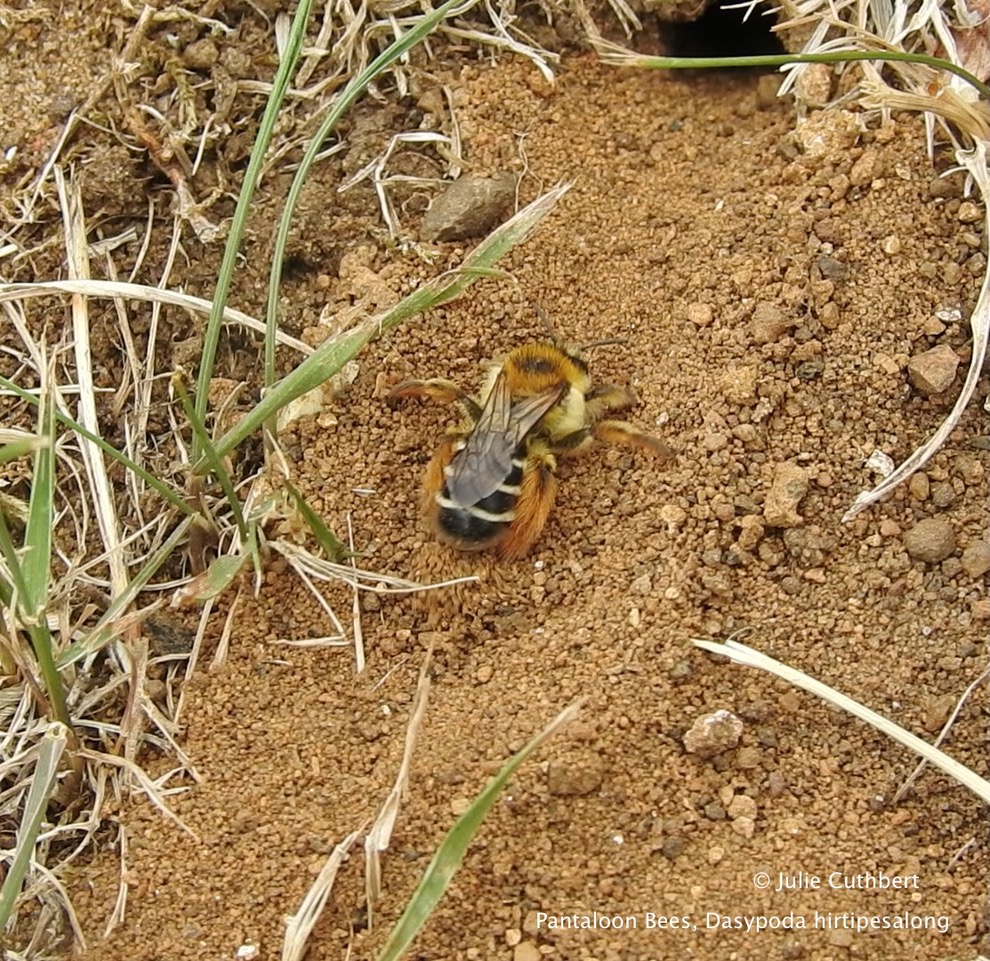
Another of our incredible wildlife residents made an appearance this month too – the beautiful and fascinating Pantaloon bees (Dasypoda hirtipes) who are busy digging their burrows on the south-facing sandy bank in our village. These extraordinary bees dig a burrow 60 to 90 cm deep. From these they excavate many more chambers in which they place an egg perched on a dough ball made from pollen and nectar. The eggs then hatch and develop from a larva to a bee before emerging in the following spring.


Pantaloon bee and nest (Photo © Julie Cuthbert)

Pantaloon bees require nectar from the yellow daisy-like flowers (Asteraceae family) ie. Ragwort, Common Fleabane, Dandelions, Hawksbeard and Cat’s Ear, so please let these flowers be a welcome part of your garden to help support our declining pollinators.

We are so lucky to be on the Greensand Ridge as, due to the sands that was washed here millions of years ago by a sudden rising sea, we are now host to many species of digger bees and wasps which are usually more often associated with coastal areas, making them very rare in Bucks.

Please check out my nature inspired artwork and more wildlife stories and photos on my website: https://juliecuthbertartist.wordpress.com

 Julie Cuthbert

July 2026

Ivy Lane Meadows in Great Brickhill: The Treasures of our Parish – Julie Cuthbert

These meadows are a magical place. I’ve found secrets hidden amongst the wildflower and grass threads, prehistoric time capsules emerging from the sandy soil and the scarcest creatures jumping across my path like ghosts. I hunt to record the wonders of the local wildlife I have found. Despite all the hostile arrows modern life endlessly throws including loss of habitat, fragmentation, industrial farming, pesticides and human interference which includes our dogs and cats, some of the rarest relic species, with their pure and precious ancient DNA have managed to survive, on the edge of Milton Keynes City, within our parish.

There are so many tales to tell. Maybe one day you will read about them in the book I am writing, but this is the story of one of my most significant local discoveries. The reason I am choosing to share this with you now is because these near threatened creatures need our protection as they are living in the Ivy Lane Meadows which are in danger of being developed into a substantial housing estate.

It all started in 2024, when I noticed on top of the cut meadow stubble an odd ball shaped hay nest, rolling about like tumbleweed, which I photographed. A few days later, I began to google my suspicions and typed “Harvest Mice Nest” into the search engine. The images matched! It was absolutely pouring with rain at that time but I was on a mission to re-find my hay ball and, despite getting soaked, I found it. I carefully loaded the ball of soggy woven grasses into a bag and returned home to dry it out with a hairdryer on the lowest setting. A few insects (which I relocated in our garden meadow area) and a couple of tiny mouse droppings fell out onto the foil tray I’d placed it in. How exciting! The research journey was now in full swing. I placed the droppings onto a glass slide and looked into their depths with my compound microscope which has a huge magnification.


Harvest mouse nest (Photo©Julie Cuthbert)

I could see grass seed particles and splinters of insects including the lens of a fly eye but, best of all, it was entwined with tiny ginger hairs. Harvest mice are ginger. I posted my photographs of the nest and magnified dropping to experts for verification and received validation from many sources including, most importantly, Derek Crawley who runs the National Harvest Mice survey and is one of the leading experts in the country. Derek was hugely supportive and taught me how to recognise the defining characteristics that provide proof that it was a Harvest Mouse nest.

Since then I have found more than 20 nests along the Ivy Lane Meadows footpath all validated by Derek and recorded. Harvest mice were once plentiful but are now considered near threatened in Great Britain and are a priority species. Reintroduction programmes have had limited success as the captive bred mice don’t have natural instinct.

Why are they in the Ivy Lane Meadows when elsewhere they are rapidly declining or extinct? They are here because these pristine meadows are one of the rarest habitats left in our country. The UK has lost 97% of our flower meadows since the 1940s which equates to 7.5 million acres of species-rich habitat lost. Biodiversity net gain is a fallacy as these sensitively balanced, complex ecological systems cannot simply be relocated, replicated or recreated. For example, the importance of the microorganisms alone is something we are only just beginning to grasp. Areas like this must be protected for our future generations as we are not separate from nature, we are part of nature. Without the worms and the bees we would not survive.

Please take a look at my film on YouTube by searching for “ Ivy Lane Meadows in Great Brickhill ” or paste  https://youtu.be/5OwQcFa-sDE

Please visit my website for more Harvest Mice nest photographs at https://juliecuthbertartist.wordpress.com

Julie Cuthbert

From the Brickhills – Little Wonders by Julie Cuthbert


February was a miserable month for getting out to photograph wildlife but we did have a few highlights. A visit to the Floodplain Forest Nature Reserve near Old Wolverton produced this pair of Little Owls enjoying one of the rare sunny patches in their favoured ancient tree. These lovely Owls have declined drastically in the last couple of decades, disappearing from many former regular haunts, due to a combination of declining large insect prey and loss of habitat. They are also susceptible to prolonged freezing conditions during the winter.

The Goldfinches have been a constant source of colour in the garden, feeding on the seedheads of various plants such as Verbena bonariensis and Lemon Balm. We deliberately leave all the herbaceous plants standing over the winter to provide seeds for the birds and a haven for wintering insects to hibernate. It won’t be long before the latter are emerging in the early spring to liven up the garden once again.

Julie Cuthbert
February 2026

From the Brickhills Sept 2025: The Emerald on the Oak – Julie Cuthbert

The season has changed so quickly. The severe drought which started in early spring and lasted through the summer has now been followed by an onslaught of torrential rain and thunderstorms. The rain did not come soon enough to save our lawn though which is now a soggy mud pit with grass seeds sprinkled on top in an attempt to revive it.

New species have arrived along with the rising summer temperatures. The Hummingbird Hawk-moth Macroglossum stellatarumis is now a very common visitor in our garden. The first time I saw one was over 20 years ago in Somerset. I’d never seen or heard of one before and believed I was looking at a real Hummingbird. How embarrassing.

The best sighting this month was our first Willow Emerald Damselfly Chalcolestes viridis resting on an Oak in Rushmere Park. This Mediterranean species of Damselfly was first recorded in the UK around East Anglia in 2007 and is now quickly spreading through the country. They lay their eggs on Willow or Elder near water so there is a very good chance that they could be breeding in our wood.

There have been a good number of Crossbills Loxia curvirostra locally too. They are a large finch with, as their name suggests, a crossed-over bill which has evolved to extract seeds from conifer cones. We have regularly seen a flock of 17 feeding in the Scots Pine behind our garden and in Rushmere too.

There have been a good number of Crossbills Loxia curvirostra locally too. They are a large finch with, as their name suggests, a crossed-over bill which has evolved to extract seeds from conifer cones. We have regularly seen a flock of 17 feeding in the Scots Pine behind our garden and in Rushmere too.


Crossbill Loxia curvirosta (photo © Julie Cuthbert)

It has also been a good summer for seeing Hobbies Falco subbuteo over our garden. Hobbies are a large Swift-shaped falcon which feed on Dragonflies and Swallows. We always know when we hear the Swallows alarming that there is a good chance that a Hobby is about. Hobbies are summer visitors so will soon be following the Swallows and Martins on passage back to Africa for the winter.

Julie Cuthbert
September 2025

From the Brickhills in June: The Green Tiger and The Pantaloon Bee – Julie Cuthbert

Green Tiger Beetle  (Photo © Julie Cuthbert)

We were walking along one of Rushmere Park’s sandy bright orange and yellow paths which stretched across a felled area between the Birch, Bracken, Bramble and drought-stunted Foxgloves. There was a huge array of insects for us to search through because, despite the relentless heatwave, the insects were having a good year. Rob called it first, “Green Tiger!” and our excitement suddenly rose. The Green Tiger Beetle Cicindela campestris was very much on our want-to-see list. While it was hunting for food it flew and scuttled about erratically at great speed, making it very difficult to photograph. It even flew into my hair. This charismatic metallic green and iridescent copper armoured warrior was just as beautiful as we had hoped, which isn’t always the case.

There were also many dug-out holes along the path which could easily have Green Tiger Beetle pupae inside, listening for unsuspecting prey to ambush and devour.

Another fantastic discovery for us was a huge colony of approximately 500 rare-for-Buckinghamshire solitary bees. The Pantaloon Bees Dasypoda hirtipesalong are situated along the banks of Heath Road. They are usually found along coastal areas but because of our ancient sandy soil they have chosen to nest in our village. They are another species which is in decline because of loss of habitat and pesticides. They cannot sting humans, which is true of nearly all bees except honey bees, and they have the most fabulous furry legs designed for collecting ample pollen and digging into the soil. They are classed as solitary but tend to tunnel beside others of their kind in a neighbourhood. We have never come across Pantaloon Bees before and though they are difficult to misidentify because they are so specific in habits and looks, we had the species confirmed by experts. We then sent our record to the County Recorder.


Pantaloon Bee (Photo © Julie Cuthbert)

In my opinion, they are the most beautiful bees I’ve ever seen.

Julie Cuthbert
June 2025

From the Brickhills: Swift Action – Julie Cuthbert

I am busy building Swift boxes at the moment. We have an RSPB box which we purchased and erected last year. It has been quite an active station for our local birds already. First we had a Great Tit roosting in it through the winter. Once he left in spring, some Blue Tits showed interest and busily cleaned out his droppings. Surprisingly they didn’t stay long but the House Sparrows moved in and nested instead (maybe the House Sparrows kicked the Blue Tits out?). They may not have been our target bird but we were still pleased as they are a very much declining species too. Just before they fledged we saw some Swifts swooping above the fields and woodland high in the sky catching insects by our house. They were hunting amongst a family group of Swallows which have nested locally every season since we have lived here. Much to our excitement the Swifts also circuited our house and flew past our box several times. According to Rob, they were definitely prospecting our nest box for next year!

So now the race is on to provide more boxes for the following season in the hope that another one of our wishes comes true and we have Swifts breeding beneath our eaves. I remember having House Martins nesting on our modern estate house during the early 70s. My family very much enjoyed having the privilege of seeing these birds returning from Africa to our house each year. I don’t remember anyone else on the estate having these amazing mud-built fairy-sized huts glued to their gables but I do remember it breaking my heart to hear neighbours reporting how they had bashed the nests down to destroy and deter their breeding attempts. They were a common sight back then but are now Red-listed and protected by the 1981 Wildlife and Country Act. We will be erecting some House Martin simulated nests we purchased to try to encourage these birds next year too.


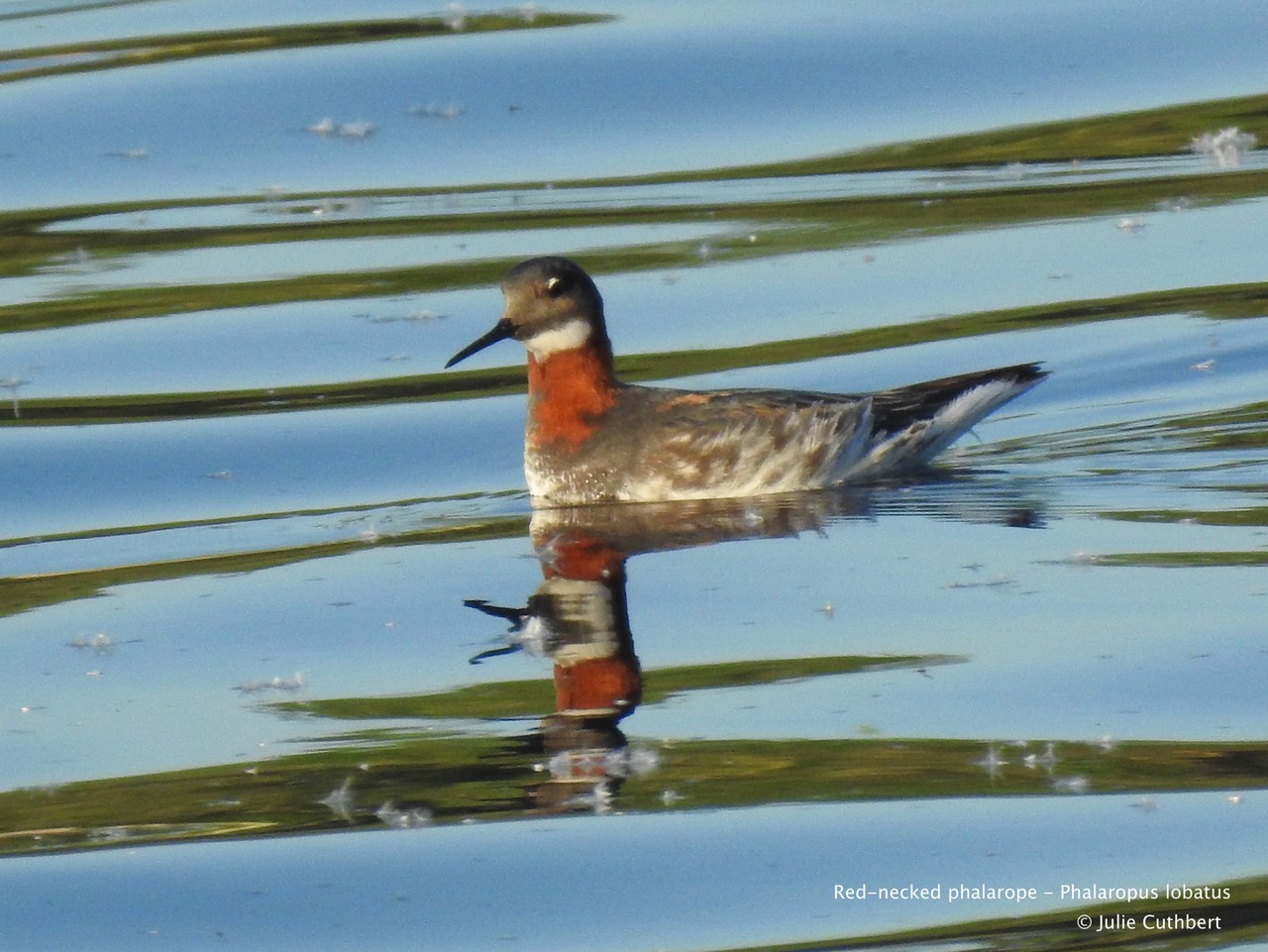
Red-necked Phalarope (f) – Phalaropus lobatus – Caldecotte Lake

Rob took me to see a rare wading bird at Caldecotte Lake during May. It was a beautiful little female Red-necked Phalarope that was stopping off on her way to breeding grounds in the Arctic region. The female has the brightest plumage which is unusual for birds and their roles are reversed. The males incubate the eggs and rear the chicks while the females look for another male to breed with before heading off on migration to wintering grounds as far away as the Pacific Ocean off South America where they spend the winter out at sea. 

Julie Cuthbert
June 2025

From the Brickhills: A Cuckoo Calling – Julie Cuthbert

 The Cuckoo has been singing its heart out all week over Rushmere Park. I tried to find him in the wood on a dog walk. I know I came close at times because his song became so incredibly loud. Louder than I’ve ever heard a Cuckoo sing before. Every time I reached the part where I believed him to be singing from, the sound stopped and then began again somewhere else. While on my hunt I came across a Squirrel taking it easy and enjoying the sun.

Grey Squirrel relaxing (Photo©Julie Cuthbert)

 Our nesting Blackbirds are still sitting on eggs. Watching their diligent devotion is fascinating and a delight. When we relax in the garden, after a while, the male makes his presence known and lands in front of us to give us his stern message, “Can you go now, my wife needs to feed and drink.” We make our way inside and watch them through the open French doors. 

Watchful Blackbird (Photo©Julie Cuthbert)

 He calls to let her know it’s safe now and she arrives on the lawn immediately. She then scans around and feeds. She is scruffy. Her feathers are all out of place from sitting still on the nest. She feeds on tiny fragments of fatball which have fallen down from the feeder. It is so hot and dry this spring that it would be impossible for her to extract any worms from the baked lawn. He watches over her, occasionally taking a few mouthfuls too. After a short while he becomes impatient and goes over to the pond and starts to mime to her to take a bath. She comes over and drinks from the waterfall, then pops herself into the bathing area and, after checking around again, she really flaps about and relishes the moment. Droplets of water spray everywhere and catch the sunlight like diamonds. We can hear the splashes of her wings beating the water surface. She then hops out and preens. The male is watching over her all the time. It is plain to see how much better she feels after having fed and bathed, then off she goes back to her duty on the nest, brooding. 

Julie Cuthbert, May 2025

The Joys of Spring – Julie Cuthbert – From the Brickhills

 It’s been a sensational sunny spring so far and our garden has been full of life and colour. The Swallows have returned to Great Brickhill from Africa and our garden Robins have already fledged young. They nested in our next door neighbour’s barbecue again. 

This week we have watched a pair of Blue Tits collecting tufts of our dog’s hair which I leave around the garden. We try not to use chemical flea treatments on her but regularly use a Flea comb instead which so far has been effective and keeps wildlife safe. The Blue Tits have chosen to nest in one of the nest boxes that doesn’t have a camera in it. This happens every year. 

We also have a pair of Blue Tits nesting in our Swift box and another single Blue Tit taps away every evening in our Bat box. This has been going on for months. We can only guess that it is trying to enlarge the space for a nest. The Bat box is next to the empty nest box that has the camera inside it.

A pair of beautiful red-listed Starlings have also been collecting grass and sticks from our garden for their nest which they built beneath a neighbour’s roof tile. It took them over two weeks to complete their build. I saw one of the Starlings carefully pick some of the blossom from our cherry tree which it then took to its nest. A few years ago I watched a male Starling waving a Dandelion flower about like a flag by the entrance of his gutter nest site. He was trying to entice a female in to pair with him. Maybe they use flowers to decorate the inside of their nest too! They use our pond each day for their morning bath and then patter about the lawn looking and listening for things to eat. 

A couple of Blackbirds are presently also making a nest in our hedge. This suggests that their first attempt failed as it is quite late for Blackbirds to be still building. I took a crop of fibrous compost from the bottom of our compost bin and spread it over a dry sandy bed which the Blackbirds gathered up to add to their home along with a lot of green algae from our pond. I’ve never seen these materials being used by Blackbirds before.

At night we go out with a torch and shine it into the pond and count the newts. There are lots in there which is great news considering the pond is only a few years old.

Julie Cuthbert
April 2025

From the Brickhills: A Fossil in my Pocket and a Feather in my Hand – Julie Cuthbert

We had a change of scenery recently and took a trip out of county to Bedfordshire where we had some great views of Grey Partridges (Perdix perdix.) We haven’t seen any Grey Partridges around the Brickhills and would love to know if anyone else has. They are a ground-nesting farmland bird that have seriously declined by over 90% in the last 50 years in the UK and since 2015, they have become a Red Listed species (Birds of Conservation Concern 5*) due to farming intensification, disturbance and habitat loss.

 We do have Eurasian Skylarks (Alauda arvensis), another ground-nesting farmland bird which is Red Listed for the same reasons. They are beginning to sing above the fields up from Cuff Lane and I managed to photograph one on the ground recently. It’s not a great photo because I didn’t want to disturb the bird in any way and kept my distance. They are definitely preparing to nest in these fields again. I so hope they are successful.

Skylarks are one of my favourite birds because of their high-pitched melodic warbling song. This beautiful sound always transports me back to my childhood when they were common and going on long summer walks around Chartridge and the Lee with my dog. I would amble for hours exploring the countryside around this area and would regularly return home with fossils in my pocket and a feather in my hand, something I still love to do to this day.

Julie Cuthbert
March 2025

*See https://www.bto.org/our-science/publications/birds-conservation-concern

FROM THE BRICKHILLS: WINTER WONDERS – Julie Cuthbert

We haven’t had much success recording wildlife this month as the weather has been dull and stormy, but we have enjoyed trying to photograph a Water Rail (Rallus aquaticus) which is over-wintering along the stream that runs beside Rushmere Park. This is ideal for the Water Rail as it is well vegetated and fenced off from the path. It is also perfect habitat for a Nightingale which Rob dreams of one day finding here. I have failed to capture anything other than the scene from which the bird has shot off. Rob, on the other hand, has only managed to get a blurred record shot so, for the first time, I have used an image from another county, year and month to illustrate my article.

Water Rails are sought by birders because of their secretive nature. They are a freshwater wetland bird and are in the same family as Coots and Moorhens, but much smaller, daintier and with more attractive markings. They have a comical pig-like squealing call which is mostly heard in the breeding season. When we glimpse ours, out in the open, it will instantly lift up on its long legs and scoot across the water’s surface at great speed like the cartoon character, Road Runner as it heads for cover.

I am also enjoying winter walks through the wood when it’s beginning to get dark. It feels so magical at this time particularly when the mist is falling and the Tawny Owls are calling. My dog and I will take a moment on each walk to just stand and listen to all the many sounds that can be heard around us. At these times, I also like to watch my Collie’s huge upright ears pivoting, as they follow the directions of the rustles and the diurnal birds’ last calls before they go to roost.


Julie Cuthbert
December 2024

Photos © Julie Cuthbert

From the Brickhills: A Hungry Vole and a Beautiful Caterpillar – Julie Cuthbert

A regular article written by Julie Cuthbert for The Brickhills Parish News 

I usually never find the perpetrators of the scuffling noises in the undergrowth but on this occasion I got lucky. I was walking down the path into Rushmere Park, off Cuff Lane, when I first heard the rustling sounds amongst the fallen leaves and nettles. As I crouched down I instantly saw, by the side of the run-off stream, a Bank Vole Myodes glareolus.  My collie and I remained unnoticed by the vole because it was so engrossed in devouring a freshly caught slug. It clutched the slug in its delicate hands and rolled it around whilst munching intently, like a leg of lamb in the hands of Henry VIII at a banquet. I could hear the slurping sounds from its tiny jaws as it chewed. Then, after having its fill, I watched it return to hunting for a while before disappearing down a hole.

On another of our autumnal walks through the wood, I found this beautiful caterpillar coyly curled up round a twig. It was out looking amongst the leaf litter for somewhere to pupate. When I researched it later I found it to be a Pale Tussock Calliteara pudibunda caterpillar which would transform into a subtle brown moth with a really woolly body, head and legs.

As always, Rob has been very busy recording the birds on Autumn migration. He reports to me each morning the highlights of his count from the early morning dog walk. Bramblings, Siskins, Linnets and Redwings often get a mention but this year’s star in the UK has been the Hawfinch numbers. So far Rob has seen 12 flying over Great Brickhill, which is a fantastic count for North Bucks.

Julie Cuthbert
November 2024

From the Brickhills – A Lichen Disguise – Julie Cuthbert

Recently Rob came home with a very dead looking, 2-metre high, Holly tree stump. He was sure that we could resurrect it if we gave it some love. I wasn’t convinced but planted it in a large pot and hoped for the best too. Every week we scoured the stump for signs of a bud breaking through but it stayed unchanged, gnarled like elephant skin and tinged green-grey with lichen.

While we were performing one of our inspections, Rob suddenly noticed the tiniest blip near to the top of the trunk and said excitedly, “It’s a bud!” When I went in closer with my glasses on, I could see what looked like a scuffed-up mound of lichen around the size of half an apple seed. While I was studying the area, it suddenly raised up and then started running about. “It’s definitely not a bud. I’m getting the cameras.”

Once we had our macro lenses focused on the strange alien thing we were amazed, as we had never seen anything like it before. Its body part was amassed in Lichen and tufts of bristly hairs. It had fierce red pincers and ran about like crazy. After some research we were able to identify it as a Common Green Lacewing larva Chrysoperla carnea and learnt that they cloak themselves in anything they can find to deter predation. Lacewing larvae will use plant debris, lichen, insect shells and anything else they can find; these they cache on their back bristles.

I have always appreciated the delicacy of the adult Green Lacewing and remember them to be everywhere when I was a child, but I rarely see them now.

It’s unlikely the Holly will come to life this late in the season, but it has still acted as a good host to this creature. It’s also had several Toadflax Brocade caterpillars Calophasia lunula marching up it, searching for somewhere ideal to pupate, so maybe we’ll be keeping our dead Holly tree after all.

Julie Cuthbert
October 2024

Photos of Common Green Lacewing larva (top) and Toadflax Brocade caterpillar (bottom) © Julie Cuthbert