
Above: The boardwalk through the Wet Woodland (Photo © Janice Robertson)
Introduction
The area visited is what remains of a much larger mire in the valley of the alkaline River Flit which rises at the foot of the Chilterns and flows downstream into the Great Ouse via the River Ivel. Alkaline peat accumulated over time but was infiltrated by iron-rich acid springs (or chalybeate) from the Lower Greensand. Peat extraction in the 19th century was initially for local fuel use but by the time it stopped completely in the 1960s it was being sold commercially for the purification of natural gas. The commercial value of the chalybeate was also recognised and it was bottled and sold as a ‘cure-all’ tonic!
The importance of Flitwick Moor as an uncommon biodiverse wildlife habitat in the south-east of England was formally recognised in 1984 when it was designated a Site of Special Scientific Interest (SSSI) under the management of the Wildlife Trust for Bedfordshire, Cambridgeshire, Northamptonshire (WTBCN).
This Trip Report covers the three main habitats visited and these same habitats are used in the Consolidated List of Species which supports the Report. They are the Wet Woodland (including a subsection on the open wetland within the wood), Rough Meadow, and River Flit flood area. Our main focus was to find and identify uncommon species, and the uncommon habitats in which they were located.
A Consolidated Species List was prepared after the event, and can be found here.
This is supported by a Photo Annex, illustrating key identification features of selected plants, which can be found here.
Wet Woodland (an overview)
 Pendulus Sedge and Phragmites at stream (Photo © Janice Robertson)
Our first habitat was the Wet Woodland following the boardwalk which is about 40cm above ground level. This took us through the middle of the woodland roughly in an east-west direction. The woodland to the north of the route is slightly lower and dominated by Alder with limited biodiversity other than close to the boardwalk itself. Here we were able to view Broad Buckler-fern of a variety of sizes, the smaller growing from cut-back older rootstock, and the Hart’s-tongue Fern growing from the stonework that supports a bridge over one of the larger slow-flowing ditches. Purple Moor-grass, Remote Sedge, Soft Rush, and Raspberry were amongst those that added to the diversity.
On the south side of the boardwalk the land is slightly higher and acid soils support mainly Silver Birch and Pedunculate Oak, with an understorey of dense Bracken, Common Reed (Phragmites, a grass) and Pendulous Sedge. Dead trees and understorey are cleared from time to time. Open wetland areas (see below) are also found on this side of the boardwalk. The far end from the car park is wetter with more standing water and ditches – a habitat for water plant species such as Lesser Water Parsnip. This plant required close observation for identification (see photos in Annex) because of its similarity to Fool’s Watercress. We recommend a revisit in mid-summer when both plants should be in full flower. We also spent time on identifying the Horsetails. Our initial identification was Wood Horsetail with its branched branches but after further checks its was identified as Field Horsetail, which in shady wood edges (the exact habitat of its setting) can also have branched branches.
Wet Woodland (open wetland areas)
 Management: removal of Phragmites into piles (Photo © Janice Robertson)
In the open wetland areas on the south-west side of the wood Sphagnum mosses contribute to peat-forming today and this area is managed closely by the WTBCN. Ten of the 30 British species have been identified here. Our group was able to walk on the managed area, where Phragmites (some 1.75 metres high) had been cut down and removed by a team of volunteers. The spongey ground, comprising Sphagnum mosses up to 20 cm in length underfoot, was not in waterlogged conditions after this summer’s drought.
The website for WTBCN (wildlifebcn.org) gives a good schematic map of the more ’open wetland areas’ which we were unable to walk through due to the density of the Phragmites. Two highland cattle have been put on the wetland scrub area to help clear the vegetation there. Also we had been warned that some deeper peat workings still remain full of water, not always visible to the inexperienced visitor.
We had hoped to see Common Cottongrass (Eriophorum angustifolium, a sedge) in the area we walked on but there was no evidence of it in the areas we visited. The last record of Cottongrass being listed at a Society event here took place in June 2019 and by the next visit (June 2023) it was no longer to be found.
During our time on the Sphagnum moss we were very pleased that Julie Cuthbert was able to give us a global overview of its importance:
Sphagnum Moss, a Tiny Moss that Outperforms the Global Forests
(contributed to the Group by Julie Cuthbert – thank you, Julie)
‘Sphagnum moss is one of Earth’s most powerful ecosystems. Covering just 3% of the world’s land surface, these plants act like massive biological sponges, absorbing 16 to 25 times their dry weight in water. The Sphagnum genus covers more of the world’s surface than any other single plant but only accumulates 1 mm of peat a year. The growth of an individual plant may maintain connection with its dead portion as far down as 15 cm away and genetic analysis shows some individual plant clones have survived for over 1600 years.
For centuries, these landscapes were feared. Historic cultures blamed bogs for ‘marsh ague’, which was actually malaria spread by mosquitoes breeding in the water. Travellers also feared the will-o’-the-wisp, eerie glowing lights now known to be methane and phosphine gases rising from decaying matter.
Today, protecting Sphagnum is vital for our climate. Peatlands store 30% of global soil carbon – twice as much as all the world’s forests combined. Because harvesting peat releases these greenhouse gases, the UK horticultural industry is actively transitioning to eco-friendly alternatives, targeting a full phase-out by 2030 to keep these ancient, misunderstood carbon sinks intact.’
Rough Meadow
 Flitwick Moor – rough pasture with anthills (Photo © Charles Kessler)
This is an area of slightly higher ground containing permanent pasture with scattered small trees and scrub. Its main physical characteristics are the metre-wide semi-permanent ant hills which offer micro-climate habitats for plants (and a home for the Yellow Meadow Ant Lasius flavus but none seen). Our visit took place after the long drought of August and early September and this coupled with the very close grazing of cattle meant that plants still in flower were few and far between. These were Creeping Buttercup, Cat’s-ear, a Hawkbit species, Common Ragwort and three species of thistle mainly at the seeding stage with the odd flower: Marsh, Spear and Welted, the latter being less well known to us. More diverse were the wetter woodland edges. Here among the clumps of Brambles, Tufted Hair-grass, Soft Rush, and Stinging Nettles, we identified Bittersweet, Bifid Hemp-nettle, Water-pepper and Marsh Horsetail. A Muntjac feeding under a Crab Apple watched us for some time. Most of our time in the Rough Meadow was in the damper areas but we were aware that the drier areas including the ant mounds would have been very different in mid-summer when the Society’s last three visits took place (2016, 2019 and 2023).
River Flit
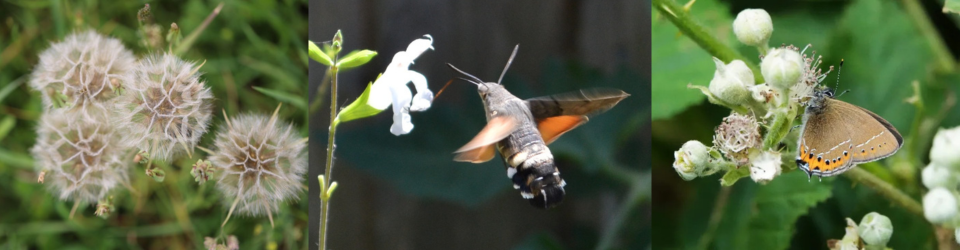
A footpath exits the meadow area within about 100 metres of the River Flit, first crossing a bridge over a drainage channel and then through a short section of young woodland where we identified Grey Willow, Mugwort, and Indian Balsam. The riverbank itself was positively lush with vegetation, much of it already no more than the woody framework of the plant concerned: Russian Comfrey, Burdock sp., Hogweed, Stinging Nettle, Common Teasel, Small Teasel and Hemlock up to a height of 3 metres. Small Teasel with its rounded seed heads was new for many of the Group. It needs damp conditions and thrives on alluvial calcareous soil. It is described as ‘rather local’ by both Harrap and Collins and was certainly one of the uncommon species we had made the focus for our visit.
An overview of the Event
Twelve members attended the Event and for 6 of them this was a first visit either on 13th September or the recce prior to it. When planning the annual Events Programme, the Group Planning Team takes into account the accessibility of chosen locations. Flitwick Moor met our criterion of plants and their habitats that cannot be found in Milton Keynes. We ran over the 2-hour norm for a visit by over half an hour with a few having to make their own way back to the car park, but all reluctantly. Those that did stay on had the bonus of several new plant species not previously listed (and Jenny’s offer of a cup of tea and biscuits in the car park before dispersing!).
As to the location itself, it is very special, the wet woodland and open wetland within it in particular. It has a ‘primaeval’ charm of its own and to walk through it is to observe a different natural world. We recommend that the Group returns in June 2028 or 2029. The management of the Reserve is a key to its future biodiversity. Common Cottongrass was still evident from the boardwalk in 2019 and it is now limited to cleared areas in more remote parts. As the Bedfordshire Natural History Society put it in Bedfordshire – our changing habitats and wildlife published in 2020: ‘The SSSI … is not only an important habitat for the county but the site is also of national importance.’
Thanks
WTBCN has been most helpful and supportive of our visit from the start, both in the Bedford office agreeing to use of their car park, and in answering questions about the management of the Reserve.
Thanks to Janice Robertson who has been a most efficient and knowledgeable Field Lister, managing the creation of the Consolidated List with able assistance from Joan Hughes at the listing stage; Julie Cuthbert for giving us a wider context for our visit to the Sphagnum moss bog; Bob Phillips, Janice Robertson, Julian Lambley and Charles Kessler for their photographs; and Martin Ferns our ever-helpful Web Editor.
Jenny Mercer and Joe Clinch, Co-leaders
Publications referred to in the text
Bedfordshire – our changing habitats and wildlife: A Photographic Record, published by Bedford Natural History Society 2020
Collins Wild Flower Guide: The Most Complete Guide to the Wild Flowers of Britain and Ireland, 2nd Edition, published by Collins 2016
Harrap’s Wild Flowers: A Field Guide to the Wild Flowers of Britain and Ireland, published by Bloomsbury Publishing 2013