
For the first time this annual event was held at Linford Lakes Nature Reserve, courtesy of The Parks Trust. That was the plan last year, but a horrible weather forecast forced cancellation.
This year it was all systems go. Frances Higgs and Rachel Redford were the most important participants and their recollections about George and Gordon always enhance this evening. Indeed, the night was extremely successful and enjoyable, with a considerable increase in attendance compared to recent years and particularly by MKNHS members. The unforeseen issues around the complex access and indeed departure arrangements did not blight the meeting!
This is always a MKNHS and Bucks Invertebrate Group (BIG) joint event and this year BIG started their activities at 11 am, finishing up about 4 pm. Five hours in the full heat of the day was a tremendous effort. One particularly interesting moth was caught in a pheromone trap and retained until the start of the mothing session at 8.30 pm: a Red-tipped Clearwing, which is a beautiful species and new to some of the group.

Red-tip Clearwing (Photo©Andy Harding)
Neil Fletcher, who trapped the Clearwing, and Martin Harvey stayed over from the BIG event to trap moths in the evening. Just as well, since the equipment they bring now forms the centrepiece of the night. Neil suspends vertically a very large sheet with a powerful mercury vapour light in front of it. Martin suspends an equally powerful bulb inside and near the top of a moth tent, with four compartments in which one can easily stand. However, the huge aggregation of tiny insects, some less benign than others, suggests that standing in the compartments is not a very good idea, but excellent photographs or a quick sally to pot something works well enough.

Above and lead photo: Gypsy Moth (Photos©Jagoda Zajac)
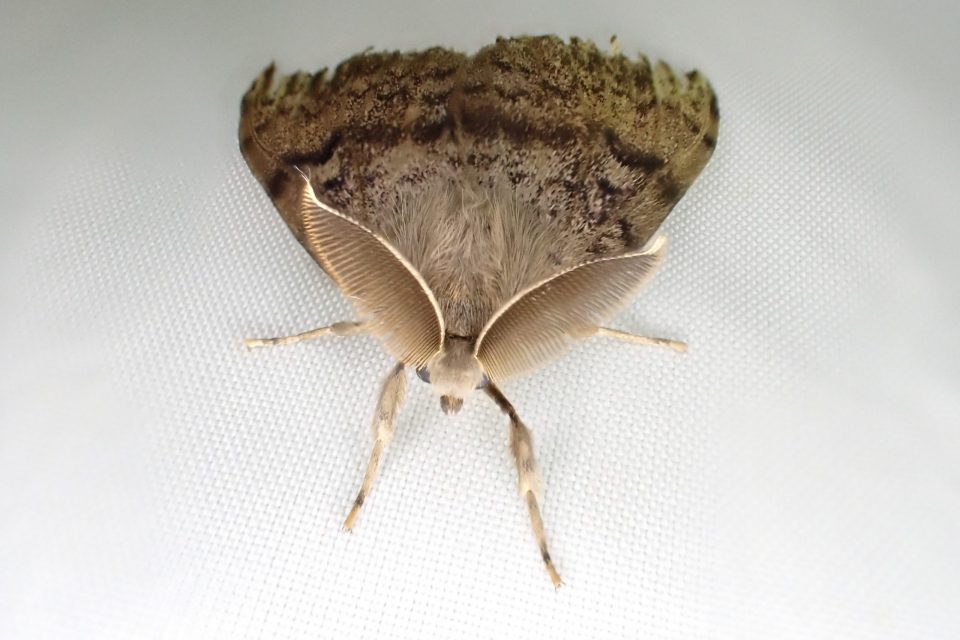
3 male Gypsy Moths were early arrivals at the tent – a large and attractive species declared extinct in Britain early in the 20th century, but now rapidly recolonising from the continent, where it is regarded as a serious pest to forestry. Calamatropha paludella, a large micro-moth, was another early arrival – not too surprising since this is prime habitat for a Bulrush feeding species. Talking of Bulrushes, a Bulrush Wainscot, one of the largest Wainscots, was one of the more interesting early arrivals on the sheet. The closely related Webb‘s Wainscot appeared later in the evening for comparison.

Bulrush Wainscot (Photo©Andy Harding)
One of several Pale Prominents was the first of that attractive group to arrive, followed by Swallow and Iron Prominents. A very large and gaudy Red Underwing needed to be checked for other similar species given this was an early record of a moth considered decidedly autumnal. However, early emergence has been the norm for numbers of species in this summer of unusually high temperatures for weeks on end. Unfortunately the Underwing made an exit from the sheet before everyone could get to see it.

Red Underwing (Photo©Andy Harding)
It was replaced by a female Hook-tip, but which one? Until recently good views and the Hook-tip page of the latest field guide tell us it is Oak Hook-tip. Recent DNA research has unearthed a very similar species, the Spiny Hook-tip, which has now been seen in the county. Has it moved in from the continent, or has it always been hiding here in plain sight? Comparison with photos on the old Interweb strongly suggest it is the much commoner Oak Hook-tip.

Female Oak Hook-tip (Photo©Jagoda Zajac)
A thinly distributed denizen of habitat such as Linford is the bizarrely named Cream-bordered Green Pea. This species needs to be differentiated from the similarly sized micro-moth, Green Oak Tortrix, but its tent-like posture gives it away. Much more common, but more photogenic, is the Spectacle. Close up photos taken from the front, as it sits obligingly on the lighted tent, tell us it is appropriately named.


Cream-bordered Green Pea (Photo©Andy Harding); Spectacle (Photo©Jagoda Zajac)
There were bright lights in or on a total of eight traps around the site, so compiling a total list will be a time-consuming task and I make no attempt to produce figures here. I heard suggestions that the number of individual species was really quite high, which created great interest in providing a solid stream of new species, often singletons, to look at, but the number of individual moths was not as high as might be expected. Nonetheless, there was plenty to do such as comparing pairs of closely related species, such as Knot Grass and Poplar Grey. New species for the night were still being found as we packed up at 1.30 am, including two more large micros – a European Corn-borer which has moved fairly recently into north Bucks, and Evergestis pallidata which has been here since the 1980s.

European Corn-borer (Photo©Andy Harding)
And then it was bedtime.
Particular thanks to everyone who brought any equipment to enhance the event, and, indeed, everyone who simply came to enjoy the moths and will now go out to spread the word on the brilliance of moths.
So, a very successful night, and I strongly suspect we will try to repeat the experience here at Linford Lakes in 2027.
Andy Harding
1 August 2026
Photo note: photos taken at night are not always very informative to the general reader, so those which accompany this little article are a mixture of those taken at the time and in daylight. All were taken locally by MKNHS members.