
© Aaron Woods
A significant ancient woodland owned and managed by The Berks, Bucks & Oxon Wildlife Trust (BBOWT). Little Linford Wood has a good mixture of mature trees, young trees and shrubs giving a variety of habitats for wildlife. Following earlier felling, there are areas of the wood showing recent natural regeneration.
Little Linford Wood is an ancient wood, as indicated by the presence of centuries-old remnants of the trunks of Ash trees and a range of plants typical of ancient woodland (for example Bluebells, Wood Anemone and Dog’s Mercury). However, its first appearance on a map seems to be in a book published by Jeffreys in 1788. The wood was traditionally managed as ‘coppice with standards’ to provide a variety of products such as thatching spars, posts and binders used when laying a hedge, as well as firewood and Oak timber. Management decreased during the twentieth century, causing the canopy to close, creating dense shade in which the ground-level plants struggled to survive.
Note that this site should not be confused with the Linford Wood which is in the urban area of Milton Keynes and about 5 kilometres south of Little Linford Wood (see Access below).
Site history
The wood was acquired by BBOWT in 1984. A contractor had already cut down a third of the wood and extracted many of the larger oaks, damaging the surface with heavy machinery and threatening the wildlife. Neighbouring farmers alerted the Trust, which was able to persuade a generous donor to provide sufficient funds to buy the wood. The Trust drained the rides and re-planted the cleared areas with a mix of Oak, Ash, Hazel, Cherry and a range of shrub species. However, little maintenance was done so these areas became a dense scrub of Birch, Willow, Brambles and Roses together with some of the planted trees.
For the last decade maintenance has concentrated on coppicing on the one hand and maintaining the woodland rides (linear open spaces) on the other. Coppicing is carried out on a 50-metre square area of trees (such an area is called a ‘coppice coupe’). This is intended to restore the historic management of the wood, to create a variety of levels of height and age in tree growth and allow ground-level plants enough light to flourish. The rides themselves have been maintained by mowing on a three-year rotation and at intervals cutting back adjacent 30 x 10 metre strips of woody plants. This allows for increased light levels and the creation of a variety of age and height of vegetation favouring food plants for butterflies. It also prevents scrub from taking over. The result has been that the wood (42.5 hectares; 100 acres) now has several well-defined nature trails and bridleways giving ready access to most areas.
What to look for
Plants
You can always be certain of seeing Trees – Pedunculate Oak, Ash, Cherry, Aspen, and several species of Willow are common.
Among the many Shrubs you will find Hazel, Hawthorn, Blackthorn, Bramble, Wayfaring Tree, Guelder Rose and Spindle.
Also Climbers, such as Rose, Honeysuckle and Traveller’s-joy.
In spring and summer you will see Bluebells, Dog’s Mercury, Primroses, Violets andCommon Spotted-orchids and you may be able to find rarities like Herb Paris andBroad-leaved Helleborine. In summer and autumn you will see several species ofVetch on the rides.
Fungi
In autumn a huge variety of Fungi may be found, perhaps including the Scarlet Elfcup.
Mammals
You’ll see the pathways and footprints of Badgers and Deer, mostly Muntjac, but also Roe. To see the animals themselves you have to time your visit at dusk and move quietly. Similarly, if you hope to see Dormice. However, Squirrels, Rabbits, Hares and Foxes are more obliging.
Birds
You’ll see many Blue and Great Tits and may well see Long-tailed and Marsh Tits, perhaps even Willow Tits if you’ve got your eye in. You’ll see and hear large numbers of ‘little brown jobs’, good practice for experts, but hard work for those who depend on books for identification. Woodpigeons are ever-present, Green and Great-spotted Woodpeckers frequent the wood and you’ll often see Jays disappearing as you approach. Sparrowhawks and Buzzards are frequent. Peregrine and Red Kite have also been seen.
Reptiles
You may see a Grass Snake sunning itself or making off to avoid you.
Insects
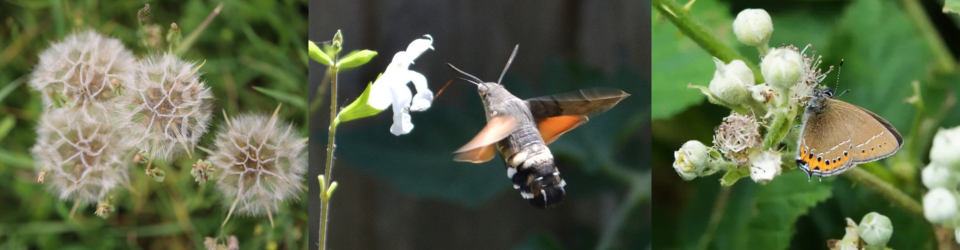
In season you will also see many insects: among the Butterflies, Gatekeeper,Green-veined White, Speckled Wood and Ringlet are numerous, but you may also see White Admiral, Purple Hairstreak and Wood White.
Several different Dragonflies and Damselflies cruise along the rides looking for prey, as do Hornets, impressive in size and sound, but less aggressive than Wasps unless you threaten their nests.
Little Linford Wood species glossary
The scientific names of all the species mentioned for Little Linford Wood can be found in order of appearance in this species glossary.
How to get there
Please note: Little Linford Wood car park is no longer open to the public. There is no public transport to or near this site.
Access to the reserve is possible on foot on Public Rights of Way Footpaths and Bridleways running from Little Linford and Haversham villages, or from Hanslope.
The easiest access is by foot along the Bridleway from the small area of verge located on the north edge of Haversham Road, between Hill Farm and Hall Farm: SP 83899 44078; what3words: respect.breached.vanish. There is car parking space for a small number of cars. The entrance to the SW corner of Little Linford Wood is about 1km from the road at SP 83438 44897; what3words paintings.isolated.pouch
There is a network of rides and nature trails in the Wood. Rides are 4 to 10 metres wide with mown grass paths and a variety of other plants. Nature trails are narrower, more shaded and often of bare earth and likely to be muddy after rain. It is easy to find your way around the wood and because it is over 40 hectares, it offers long, as well as short, circuits. The paths are somewhat uneven and some slope appreciably, so wheelchairs and buggies are not practical.
Note that Little Linford Wood is owned and managed by BBOWT but has several Public Rights of Way paths through it. Access to this nature reserve is not limited to BBOWT members, but you are encouraged to become a member.
Useful Links